That single regulatory line is the filter through which every other decision about a month-long Edinburgh workation now flows — including the choice to base yourself in a Joppa coastal cottage rather than a serviced flat in the Old Town.
The pitch is straightforward. A month-long remote work stint combines two assets: a quiet, sea-facing environment and a base within commuting distance of meetings that still demand a physical presence. Joppa, sitting east of Portobello on Edinburgh’s coast, satisfies both conditions. The reality, once a guest starts cross-checking listings against the regulatory record, is more layered.
A good seaside cottage has to work as accommodation, office and temporary base of operations at the same time. The beach view matters, but it cannot compensate for unreliable broadband, an unclear cancellation policy or a property that has not completed the licensing process. For a long stay, the operational details are the product.
The Licensing Floor
Scotland’s short-term let licensing scheme came into force on 1 October 2022, but the enforcement deadline — the date beyond which unlicensed operation became a prosecutable offence — was 1 January 2025. Edinburgh Council treats the city as a Short-Term Let Control Area. For owners of secondary lets — properties that are not the operator’s primary residence — a planning permission application must accompany the licence application. Primary residence lets, where the host lives on site, follow a different compliance path but still require a licence.
A short-term let licence is not optional. It is the legal threshold below which a property cannot lawfully accept paying guests in Scotland.
For the workation guest, the practical consequence is simple: the licence number must appear on every public listing and on every piece of marketing material. A property that displays neither a licence number nor, for a secondary let, evidence of planning consent is operating outside the regulatory perimeter.
That is not merely an administrative concern. Booking an unlicensed property creates a genuine continuity risk. If the property is reported, refused a licence or has an existing licence revoked, the guest may face cancellation or relocation in the middle of a planned working month. That can mean losing a carefully chosen base, rebooking at a higher seasonal rate and trying to maintain work commitments while moving between properties.
The City of Edinburgh Council publishes a public register of licensed short-term lets. It is the first place a serious long-stay guest should look before any money moves. The address on the register should correspond to the accommodation being offered, and the licence details should not be treated as interchangeable with a booking-platform badge or a host’s general statement that the property is compliant.
For property owners and managers, the inverse is also true. The licence is now a marketing asset, not merely a compliance chore. Listings that lead with the licence number, the planning reference where relevant and the licence expiry signal an operator who has invested in staying in the market rather than skirting the edge of it. For a guest booking several weeks, that signal has commercial value: it suggests the operator expects to be accountable for the condition and availability of the property throughout the stay.
Coastal Geography and Transit Math
Edinburgh’s coast is short and unusually well-defined. From Leith in the north to Joppa in the east, the shoreline runs for about seven miles of continuous urban frontage, with Portobello occupying the centre and Joppa sitting at the quieter eastern end, where the promenade meets the Figgate Burn.
For remote workers, the choice between Joppa and Portobello is not only an aesthetic question. It is a logistics question. A cottage beside the beach may provide the right conditions for concentrated work, but the value of that quiet depends on how easily the guest can reach the city when a meeting cannot be moved online.
Lothian Buses route 26 connects Joppa and Portobello with central Edinburgh. Route 19 also connects Portobello to the city centre via the main arterial road. Either route can make the central journey practical in normal traffic, although the actual time depends on the stop, destination, road conditions and time of day. That is competitive with accommodation in several inner-city neighbourhoods and more convenient than a location farther out towards Cramond or South Queensferry.
The qualification is the phrase “normal traffic”. Coastal bus travel is still subject to congestion, roadworks, weather and the uneven rhythm of a working day. A guest whose calendar contains one important in-person meeting should leave more margin than the headline journey time suggests. For everyday access to central Edinburgh, however, Joppa is not remote in the meaningful sense. It is quieter than the centre without being disconnected from it.
Joppa buys you beach, sea air and a manageable city connection. Portobello buys you the same coastline with more places to eat, work and improvise.
The trade-off is density. Portobello’s High Street has more food options, gyms and places where a guest can work for an afternoon without returning to the cottage. It is easier to replace a missing lunch ingredient, find somewhere different to sit or make an evening plan without checking transport first.
Joppa is more residential and quieter. That is useful when the work pattern consists of deep-focus blocks followed by a long walk on the sand. It is less convenient when the guest wants a choice of cafés within a few minutes’ walk or expects the neighbourhood to provide a full evening economy.
The two areas also produce different kinds of friction. In Portobello, the problem may be noise, parking pressure or the temptation to treat a café as a substitute office every day. In Joppa, the problem may be that the guest has underestimated how often they need a shop, a workspace or a quick meal outside the property. Neither is a flaw in the location. They are different operating environments.
Both areas sit inside the same regulatory regime and the same control area. The decision is one of operating style, not legality. Portobello is the more forgiving choice for a guest who wants local infrastructure close at hand. Joppa is stronger for someone who sees the coastline itself as part of the working arrangement.
Connectivity as the Core Product
A month-long remote work stay is, functionally, a sale of bandwidth. The cottage can be immaculate and the sea view uninterrupted; if the upload speed cannot sustain a full day of video calls, file transfers and cloud-based work, the product fails.
Modern self-catering units along the Portobello and Joppa beachfront routinely advertise fibre-to-the-premises connections with advertised speeds of up to 200Mbps. Some go further, providing Ethernet cabling at the workstation, a second monitor and a dedicated desk with adjustable height. These are the units targeting the workation market explicitly, and they price accordingly.
The premium is real. A cottage with an established workstation, stronger connectivity and a suitable desk will generally sit above an equivalent non-equipped coastal flat. From the host’s side, the investment is straightforward: a 28-night booking at a slightly higher nightly yield can outperform two separate 14-night leisure bookings once cleaning, linen turnover and channel fees are accounted for. From the guest’s side, the calculation is less abstract. A proper desk and dependable connection can remove the need to improvise an office in a dining area for four weeks.
The phrase “WiFi included” is not enough information for a long stay. It says that a connection exists, not whether it is suitable for the way the guest works. Before booking, ask for the connection type, the latest speed-test result, the provider and the location of the router. It is also worth asking whether the advertised speed is measured at the router or at the workstation. Thick walls, awkward room layouts and poorly placed equipment can make the practical connection very different from the headline figure.
Older Victorian cottages in Joppa — and there are many, given the area’s late-nineteenth-century build-out — do not automatically inherit modern infrastructure. A listed property with thick stone walls and original lathe-and-plaster interiors may advertise WiFi without specifying the underlying technology. That does not make it unsuitable, but it does make verification more important.
The workstation itself deserves the same scrutiny as the broadband. A small table beside a window may look attractive in photographs and prove uncomfortable after several hours. Check whether the desk is a genuine work surface, whether the chair offers adequate support and whether the room can be heated without becoming unpleasantly warm or noisy. In a coastal cottage, the most attractive room is not always the best office. Glare from a large window, background noise from the promenade or a lack of sockets can turn a beautiful view into a daily distraction.
A sensible remote-work setup should cover at least these points:
- A fixed desk or stable table with enough depth for the guest’s laptop and other equipment.
- A chair suitable for sustained work rather than occasional breakfast use.
- Reliable broadband with a recent speed test available on request.
- Sockets close to the workstation, ideally without requiring a trail of extension leads.
- A backup connection or a clear mobile signal if the primary broadband fails.
- A quiet room that can be closed off from the rest of the cottage during calls.
- Adequate lighting for darker afternoons and winter working.
- Enough storage to keep work equipment in place rather than packing it away every evening.
The point is not to turn a seaside cottage into a corporate office. It is to establish whether the property can support the ordinary friction of working life for a month.
A guest should also distinguish between the technical connection and the working environment around it. Video calls are affected by upload stability, not just the download number shown in a listing. A property may perform well for streaming and casual browsing while struggling when several devices are connected and a call is running at the same time. If the host cannot provide a recent test or answer basic questions about the setup, that uncertainty belongs in the booking decision.
The Fiscal Stack
Three cost layers can sit on top of the headline nightly rate, and the order in which they bite depends on the arrival date.
First comes the Edinburgh Visitor Levy. From 24 July 2026, every paid overnight stay in Edinburgh is subject to a 5 per cent levy applied to the accommodation cost of the first five consecutive nights. For a month-long workation, the levy is 5% of the accommodation cost for the first five consecutive nights. It is collected by the operator and passed to the city. Operators are required to display the levy separately on every booking confirmation.
That distinction matters when comparing a 28-night stay with a shorter booking. The levy does not apply to the full month, so it should not be treated as a percentage of the entire accommodation total. The relevant figure is the accommodation cost assigned to the first five consecutive nights. A clear quote should show that calculation rather than burying it in an all-in figure.
A listing that folds the levy into the headline rate, or fails to itemise it, deserves a question before payment. It may simply reflect an outdated booking system, but a long-stay guest needs predictable invoicing. The more moving parts there are in a month-long booking, the less useful a vague total becomes.
Second comes the long-stay cleaning premium. Self-catering operators typically price a periodic refresh into longer bookings — usually one mid-stay clean and linen change, with the final clean folded into the headline rate. The negotiation that actually matters is whether the property is treated as a single turnover or as a four-week residence.
The former is standard in the coastal Edinburgh market. The latter is less common and usually commands a modest long-stay discount, reflecting the lower turnover cost. Guests should ask exactly what the cleaning arrangement includes. A mid-stay visit may cover linen and towels but not a full domestic clean, while a property that includes utilities may still charge separately for additional housekeeping.
Third comes seasonality. Edinburgh coastal self-catering yields are counter-cyclical to the rest of the city’s accommodation market. August is peak season: Fringe spillover, festival demand and school holidays push prices upwards. November through February is the trough, with the exception of Hogmanay and the Christmas–New Year fortnight.
A workation guest who can move dates into the late-winter window will typically see a substantial seasonal discount, often in the region of a third off the peak rate, without sacrificing the underlying quality of the property. The compromise is daylight, weather and the amount of time the guest is likely to spend indoors. A winter booking makes the quality of heating, lighting and the work setup more important, not less.
Utilities also need to be separated from the headline price. Some operators include gas, electricity and broadband in the long-stay rate. Others apply a fair-use policy or a cap, particularly for winter bookings. A cap is not automatically unreasonable, but it needs to be visible before the booking is confirmed. A guest working from the property all day should not discover later that ordinary heating use is treated differently from leisure occupancy.
| Cost layer | What it covers | What to verify before booking |
|---|---|---|
| Headline rate | Accommodation only | Compare across seasons and tiers; ask for an itemised quote |
| Edinburgh Visitor Levy | 5% of the accommodation cost for the first five consecutive nights | Confirm that it appears as a separate line on the booking confirmation |
| Mid-stay clean and final clean | Linen, towels and the property reset | Confirm frequency, scope and what is included in writing |
| Utilities during a winter long stay | Gas, electricity and fibre | Confirm whether they are included or capped, and verify the cap amount |
The useful comparison is therefore not simply one nightly figure against another. It is the cost of a workable month, including the conditions under which that price can change.
There is also a difference between a discount and a lower standard of service. A long-stay rate may remove some of the turnover cost, but it should not quietly remove essentials such as functioning heating, reliable internet or a clear maintenance process. The guest is committing more nights, not accepting more uncertainty.
Booking Hygiene
A month is a long time to live inside someone else’s operating decisions. The verification list before transferring any funds is short and worth running in order.
The first check is the licence. Pull the property’s licence number from the listing and confirm it against the City of Edinburgh Council’s public register. The listing should also display a planning reference if it is a secondary let, and that reference should resolve on the council’s planning portal. If either lookup fails or returns a different address, the booking should not proceed until the discrepancy is explained.
The second check is connectivity. Ask the host directly for the speed-test result, the provider and the failover arrangement. A mobile broadband backstop can be useful in a coastal property, particularly where the fixed-line connection is vulnerable to local faults or where mobile reception varies from room to room. The guest should know whether the backup is provided by the operator or is something they would need to arrange themselves.
The third check is the levy. The booking confirmation should itemise the 5 per cent Visitor Levy on the accommodation cost of nights one through five as a separate line. If it does not, the property may be pre-levy inventory or the operator may not have updated the booking system. Neither is a good sign for a long-stay guest who needs predictable invoicing.
The fourth check is the cancellation structure. Most operators will not offer fully flexible cancellation on a month-long booking. What they should offer is a clear tiered structure, with the penalties and deadlines stated before payment, along with a clear position on what happens if the property becomes unavailable during the stay.
Relocation to a comparable licensed unit or a full refund are the practical outcomes a guest should look for. A general assurance that the operator will try to help is not a substitute for a policy. The same applies to maintenance problems. Ask who handles urgent repairs, how quickly the operator normally responds and whether there is a local contact rather than an entirely remote support arrangement.
The booking should also establish what happens with access, waste collection, heating controls and deliveries. These details are easy to ignore when looking at photographs and much harder to improvise after arrival. A guest working from the cottage may receive equipment, documents or groceries during the stay. Knowing where parcels can be left and how waste is collected is part of making the property function as a temporary base rather than a sequence of overnight bookings.
A sensible pre-booking exchange should settle the following:
- The property’s licence number and, where relevant, planning reference.
- The exact address or at least enough location detail to match the listing to the licence record.
- The broadband provider, recent speed-test result and router location.
- The dimensions and location of the desk or work surface.
- The cancellation terms for the full stay.
- The treatment of utility costs, fair-use rules and any deposit.
- The schedule and scope of mid-stay cleaning.
- The process for urgent maintenance and the local contact number.
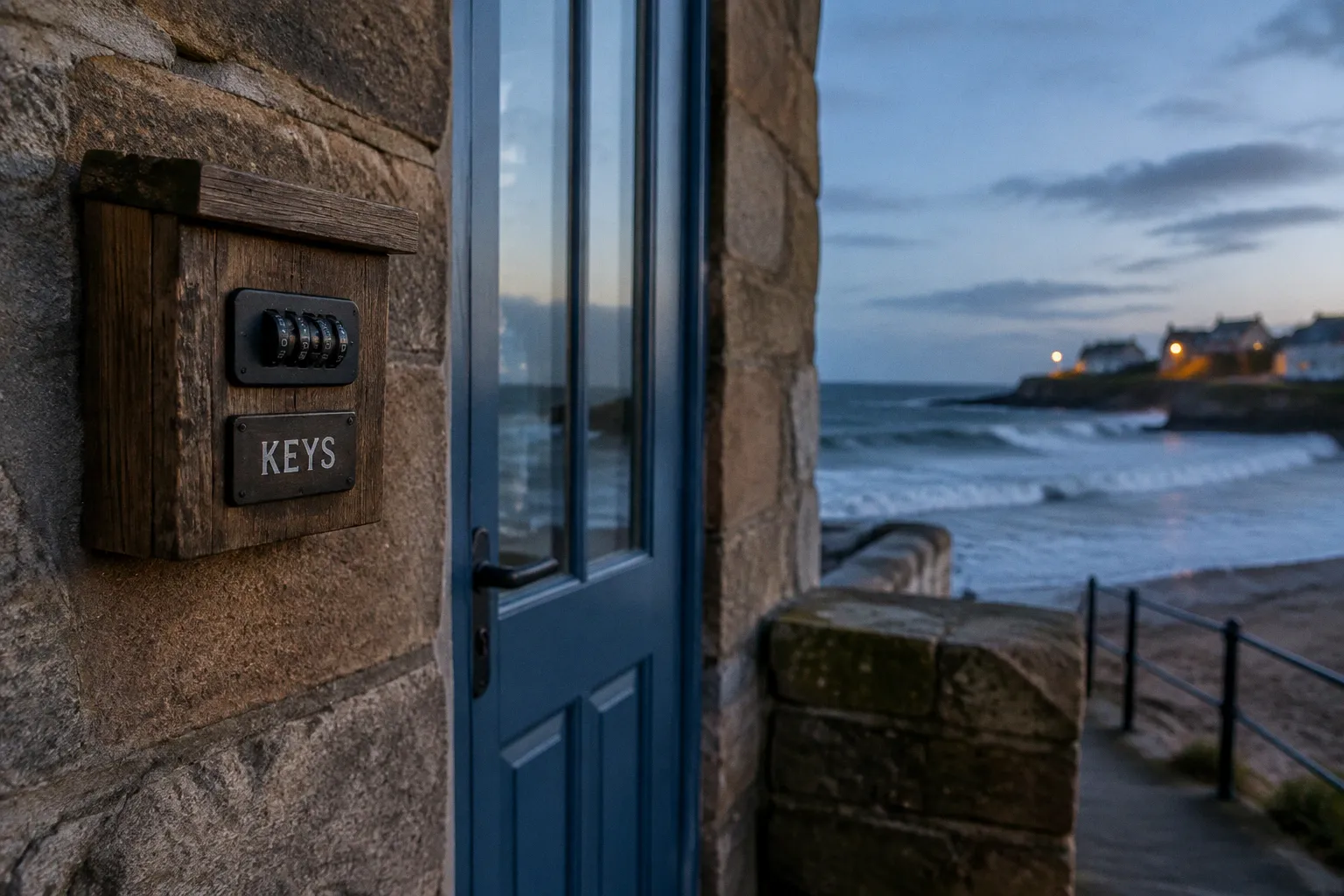
- The arrangements for keys, access, waste and deliveries.
- The remedy offered if the property becomes unavailable before or during the stay.
None of these questions is excessive for a two- or three-night break. For a month-long booking, they are basic operating information.
The coastal factor
The seaside setting introduces a few practical concerns that do not always appear in standard city accommodation. Salt air, wind-driven rain and older building fabric place more pressure on windows, doors, heating systems and exterior fittings. A cottage does not need to be new to be comfortable, but the operator should have a clear maintenance process and should not treat every problem as an unavoidable feature of living by the water.
Heating deserves particular attention outside summer. Ask whether the property has central heating, electric heaters or a combination of systems, and whether the controls are straightforward. A beautiful stone cottage that takes hours to warm up may be perfectly pleasant for a weekend and frustrating for someone working there every day. The same is true of draughts, condensation and poor lighting.
Noise also works differently near the coast. A property facing the promenade may be quiet during one viewing period and busier at weekends or in good weather. Wind can amplify the sound of loose fittings, windows or external doors. None of this makes a beachfront location unsuitable, but it makes the exact position of the bedroom and workstation more significant than the phrase sea view suggests.
Parking is another point where the Joppa and Portobello experience can differ from a rural cottage stay. A property may be described as coastal or cottage-style without having a private driveway. If the guest is bringing a car, the listing should make clear whether parking is allocated, on-street or dependent on local availability. If the guest is relying on public transport, proximity to the beach does not necessarily mean proximity to the most useful bus stop.
Building a Workable Month
The best coastal self-catering workation is not the one with the most decorative photographs. It is the one that removes small daily decisions.
That starts with separating work space from rest space wherever the layout allows. A dedicated room is ideal, but even a stable desk in a quiet corner is better than moving a laptop between the kitchen table and the sofa. The guest should be able to finish the working day without leaving equipment in the middle of the living area.
The same principle applies to supplies. A month-long stay needs more than a weekend’s worth of tea, cleaning products and basic groceries. The property does not need to be stocked like a serviced apartment, but its practical relationship with local shops matters. Portobello offers more immediate choice. Joppa rewards planning, particularly if the guest intends to work through the day and avoid unnecessary trips into town.
A realistic weekly rhythm might include central meetings on selected days, concentrated work from the cottage on others and a longer walk along the beach when the weather permits. That is where Joppa has an advantage over an anonymous city-centre flat. The coast changes the shape of the day without requiring a full excursion. A short break can be genuinely separate from the screen.
But the location should not be romanticised. Winter daylight is limited, wind can make the promenade uncomfortable and a sea view does not create a productive routine on its own. The guest still needs a suitable chair, planned breaks, reliable food and a clear boundary between work and leisure. The cottage gives those habits a better setting; it does not supply them automatically.
For guests sharing the property with a partner or family member, the layout becomes even more important. A single attractive living room may not support two simultaneous calls. Bedrooms can offer privacy but may have poor heating, weak WiFi or no suitable work surface. Before confirming a longer stay, identify which rooms can realistically be used for calls and whether the connection reaches them consistently.
A month also exposes storage and housekeeping weaknesses that a weekend can conceal. There should be enough room for clothing, work equipment and groceries without turning the cottage into a storage unit. The cleaning arrangement should be clear enough that the guest knows when access is required and what they are expected to manage between visits.
Joppa or Portobello?
The two locations are close enough to compare but different enough to produce a different month.
| Consideration | Joppa | Portobello |
|---|---|---|
| Atmosphere | Quieter and more residential | Livelier, with more activity along the High Street and promenade |
| Remote-work appeal | Better for privacy and a slower daily rhythm | Better for flexibility outside the property |
| Food and errands | More limited immediate choice | Wider range of cafés, shops and restaurants |
| City access | Connected to central Edinburgh by bus | Connected to central Edinburgh by bus, with more local alternatives |
| Main risk | Underestimating the need for nearby services | Choosing a property with more noise than expected |
| Best suited to | Deep-focus work and a deliberately quiet stay | Guests who want work, errands and social plans close together |
The distinction is not whether one is objectively better. It is whether the guest wants the neighbourhood to provide an active extension of the accommodation.
A Joppa seaside cottage workation makes sense when the property itself is the anchor. The guest is choosing a coastal base, planning the day around the accommodation and using the beach as a nearby reset. A Portobello beach holiday flat for remote working makes more sense when the guest wants options: a coffee outside, an easier dinner, a change of scene or a less deliberate approach to daily logistics.
The category also affects the way a property should be evaluated. A cottage-style home may have more character and privacy but less standardisation. A serviced flat may offer more predictable furniture, heating and support while giving up some of the sense of place. For a month, character is valuable only when the underlying systems work.
What the Successful Booking Looks Like
The successful booking is not necessarily the cheapest, the closest to the water or the one with the most polished interior. It is the property whose operator can answer practical questions without treating them as an inconvenience.
The licence is current and traceable. The address is clear. The costs are itemised. Broadband is described with enough detail to assess it rather than merely advertised as an amenity. The desk, chair, heating and lighting are suitable for ordinary working days. The cancellation and maintenance arrangements explain what happens when circumstances change.
That standard applies whether the guest books directly or through a platform. A platform may provide payment processing and a review history, but it does not remove the need to understand the property itself. A direct booking may offer more flexibility around dates and long-stay terms, but it places more responsibility on the guest to verify the operator and the payment arrangement.
The month should also be viewed as a small operational test for the host. Fast, specific answers before booking are not proof that everything will be perfect, but vague answers about licence status, internet or costs are useful evidence in the other direction. Long-stay guests are not being difficult by asking how a property works. They are buying a longer and more demanding version of the same service.
The sea view is the reason to shortlist the property. The licence, broadband, heating and cancellation terms are the reasons to stay with it.
Joppa can deliver a rare combination for remote work: a coastal setting that feels separate from the city and a practical route back into central Edinburgh when the calendar requires it. The arrangement works best when the guest treats the cottage as temporary infrastructure rather than a picturesque escape. That means checking the legal status, testing the assumptions around connectivity and pricing the entire month rather than the first attractive nightly rate.
For someone looking for an Edinburgh coastal holiday flat for remote work, the right question is not whether the property looks relaxing. It is whether it can carry the demands of a working month without turning every small problem into a daily negotiation. When the answer is yes, Joppa’s main advantage becomes clear: the coast is not an interruption to city life, but a more considered base from which to work through it.