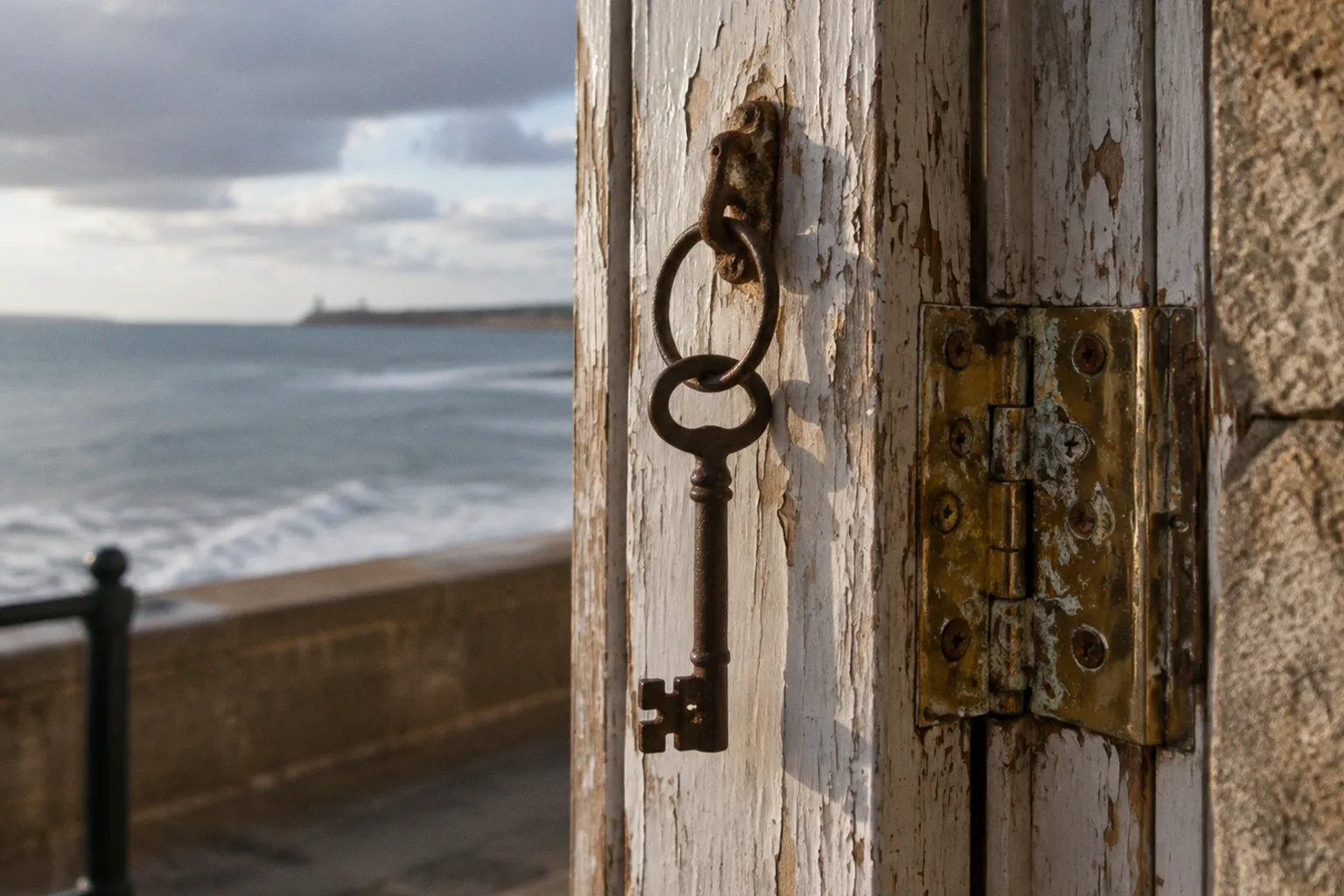
In properties within five miles of the ocean, corrosion and material degradation can move three to five times faster than in inland accommodation.
That is the inconvenient truth behind coastal guest house salt air maintenance: a building may look perfectly presentable while its fixtures are already losing their finish, its seals are becoming brittle and its replacement cycle is shortening. By the time rust is visible on a balcony fitting or a window hinge, the damage is rarely new.
For an Edinburgh guest house near Joppa, Portobello or the wider Firth of Forth, the answer is not a dramatic annual deep clean. It is a more intelligent rhythm of freshwater rinsing, soft washing, material selection and close inspection at the tactile points where guests notice decline first.
Salt does not need a storm to become a problem
The damage begins with airborne chloride particles settling on surfaces. Wind-driven spray is the obvious culprit, but salt can also arrive as a fine deposit on windows, railings, roofline details, signage and outdoor furniture. Moisture activates the residue, allowing chloride ions to attack vulnerable metals and finishes.
The chemistry is more persistent than most operators expect. Table salt can absorb moisture and initiate corrosion at roughly 75% relative humidity. Certain coastal salt mixtures can become corrosive at humidity levels as low as 33%. In practice, this means a property does not need to be visibly wet, storm-lashed or directly exposed to spray for the process to begin.
Edinburgh’s maritime climate adds its own complications. A bright morning can leave a salt film on glass and metal, followed by damp air later in the day. Sheltered recesses around sash windows, covered entrances and balcony junctions may retain deposits long after exposed surfaces appear clean. Rain does not reliably solve the problem. It often lacks the pressure and coverage needed to remove salt trapped in porous materials, joints and protected crevices.
This is why seaside B&B building upkeep must be treated as a preventative discipline rather than a response to visible grime. The aesthetic decline is only one part of the issue. Salt deposits can affect:
- Window hinges, catches, restrictors and exposed fasteners.
- Door closers, locks, letter plates and threshold hardware.
- Exterior lighting housings and cable fittings.
- Metal balustrades, signage brackets and handrails.
- Outdoor tables, chairs and planters.
- Painted timber, rendered surfaces and masonry details.
- Mechanical fixings around balconies, terraces and service areas.
The guest does not need to understand chloride corrosion to register its consequences. A stiff door handle, a pitted chrome fitting or a powdery handrail creates an impression of deferred care. In a heritage guest house, that impression is especially damaging because the promise is not simply cleanliness. It is stewardship: the sense that the building and its details have been handled with intention.
Salt air maintenance is not about making a coastal property immaculate. It is about stopping the atmosphere from quietly reducing its useful life.
The three places where guests notice deterioration first
A coastal property rarely fails everywhere at once. The most visible decline tends to appear at touchpoints and transition zones: anywhere a guest moves from outside to inside, opens something, leans against something or looks closely at a window.
1. The entrance sequence
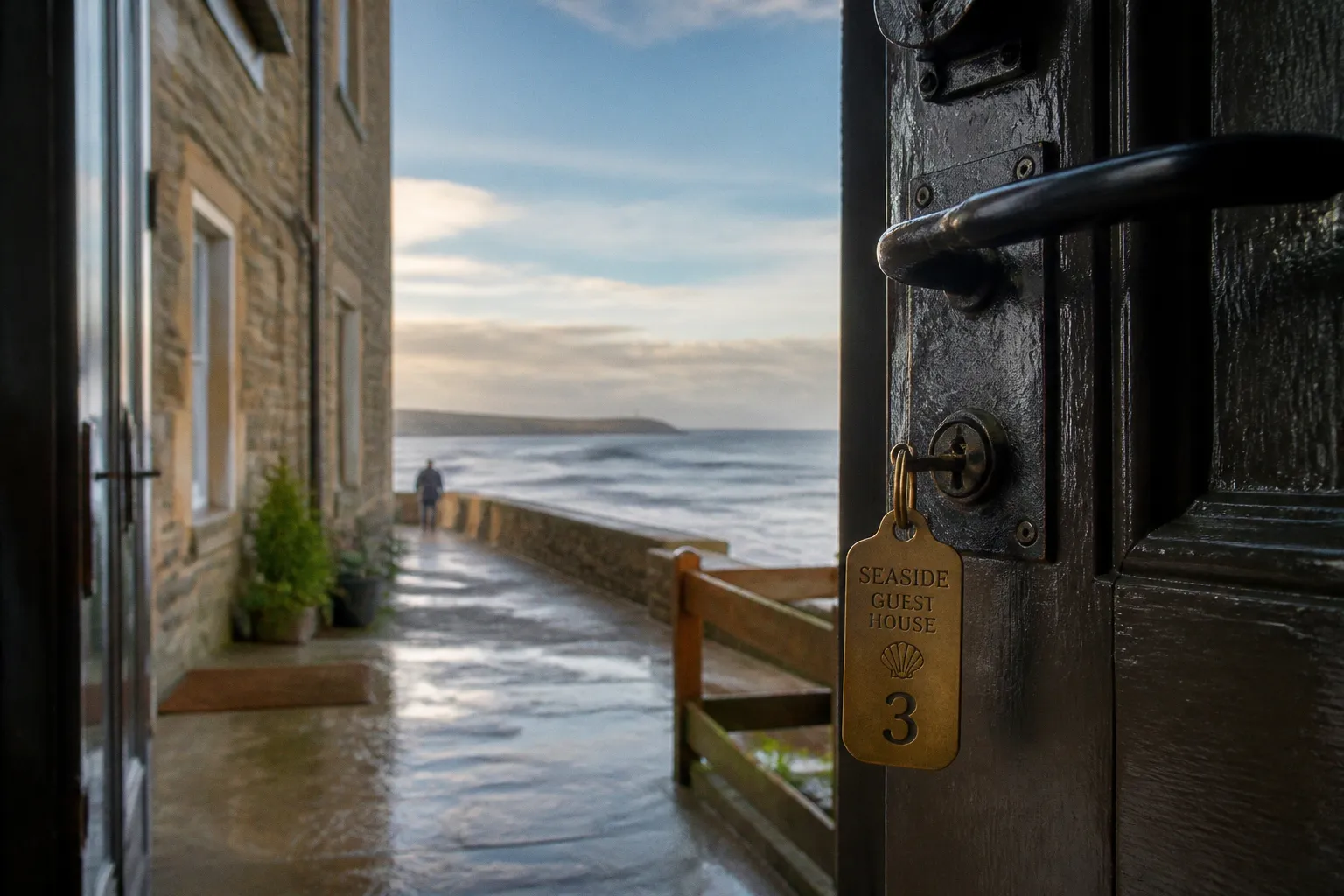
The front entrance carries an unusual amount of visual weight. Guests approach it with luggage, often in poor weather, and make several quick judgements before they have reached reception. If the door pull is pitted, the brass has a green edge or the external light fitting has begun to bloom with corrosion, the property feels less composed.
A well-maintained entrance does not need to be grand. It needs spatial harmony. The hardware should operate smoothly, the threshold should be clear of salt residue and the lighting should remain warm without looking weathered. On coastal buildings, the entrance is also where wet coats, damp bags and wind-borne deposits meet the most heavily used materials.
Inspect door furniture by touch rather than sight alone. A roughened lever, a catch that requires force or a hinge beginning to squeak may reveal deterioration before the finish gives it away.
2. Windows and the perimeter of the room
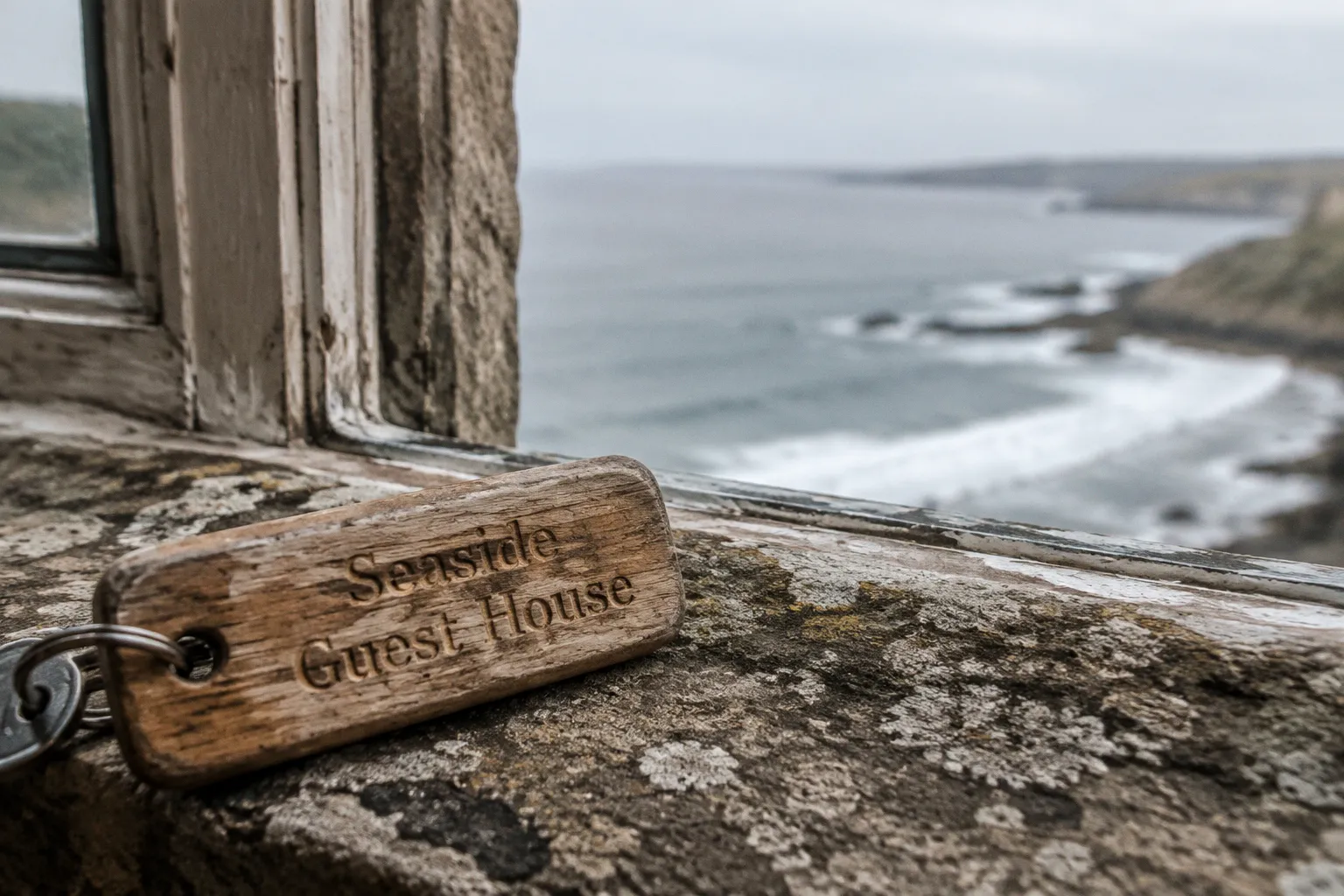
Windows are particularly vulnerable because salt settles on glass, frames, seals and metal components at the same time. The result is not always dramatic at first. It may present as a hazy surface, slight etching, a discoloured gasket or a catch that no longer closes with the precision expected in a well-run guest house.
In a traditional Edinburgh property, original sash windows make this more nuanced. Their heritage value may rule out generic replacement hardware or aggressive cleaning methods. Maintenance has to preserve the character of the window while preventing modern corrosion from compromising operation.
Look closely at:
- The lower corners of external panes, where deposits collect.
- Sash cords, pulleys and exposed fasteners.
- Putty lines and painted timber around the glazing.
- The meeting rails and catches guests handle most often.
- Drainage points and small recesses beneath the sill.
- Silicone or rubber seals, particularly where they meet metal.
The visual language of a heritage room depends on restraint. Bright new hardware can look as misplaced as damaged old hardware. The best intervention is usually the least conspicuous one that restores reliable function.
3. Outdoor and semi-outdoor FF&E
Furniture, fixtures and equipment deteriorate much faster in a coastal hospitality environment than most replacement budgets assume. Airborne chloride deposits, combined with relative humidity sustained above 70%, can accelerate the failure timeline of FF&E by three to five times compared with inland benchmarks.
This affects more than garden chairs. Consider the metal legs of a breakfast terrace table, the hinges on an external cupboard, the brackets supporting a sign, the screws securing a planter or the fittings on a covered veranda. Semi-sheltered spaces can be particularly deceptive: they are protected from direct rain but may trap salty, humid air.
A furniture piece can remain structurally usable while looking tired, which creates a difficult commercial decision. Replacing everything on a fixed calendar is wasteful. Waiting until failure is visible to guests is worse. A more considered approach is to divide FF&E into three groups:
1. Guest-facing and touch-intensive items — door furniture, chairs, tables and handrails. These deserve the most frequent inspection because deterioration is immediately legible.
2. Exposed but low-touch items — brackets, plant supports, service gates and exterior signage. Their condition may be less visible, but failure can create safety and access problems.
3. Protected interior items — fittings behind an entrance or within enclosed service areas. These usually need a slower replacement cycle, though they should not be assumed to be immune.
That hierarchy allows an independent operator to direct money where it changes the guest experience rather than spreading budget thinly across every coastal component.
A cleaning cycle that works with the building, not against it
A good coastal maintenance programme is deliberately unglamorous. It relies on repetition, low-pressure methods and records that make small changes visible over time.
For properties within 1 km of the coastline, building maintenance guidance commonly specifies exterior freshwater cleaning every three to six months. Between 1 km and 5 km from the shore, a six-month interval is a useful baseline. A highly exposed frontage, a roof terrace or a building facing prevailing winds may require more frequent attention, while a sheltered inland elevation may need less.
The point is not to impose one rigid timetable on every façade. It is to establish a minimum rhythm and then adjust it according to exposure.
The practical sequence
A sensible visit from a maintenance team should follow the same order each time:
1. Inspect before washing. Photograph vulnerable fittings, note new staining and identify areas where salt is collecting. Cleaning first can hide evidence of deterioration.
2. Rinse with low-pressure fresh water. The aim is to dissolve and carry away deposits without driving water into seals, masonry joints or electrical fittings.
3. Clean with a suitable soft-wash method. Aggressive pressure can damage paint, timber, pointing and delicate heritage surfaces, creating new routes for moisture.
4. Pay attention to sheltered details. Under sills, behind brackets, around fasteners and beneath handrails are the locations most likely to be missed.
5. Rinse again where residue remains. Salt left behind after a detergent wash defeats the purpose of the exercise.
6. Allow surfaces to dry before assessing them. Corrosion, flaking paint and failed sealant are easier to diagnose when the material is no longer saturated.
7. Record repairs separately from cleaning. A wash removes deposits; it does not restore damaged coatings, replace corroded fixings or repair failed joints.
Low-pressure freshwater rinsing is especially useful between professional visits. It is a preventative measure, not a substitute for a proper inspection. In a guest house, the process should be built into the operating routine with minimal disruption: exterior paths, entrance hardware, terrace fittings and visible lower-level details can often be checked alongside other housekeeping and facilities tasks.
The cost logic is straightforward. Frequent, controlled rinsing is inexpensive compared with replacing a complete run of exterior lighting, repainting timberwork or removing corroded fixings from a listed façade. The most valuable maintenance is often the work that leaves the building looking unchanged.
Why soft washing matters in a heritage property
Historic seaside lodging has a narrower margin for error than contemporary construction. A hard jet can erode old paint, dislodge pointing or force water behind timber trim. A harsh chemical treatment can alter the tone of stone or leave a residue that attracts further dirt.
Heritage tones work because they have depth: weathered stone, muted paint, aged brass and timber that has been maintained rather than cosmetically renewed. The wrong cleaning process can flatten that character. The correct one removes salt without stripping away the surface qualities that give the building its identity.
This is where a specialist soft wash is not simply a cleaning preference. It protects the visual asset as well as the material one.
Specify marine-grade materials before the replacement becomes urgent
Many coastal maintenance problems are created at the procurement stage. A fitting is selected because it looks suitable, matches an existing finish or arrives quickly. Its exposure rating is treated as a technical footnote. Within a few seasons, the operator is paying for removal, replacement and the disruption of repairing the surrounding material.
For exposed coastal conditions, 316 and 316L stainless steel are the more defensible standard. Both contain molybdenum, which improves resistance to chloride pitting and corrosion in marine environments. This does not make them maintenance-free. It makes them better equipped for the atmosphere they are required to endure.
Standard 304 stainless steel and basic aluminium should not be assumed to be sufficient for direct salt-spray exposure. They may perform acceptably in sheltered positions, but the risk rises sharply at exposed elevations, on seaward façades and around areas where salt remains damp.
| Component | More resilient specification | Maintenance implication |
|---|---|---|
| Exterior screws and fixings | 316 or 316L stainless steel | Reduces pitting risk, but still needs freshwater rinsing |
| Handrails and balustrade details | Marine-grade stainless steel with suitable finish | Inspect welds, joints and concealed fixings |
| Door and window hardware | Corrosion-resistant hardware rated for coastal exposure | Prioritise smooth operation and guest touchpoints |
| Exterior light fittings | Sealed, marine-suitable housings | Check cable entries, brackets and trapped moisture |
| Outdoor furniture | Powder-coated or marine-grade components with protected joints | Inspect underside surfaces and fasteners |
| Signage brackets | 316 stainless steel or an appropriately specified alternative | Avoid mixed metals that encourage galvanic corrosion |
| Decorative brass or bronze | Exterior-rated finish with a maintenance plan | Patina may be intentional; active corrosion is not |
Material selection should also account for the full assembly. A 316 screw attached to a weak bracket does not create a marine-grade installation. Nor does a high-quality fitting compensate for a poorly sealed penetration into stone or timber. Fasteners, washers, backing plates, coatings and drainage all form part of the specification.
The price-to-value question
Marine-grade materials cost more at the point of purchase. That is not, by itself, a reason to specify them everywhere. It is a reason to be selective.
Use the stronger specification where access is difficult, replacement would disrupt guests, failure would affect safety or the component is central to the arrival experience. A seaward balustrade fitting deserves a different decision from a low-risk interior screw. A front-door pull should not be treated like a back-of-house bracket.
For independent operators, this is the practical balance:
- Upgrade high-exposure, high-visibility components first.
- Avoid false economy on inaccessible fixings.
- Keep finishes consistent so individual replacements do not create visual noise.
- Record the grade and finish of installed components for future purchasing.
- Replace corroded fixings before they damage adjacent timber, stone or render.
- Ask suppliers for coastal suitability rather than accepting generic stainless steel language.
A design-conscious property should not look industrial simply because it is near the sea. Marine-grade components can be specified with a restrained finish: satin rather than mirror-polished steel, aged bronze where appropriate, or painted metalwork with a robust coating system. The point is not to display technical resilience. It is to make resilience invisible.
The best coastal specification is not the most expensive one. It is the one that spends strength where exposure, access and guest attention overlap.
Glass needs its own maintenance language
Salt on glass is often dismissed as a cosmetic nuisance. In reality, repeated deposits can leave mineral residue and contribute to etching if they are not removed properly. Windows then lose the clean, quiet quality that makes a guest room feel finished. Natural light becomes duller, views across the water lose clarity and the frame begins to look older than it is.
Vulnerable exterior windows benefit from regular freshwater cleaning rather than infrequent aggressive treatment. Maintenance protocols commonly recommend applying a mixture of one part vinegar to ten parts water every few weeks to help dissolve salt deposits and reduce the risk of glass etching.
The method should be handled with care. The solution is intended for the glass surface, not indiscriminate use across every frame, seal and metal fitting. On older windows, painted timber and specialist finishes, the cleaning team should confirm compatibility before applying any solution across the assembly.
A polished window routine has four parts:
1. Remove loose grit and surface debris without dragging it across the glass.
2. Apply the diluted vinegar solution to the affected glass.
3. Rinse and dry thoroughly so dissolved salt is not left behind.
4. Inspect the perimeter, seals, catches and sill for related deterioration.
Do not confuse clear glass with a healthy window. A pane may shine while the hardware around it is failing. Conversely, slightly aged glass in a heritage building may be part of its character, while corroded catches are a genuine operational defect. The job is not to make every surface look new. It is to preserve clarity, function and the visual balance of the room.
This distinction matters in guest communications as well. A sea-facing room is sold partly through its outlook. If the view is softened by residue, the guest experiences the maintenance failure as a reduction in value, even if the room itself is otherwise immaculate.
Build the routine into operations rather than treating it as a special project
Coastal property maintenance tends to fail when it belongs to nobody. The housekeeping team assumes the contractor is handling the exterior. The contractor cleans but does not report a stiff latch. The operator notices the corrosion only when a guest mentions it.
A small guest house does not need a complex facilities department. It does need clear ownership and a short record of recurring defects. The useful information is practical:
- Which elevation receives the strongest wind and spray.
- Which windows repeatedly show salt deposits.
- Which fittings have already been replaced.
- Which materials were specified and where they were installed.
- When the last freshwater rinse and soft wash took place.
- Which items require monitoring before the next planned visit.
- Whether a defect affects appearance, operation, safety or all three.
A monthly walk-round is enough to catch many early signs. It should take place in daylight and include the exterior entrance, windows at guest level, terraces, railings, signage, lighting and service access points. The operator should handle doors and windows, not simply look at them. Coastal damage often announces itself through friction, stiffness or a changed sound.
The maintenance record should also distinguish between salt removal and finish renewal. These are different jobs with different budgets. Washing can slow the process. It cannot repair pitting, restore a failed coating or reverse damaged timber. If the two activities are conflated, an operator may believe the building is being maintained when it is merely being cleaned.
A workable annual rhythm
The exact schedule will depend on exposure, but a sensible pattern for many seaside guest houses looks like this:
- Every few weeks: Inspect and clean vulnerable glass, entrance hardware and the most exposed touchpoints.
- Monthly: Walk the full exterior, operate windows and doors, and record changes in finish, movement or corrosion.
- Every three to six months: Arrange a freshwater exterior clean for properties within 1 km of the coast, with the interval adjusted for exposure.
- Every six months: Review properties between 1 km and 5 km from the coast and inspect all exterior FF&E.
- Twice yearly: Commission a more detailed professional soft wash where the building fabric and finish require specialist handling.
- Before winter: Check seals, drainage, lighting housings, fasteners and exposed timber before prolonged damp conditions.
- After severe weather: Inspect the seaward elevation, roofline details, signage, windows and external furniture for new deposits or physical damage.
This rhythm is intentionally conservative in the right places. A single annual clean may be inadequate for a property directly exposed to the Firth. Conversely, daily chemical washing would be wasteful and potentially damaging. The objective is a calibrated response to the building’s position, materials and operating profile.
Comfort is part of maintenance, not an afterthought
The relationship between corrosion control and guest comfort is easy to underestimate. A window that sticks affects ventilation. A swollen or poorly sealed door affects draughts and noise. A failing exterior light affects arrival confidence. A rough handrail affects the feeling of care. Maintenance is not separate from hospitality; it is one of the ways hospitality becomes physical.
The same applies to the interior atmosphere. If windows remain clean, daylight reaches the room properly. If damp and salt are kept away from frames and thresholds, materials age more gracefully. If exterior hardware operates quietly, the building feels composed rather than overworked.
This is where design judgement earns its keep. Not every sign of age should be erased. A traditional guest house should have texture, patina and evidence of its setting. But patina must be intentional. Corrosion, residue and failing hardware are not heritage tones; they are deferred maintenance wearing a more flattering name.
The strongest seaside properties understand this distinction. They use robust materials, but do not advertise their toughness. They preserve original details, but do not romanticise malfunction. They spend on the parts guests touch, see and rely on, while keeping the routine sufficiently disciplined to prevent small defects becoming capital works.
For operators around Edinburgh’s coast, coastal guest house salt air maintenance is ultimately a question of tempo. The sea will continue to deposit salt. Humidity will continue to activate it. The property either responds in small, regular interventions or pays for the accumulated consequence later.
A considered rinse, a properly specified fixing and a well-maintained window may sound like minor acts. Together, they protect the building’s finish, the guest’s comfort and the financial value of every room. In a seaside guest house, that is not housekeeping at the margins. It is the quiet infrastructure of a premium stay.