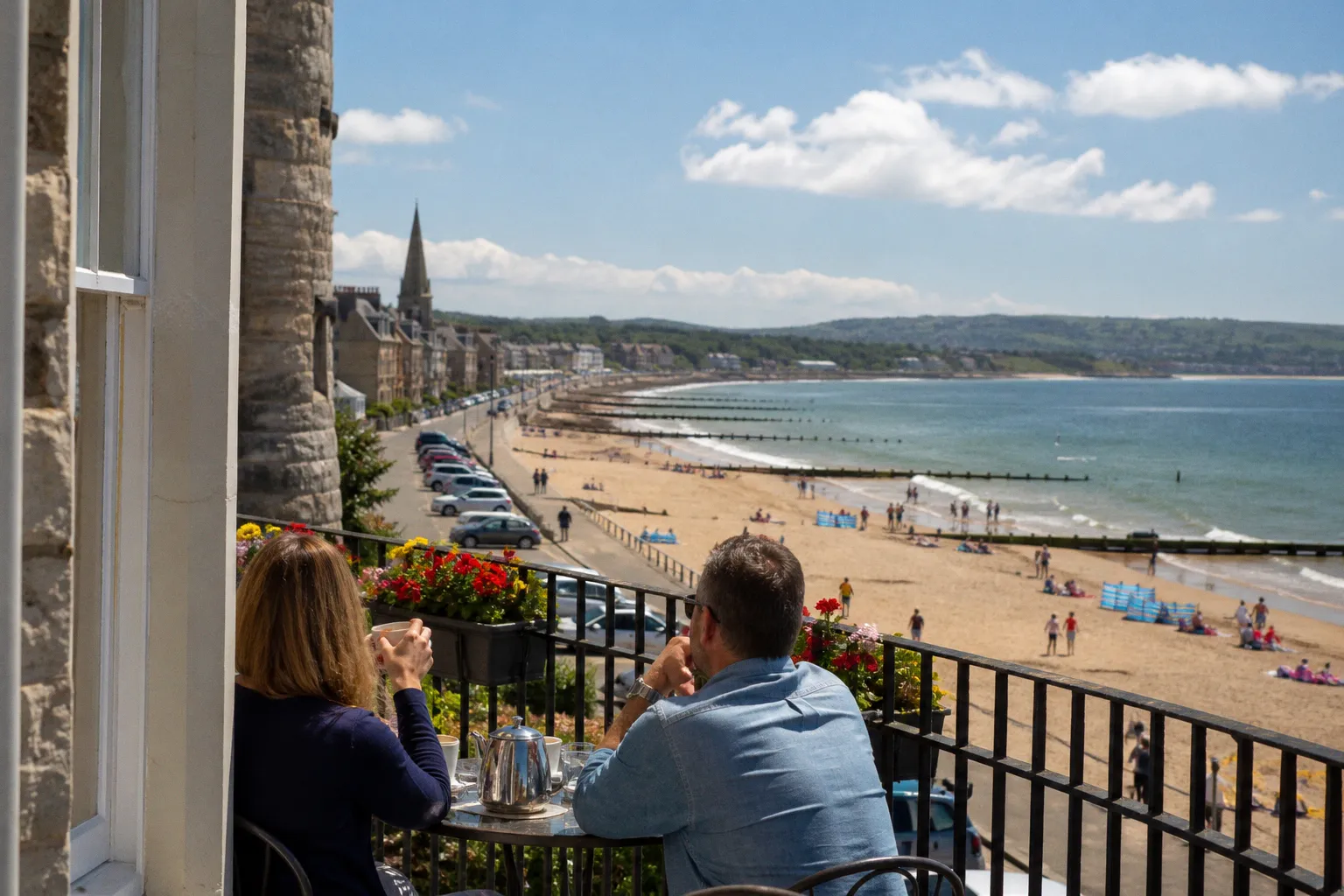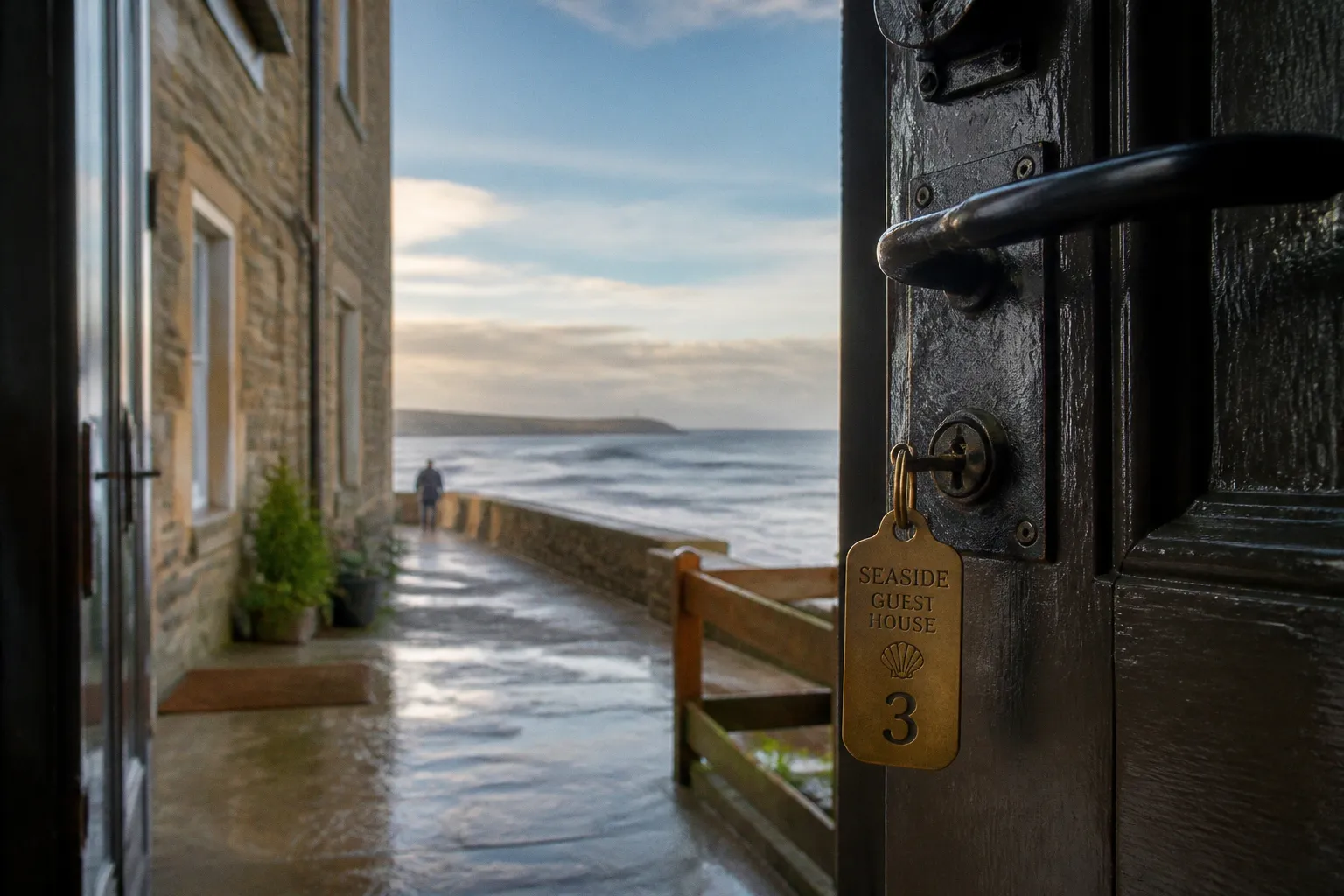
In the case of Straven Guest House, the distance is stated more precisely: 50 yards from Portobello’s sandy beach.
That changes the structure of a city break. The accommodation is not merely a cheaper substitute for a central Edinburgh hotel. It places the visitor in a coastal suburb, with the Firth of Forth, the promenade and Joppa’s residential streets forming the immediate setting. The city remains accessible, but it is no longer the only organising principle of the stay.
The practical question is whether the property can deliver both sides of that proposition: reliable access to central Edinburgh and a seaside environment that feels materially different from an urban hotel district. Joppa performs well because the distance is short enough for regular city travel, but the local experience is defined by the coast rather than by tourist infrastructure.
The Victorian edge of Portobello beach
Joppa occupies the eastern end of Portobello beach, where the built environment becomes quieter and more residential. The area is associated with Victorian guest houses, older coastal properties and accommodation positioned close to the promenade. This is a different market from the large hotels concentrated around Edinburgh’s central districts.
For a guest, the main benefit is not decorative period detail. It is spatial. A Victorian seaside house typically offers a more domestic scale than a conventional city hotel: fewer rooms, direct access from a residential street and a stronger relationship with the surrounding neighbourhood. That can make the stay feel more settled, but it also means that expectations should be calibrated accordingly. This is not a full-service city property with a reception desk operating as a permanent command centre.
The location does much of the work. A 50-yard walk to the beach is operationally more significant than a generic claim about being near the sea. It means the shoreline can be used spontaneously rather than scheduled as an excursion. A morning walk, a short break between city visits or an evening along the promenade does not require a car, a taxi or a separate day in the itinerary.
The same proximity also exposes the limits of coastal accommodation. Sea-facing properties are not automatically quiet in every condition. Wind, rain and changing light are part of the environment. Older buildings may have individual room layouts, varying views and less standardised sound insulation than newer hotels. A serious review should not turn those characteristics into either a selling point or a defect without context. They are part of the operating model.
The value of Joppa is not that it removes Edinburgh from the trip. It gives the city a second operating base: the beach in the morning, the centre by bus, and no need to choose between them.
Straven Guest House is a useful reference point within that model. It is a four-star B&B in a Victorian home, located close to the sandy beach and carrying a Gold award from Green Tourism. Those details establish a clearer proposition than the usual language of coastal accommodation: period building, B&B format, short beach access and an independently recognised environmental standard.
The result is accommodation aimed at guests who value location and scale over extensive hotel facilities. Someone looking for a large lobby, multiple dining outlets or a fully serviced leisure operation is assessing the wrong product. Someone wanting a base with direct coastal access and a straightforward route into Edinburgh is looking at the relevant advantages.
City access without central Edinburgh pricing assumptions
The journey into central Edinburgh takes approximately 20 to 25 minutes by public bus from the Joppa and Portobello seaside area. That is short enough to support a city-focused itinerary, but long enough to change how the day is planned.
The sensible approach is to treat the bus journey as part of the stay rather than as an inconvenience to be eliminated. Guests can spend the morning in the Old Town or New Town, return to the coast for a break, then go back into the centre for dinner or an evening event. That pattern is less efficient than staying beside Waverley Station if every hour is committed to central attractions. It is more flexible if the accommodation itself is part of the reason for visiting.
This distinction matters for the review of any Edinburgh seaside accommodation story. The property should not be judged solely by its travel time to the castle, museums or city-centre restaurants. Its value comes from the combination of two access points:
- The city network: a bus journey of approximately 20 to 25 minutes into central Edinburgh.
- The local coast: Portobello beach, the promenade and the Firth of Forth shoreline within immediate reach.
- The neighbourhood scale: residential streets rather than a high-density visitor district.
- The accommodation format: B&Bs, self-catering apartments and Victorian holiday rentals rather than one uniform hotel category.
There is a practical planning issue here. Central Edinburgh is dense with restaurants and late-opening venues. Joppa is quieter and more dependent on the visitor making deliberate choices about evening transport, meals and return times. That is not a weakness, but it removes some of the frictionless convenience associated with staying in the centre.
For a short break dominated by nightlife, a central hotel may have the stronger yield in time. For a longer visit, or for a traveller who wants to divide time between urban sightseeing and the shore, Joppa’s transport profile is more balanced. The 20-to-25-minute connection is the critical fact. It keeps the suburb within practical reach without making it functionally indistinguishable from central Edinburgh.
What a stay actually feels like
A coastal guest house experience is shaped by transitions. The day begins on a residential street rather than beside a major railway station. The first outside view is likely to involve the shoreline, the promenade or the broad weather conditions over the Firth of Forth, not a stream of city traffic. The return from Edinburgh is equally important: the accommodation becomes a place to decompress rather than simply a room used between attractions.
That sounds subjective, but the underlying factors are concrete. The beach is close. The bus route is usable. Local accommodation includes both serviced B&Bs and self-catering properties. Street parking is available in the area, which is relevant for guests arriving by car, although parking conditions should be treated as local and variable rather than guaranteed private provision.
The room itself remains the decisive part of the experience. A sea view can be valuable, but only if the room has enough usable space, appropriate heating and sensible storage. Coastal weather makes these operational details more important than decorative styling. Wet outerwear, shoes and luggage need somewhere to go. A property that photographs well but handles ordinary arrival conditions poorly will underperform regardless of its proximity to the beach.
The strongest seaside stays usually work because the accommodation does not overstate its role. A good B&B near Portobello beach does not need to imitate a five-star city hotel. It needs to provide a clean, well-managed room, accurate information, dependable arrival arrangements and a location that justifies the decision to stay outside the centre.
For owners and managers, this is where the commercial logic becomes visible. The coastal setting creates the initial demand, but operational consistency converts it into reviews, repeat bookings and off-season resilience. The beach cannot compensate for unclear check-in instructions. A period building cannot compensate for poor heating. A Firth of Forth view cannot compensate for inaccurate room descriptions.
Sustainability as an operating standard
Straven Guest House’s Gold award from Green Tourism is relevant because sustainability in accommodation is most credible when it appears as an operating discipline rather than as a slogan. The award signals that environmental management is part of the property’s business practice.
For a guest, the effect may be visible in ordinary details rather than dramatic gestures: energy management, water use, waste handling, purchasing decisions and communication about local transport. The practical test is whether those measures protect comfort while reducing unnecessary consumption. Sustainability that produces unreliable heating, limited hot water or vague service standards is not a competitive advantage. It is simply a cost transferred to the guest.
The location supports lower-impact travel in a straightforward way. A visitor can reach central Edinburgh by bus rather than relying on a car for every journey. The beach, promenade and nearby coastal features are accessible on foot. Local accommodation with free street parking can also appeal to drivers, but the availability of public transport means that a car is not essential for the basic city-and-coast itinerary.
A responsible review should separate three claims:
| Claim | What the location supports | What still depends on the property |
|---|---|---|
| Lower-impact access to Edinburgh | Bus travel to the city centre in approximately 20 to 25 minutes | Clear transport information and realistic journey guidance |
| Reduced reliance on private vehicles | Beach, promenade and local coastal areas are walkable | Secure arrival arrangements and accurate parking information |
| Environmentally aware operation | Straven Guest House holds a Gold Green Tourism award | Consistent delivery across energy, water, waste and guest communications |
| Comfortable coastal stay | Victorian accommodation close to the shore | Heating, ventilation, sound control, maintenance and room standards |
This is also where property owners need to avoid vague positioning. Environmental certification may support demand, particularly among guests who compare transport options and operating practices. It does not remove the need for yield management, seasonal planning or regulatory compliance. A coastal B&B still has to manage occupancy rates across the year, price rooms according to demand, and maintain a property exposed to a marine environment.
Salt, wind and moisture are not abstract risks for seaside accommodation. Exterior maintenance, window condition, drainage and heating performance affect both the guest experience and the long-term cost base. A property close to Portobello beach has a location advantage, but it also carries the maintenance profile of a coastal building.
In seaside accommodation, sustainability is credible only when it survives contact with winter heating bills, maintenance schedules and the guest’s expectation of comfort.
The Firth of Forth beyond the room
Joppa’s appeal extends beyond the beach itself. The accommodation sits along the Firth of Forth coast, close to local parks and Joppa Rocks, a geological site that gives the area a more specific identity than a generic waterfront label.
For the visitor, that creates a useful scale of exploration. The shoreline can be treated as a short walk rather than a full-day excursion. Portobello offers the broader beach context, while Joppa provides a quieter eastern reach. The coastline is therefore not a single attraction to be ticked off but a local route that can be fitted around the rest of an Edinburgh itinerary.
The practical advantage is flexibility. Weather may determine whether the walk lasts twenty minutes or two hours. A guest does not need to commit in advance, book an activity or organise transport. The accommodation’s value increases because the coast is available in small intervals.
This is particularly relevant to travellers who do not want every part of a city break to be programmed. A Joppa stay can support a more modular itinerary:
1. Use the coast at the start of the day. The beach and promenade provide an immediate walk before travelling into central Edinburgh.
2. Keep the city visit concentrated. Rather than making repeated short trips, guests can group museums, shopping or historic sites into one central itinerary.
3. Return before the evening peak. The accommodation then functions as a quieter base, with dinner plans made locally or back in the centre.
4. Reserve a full coastal period. Joppa Rocks, Portobello and the Firth of Forth shoreline can occupy a separate half-day if conditions are suitable.
5. Build around weather rather than resisting it. The coast is most useful when the itinerary has enough flexibility to change.
The limitation is equally clear: Joppa is not a self-contained resort with an unlimited supply of restaurants, bars and attractions at the doorstep. Guests should select the area because the combination of coastal access and city connectivity suits them, not because they expect a miniature version of central Edinburgh.
Choosing between a B&B, apartment and Victorian rental
The wider Joppa and Portobello area offers several accommodation formats. They are not interchangeable, even when they occupy similar streets.
A B&B such as Straven Guest House suits guests who want a managed stay with breakfast and a defined hospitality structure. The building may have more individual character than a modern hotel, but the trade-off is that room layouts and facilities can vary. The booking decision should focus on the specific room rather than relying on the category alone.
A self-catering beach apartment is more suitable for guests who want control over meals, longer stays or additional living space. It can be efficient for families and travellers working with a flexible schedule. The operational burden shifts towards the guest: arrival, food shopping, cleaning arrangements and the quality of the kitchen become more important.
Victorian holiday rentals offer another version of the same proposition. They may provide more space and a stronger sense of occupying a local property, but they also require greater scrutiny of maintenance, heating, stairs, insulation and access. Period architecture is not a service standard.
| Accommodation type | Strongest use case | Main operational trade-off |
|---|---|---|
| Seaside B&B | Short breaks and guests wanting managed hospitality | Less control over meals and potentially more variation between rooms |
| Self-catering beach apartment | Families, longer stays and flexible dining | Guest manages more of the stay and must assess kitchen and arrival arrangements |
| Victorian holiday rental | Groups seeking space and a residential base | Period features may bring stairs, uneven layouts and higher maintenance exposure |
| Central Edinburgh hotel | Dense sightseeing, nightlife and minimal transport planning | No immediate beach environment and less residential separation from the city |
The best choice depends on the purpose of the trip. A guest prioritising the Edinburgh International Festival, late-night restaurants or railway access may value centrality more than the shore. A guest looking for an Edinburgh beach B&B experience, with a quieter base and direct access to the promenade, is assessing a different set of benefits.
Room selection also matters more in a coastal property than in a standardised city hotel. A Firth of Forth sea view guest house may offer several levels of outlook, from a direct view to a partial glimpse between buildings. The phrase should be treated as a room-specific description, not a property-wide guarantee. Guests who care about the view should confirm which room carries it.
The commercial reality behind the stay
The visitor sees proximity to the beach. The operator sees a property exposed to seasonal fluctuation, transport-dependent demand and a building that may require careful capital maintenance. Both perspectives describe the same asset.
Joppa’s strongest commercial advantage is its dual positioning. It can attract visitors who want Edinburgh access but do not want to sleep in the centre, as well as guests for whom Portobello and the Firth of Forth are primary reasons to book. That creates a broader demand base than a property dependent on a single attraction.
The risk is that the property is marketed too narrowly. If it is presented only as a beach stay, the 20-to-25-minute city connection is underused. If it is presented only as an Edinburgh base, the reason to choose Joppa over a central hotel becomes unclear. The yield depends on communicating both functions accurately.
For owners, the practical priorities are straightforward:
- Maintain precise room descriptions, particularly for sea views, parking and access.
- Treat bus connectivity as a selling point only when directions and service information are kept current.
- Plan coastal maintenance as a recurring operating cost, not an occasional repair issue.
- Use sustainability accreditation as evidence of operating practice, not as decorative marketing.
- Price around seasonal demand without pretending that a beach location eliminates winter volatility.
- Preserve the residential character of the area while delivering consistent hospitality standards.
- Make arrival and departure simple for both public-transport users and drivers.
These points are not glamorous, but they determine whether the guest’s impression matches the booking promise. In a competitive accommodation market, accurate positioning is more valuable than inflated language. Joppa does not need to compete with central Edinburgh on centrality. It has a different proposition and performs best when that difference is stated plainly.
Verdict: a useful base for the right Edinburgh itinerary
A Joppa coastal guest house stay in Edinburgh makes sense for travellers who want access to the city without giving up the coast. The beach is not a distant bonus; in properties such as Straven Guest House, it can be approximately 50 yards away. Central Edinburgh is not isolated; the bus journey is approximately 20 to 25 minutes. Those two figures explain most of the area’s practical value.
The experience is less suitable for visitors who want every attraction, restaurant and evening venue within a few minutes’ walk. It is better suited to a divided itinerary: city sightseeing during the day, coastal access before or after it, and a quieter residential base between commitments.
Straven Guest House provides a clear example of the category: a four-star Victorian B&B close to Portobello beach, with a Gold Green Tourism award and a location that supports car-free access to both shore and city. The wider area adds choice through self-catering apartments and Victorian holiday rentals, but each format requires a different assessment of comfort, service and responsibility.
The conclusion is operational rather than sentimental. Joppa works because the geography is efficient. It offers a real beach environment without severing the connection to Edinburgh, and it gives accommodation providers a distinctive position between city hotel and coastal retreat. For the traveller, that means the stay can carry two identities at once. For the operator, it means delivering both promises without allowing either one to become vague.