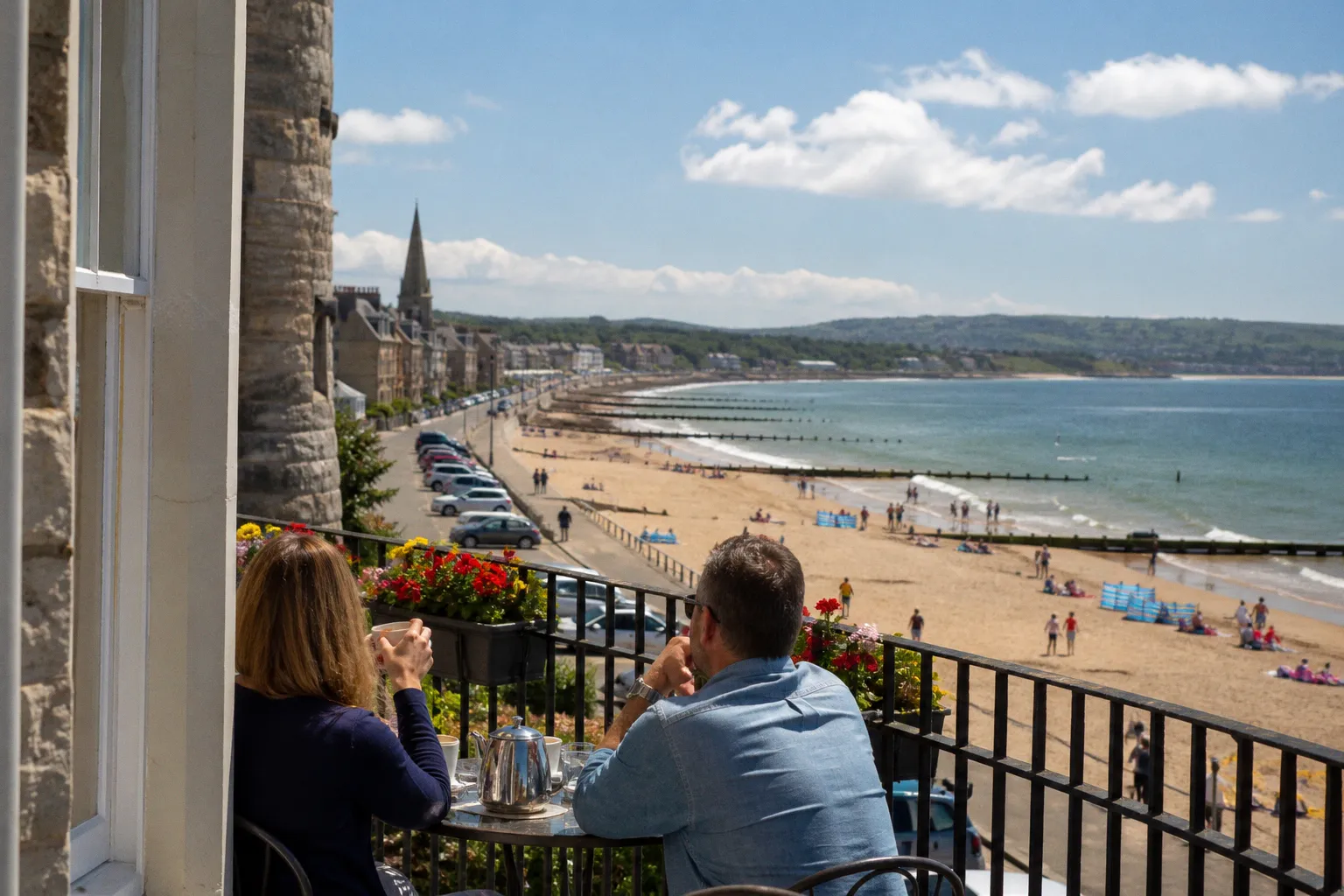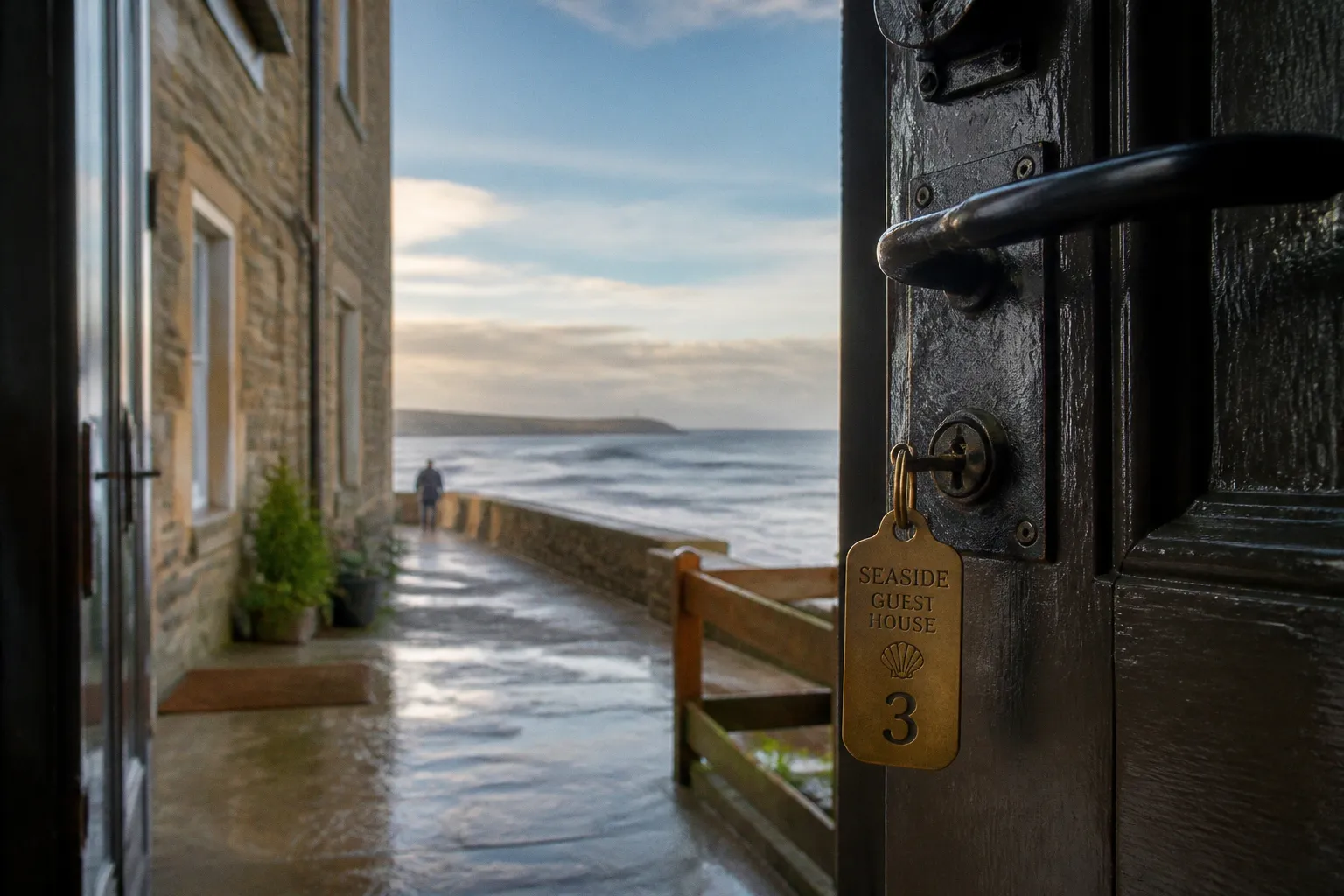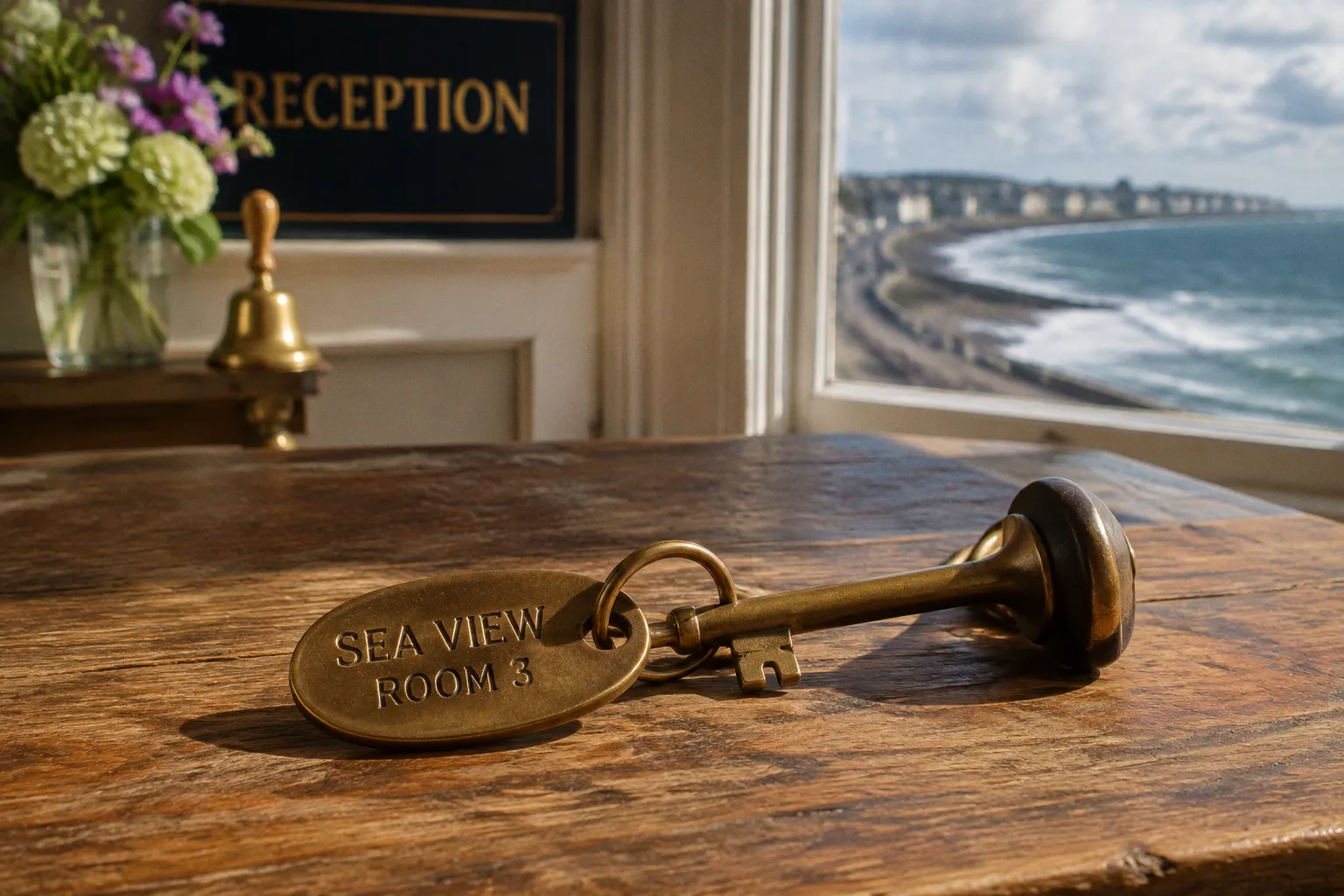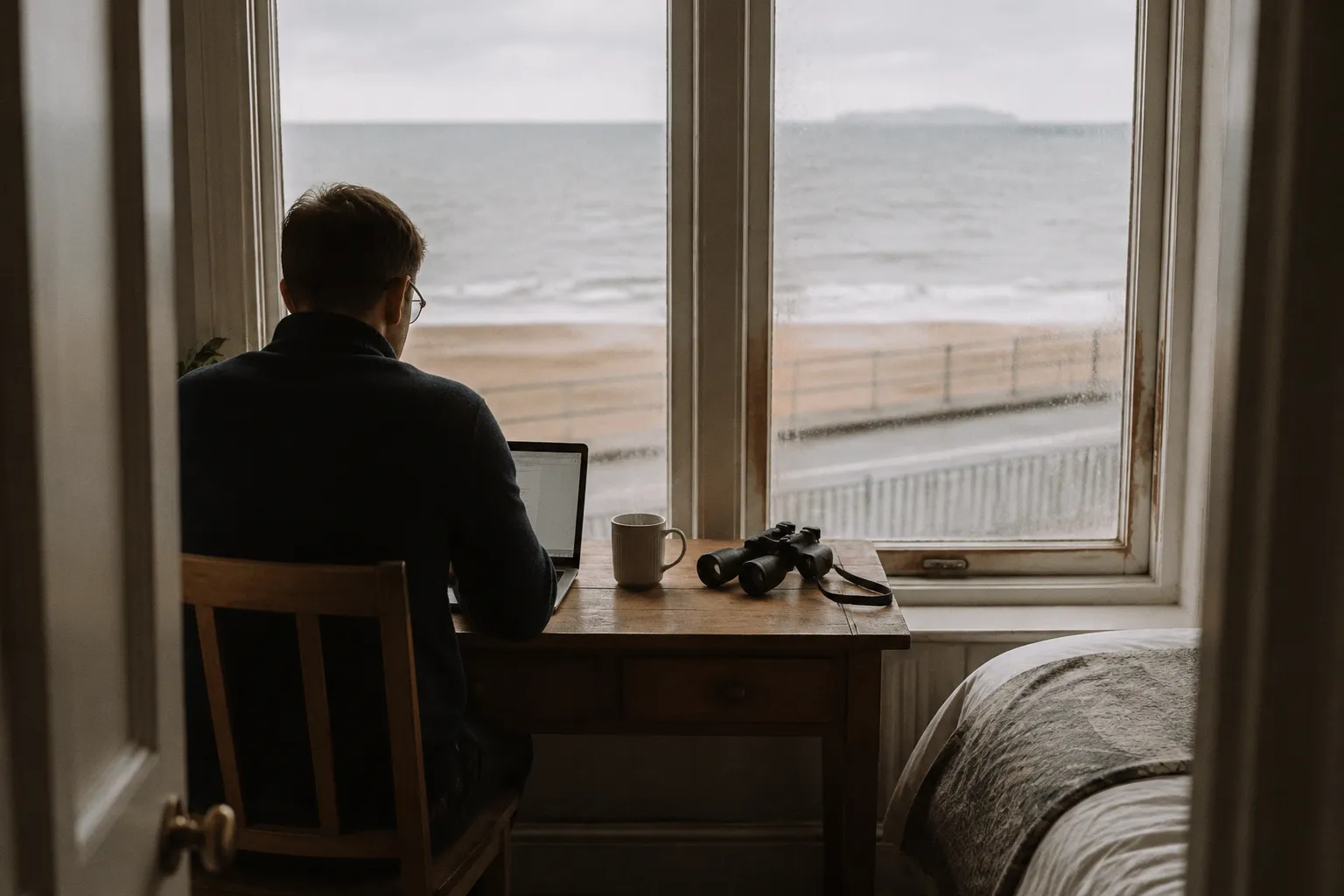
The promenade, the Victorian terraces, the wind off the water and the steady bus connection into town create a different daily geography: work can begin within sight of the tide, while the city centre remains close enough for an afternoon meeting, a museum, or a late train.
That balance is the real appeal of a Portobello seaside B&B in Edinburgh. It is not simply a cheaper base for visiting the Old Town, nor a coastal retreat cut loose from the city. It is a place where the working day is shaped by shoreline distances: ninety metres from a guesthouse to the sand, five minutes from the promenade to a community coworking space, and roughly twenty to twenty-five minutes by bus to central Edinburgh.
For a remote worker, those distances matter more than a polished list of amenities. A desk in a room is useful. So is Wi-Fi. But the difference between a stay that supports concentration and one that merely provides a bed lies in how easily the accommodation connects to the wider place.
The Victorian coastal office
Portobello's built character comes from its position as Edinburgh's historic seaside quarter. Along the streets behind the promenade, Victorian buildings hold the practical proportions of an older resort: bay windows, tall rooms, narrow entrances and façades designed to face both the street and the sea air. The architecture is not a stage set. It remains part of ordinary residential life, which is why a guest house here can feel more settled than a hotel in the centre.
That vernacular has consequences for remote work. Older buildings often divide space differently from purpose-built accommodation. A bedroom may be generous but short on floor area around the desk; a staircase may be narrow; sound may carry through a period property in ways that do not appear on a booking page. The reward is a sense of place that newer blocks rarely provide, but the working arrangement needs to be read carefully rather than assumed.
Straven Guesthouse, at 3 Brunstane Road North, is approximately 90 metres from Portobello Beach. Its rooms include full ensuite facilities, free Wi-Fi, work desks, flat-screen televisions and USB charging ports. Those are unglamorous details, but they define whether a coastal stay can carry a working week. A USB port beside the bed is convenient. A proper desk is more important. The distinction between the two is the distinction between a room that supports work and one that merely permits it.
The phrase "sea view" can also conceal a practical compromise. A room looking towards the Forth may offer changing light, the line of the promenade and the broad northern horizon, but it may also face the prevailing weather. The haar — the sea fog that can move in from the Forth on a cool day — softens the outlook and can make the shoreline feel suddenly distant. That is part of the local climate, not a defect to be dramatised or romanticised. Anyone booking a Portobello beach guest house for work should value a quiet room, dependable heating and a usable desk at least as highly as the view.
A workable room has a few recognisable features:
- A fixed desk or proper work surface, rather than a dressing table crowded with a mirror, kettle and toiletries.
- Power within reach of the chair, with USB charging available as a useful addition rather than a substitute for sockets.
- A door that closes properly, especially in a guesthouse where stairs and shared corridors may be close to the bedroom.
- Free Wi-Fi described clearly, while remembering that advertised availability is not the same as a guaranteed measured speed in every room.
- Enough separation between work and sleep to allow the room to change character at the end of the day.
The last point is easy to miss. A week spent answering messages from the edge of a bed can make the coast feel like an office with weather. A desk facing a wall may be better than a spectacular outlook if it lets the room become a bedroom again at six o'clock.
In Portobello, the practical luxury is not being beside the sea. It is being able to leave the desk without leaving the place.
A commute measured in bus stops, not miles
Portobello is close to the centre in the way Edinburgh understands closeness: not by straight-line distance, but by the movement of buses through streets, bridges and junctions. Services including routes 26, 45, 15 and 49 connect the area with central Edinburgh, with journeys generally taking about 20 to 25 minutes.
That is short enough to make city-centre work possible, but long enough to protect a morning from becoming an automatic rush into the New Town. For a remote worker, the bus can become part of the week's rhythm. A meeting in town does not require abandoning the coastal base; it requires allowing for the fact that the Forth and the city occupy different tempos.
The most useful way to plan the journey is to distinguish between three kinds of day.
The day that stays in Portobello
This is the reason to book an Edinburgh seaside bed and breakfast rather than an anonymous city-centre room. The working day begins at the guesthouse, continues perhaps at a local café or community space, and ends along the promenade. There is no commute to absorb the first and last pieces of attention.
Such a day works best for writing, video calls and tasks that need continuity. The shoreline provides a clear boundary around the day without demanding a grand excursion. Portobello Beach is close enough for a short walk between calls, but the beach remains a working coastline: gulls, dogs where permitted, cyclists, prams, sea wind and changing tide. It is public space, not a private spa.
The day that moves into central Edinburgh
A 20–25-minute bus journey gives a remote worker access to the city's libraries, cultural institutions, cafés and meeting places without requiring a change of accommodation. The advantage is not only convenience. Staying in Portobello means the city can be used selectively. A client meeting or an afternoon appointment becomes a reason to travel, rather than the default condition of the whole trip.
The return matters as much as the outward journey. Coming back east towards the Forth changes the visual field: denser streets give way to wider horizons, then to the familiar grain of Portobello's terraces and wynds. This is a small geographical shift, but over a week it prevents the stay from becoming a sequence of disconnected workdays.
The day that uses the coast beyond Portobello
The area also works as a base for looking towards Musselburgh and East Lothian, where the urban edge loosens into beaches, links and open ground. Arthur's Seat is approximately 4.5 kilometres from Portobello, offering a more substantial inland walk without requiring a full day away from Edinburgh. The point is not to collect destinations. It is to use the location's position between city and coast intelligently.
Portobello's distance from Edinburgh Airport is about 27 kilometres. That is manageable, but it is not the same as being beside the airport or on a direct airport corridor. A traveller with an early flight should plan the final transfer rather than rely on the apparent simplicity of the map.
| Working need | Portobello arrangement | Practical implication |
|---|---|---|
| A quiet day of focused work | Desk and Wi-Fi in a guesthouse room | Best when the room has enough separation from the bed and shared circulation |
| A meeting in central Edinburgh | Bus routes such as 26, 45, 15 or 49 | Allow roughly 20–25 minutes, with additional time at busy periods |
| A change of scene without a city commute | Portobello promenade and beach | Close at hand, but exposed to wind, haar and ordinary public activity |
| Collaborative work outside the room | Tribe Porty | A community coworking option near the promenade rather than a generic business centre |
| Early airport departure | Portobello as a coastal base, around 27 km from the airport | Arrange the final journey in advance |
Tribe Porty and the difference between a desk and a workplace
The presence of Tribe Porty changes the calculation for anyone considering longer Firth of Forth coastal accommodation. It operates from 19 Windsor Place, around a five-minute walk from the Portobello Promenade. That makes it close enough to form part of an ordinary working day, not an occasional emergency alternative when the guesthouse room becomes tiring.
A private room with Wi-Fi offers control. A coworking space offers separation, social contact and a reason to get dressed before the first call. Neither is universally better. The useful choice is to move between them according to the shape of the work.
A week might divide itself naturally:
1. Use the guesthouse room for concentrated mornings. Early work often benefits from the absence of conversation and the ability to control the immediate environment.
2. Move to Tribe Porty when the work requires external momentum. A community coworking space can provide a clearer professional setting than a bedroom, particularly for a full day of calls.
3. Keep the promenade for the transition between modes. The five-minute walk matters because it is long enough to mark a change, but short enough not to become a second commute.
4. Reserve the city for meetings and cultural obligations. Central Edinburgh is close, but it does not need to consume every evening.
5. Let one day remain deliberately local. A coastal stay loses its character if every hour is organised around returning to the centre.
This is where the community dimension becomes important. Portobello is not a resort built solely around visitors. People work there, raise families there, shop there and use the promenade without treating it as an attraction. A visitor who works from a local coworking space is participating in that everyday geography, but participation should not become appropriation. Spend locally, follow the space's own rules, and remember that a neighbourhood facility exists first for its community.
The best Portobello guest house reviews tend to focus on softness of towels, breakfast and room size because those things are easy to describe. For a remote worker, the more revealing questions are less decorative:
- Can the room support a video call without the bed appearing behind the chair?
- Is the desk wide enough for a laptop and notebook?
- Is the accommodation adults-only, and if so, does that suit the trip?
- Is there a sensible alternative when the room is too warm, too noisy or simply too familiar?
- Can the host explain the local bus options without treating the area as an afterthought?
Those details tell you more about the quality of a working stay than a broad phrase such as "ideal for business travellers".
The quiet boundaries of a seaside guesthouse
Independent accommodation has a social texture that larger hotels often flatten. The host may know the building's quirks, the best time for the bus, the direction in which the haar usually arrives and which parts of the promenade feel busiest at the weekend. But the same intimacy means that house policies have more weight.
Straven Guesthouse is adults-only and does not accommodate pets or children under 12. That should not be read as a universal rule for Portobello accommodation. It is a specific policy, and it illustrates why a guesthouse's character cannot be separated from its boundaries. A quiet room shaped for adult travellers may suit a solo worker or couple precisely because the property has chosen a narrower form of hospitality.
Other houses may make different decisions about children, animals, arrival times or shared spaces. There is no single standard across the area. A historic B&B is not a miniature hotel with fewer rooms; its operating model is usually more personal, more constrained and more connected to the building in which it sits.
Parking is another point where assumptions can turn into friction. Dedicated on-site parking garages are not standard for Portobello seaside guest houses. Visitors may need to rely on local unrestricted street parking, subject to the conditions in force where they leave the vehicle. For a remote worker arriving with equipment, this is not a minor detail. Carrying a monitor or luggage from a distant space changes the ease of the first evening, particularly when the tide is high, rain is moving along the promenade, or the street outside is busy.
A useful booking conversation is direct and unromantic:
- Ask whether the room's desk is a permanent work surface or a small occasional table.
- Ask which floor the room occupies and whether there is lift access if mobility or heavy equipment is a concern.
- Confirm the age policy and pet policy rather than inferring them from photographs.
- Ask about parking in terms of likely street availability, not the vague promise of parking nearby.
- Confirm the distance to the beach in walking terms, then check whether the room itself faces the shore.
- If staying for a week, ask about the practical arrangement for cleaning, towels and working undisturbed.
These questions do not strip the stay of atmosphere. They protect it. The point of a coastal base is to make daily life easier, not to create a series of small surprises that the sea view is expected to excuse.
The tourist levy and the cost of a working week
Edinburgh City Council introduced a 5% tourist levy on room stays from 26 July 2026, and the charge now forms part of the accommodation cost for any stay that falls within its scope. Anyone planning a Portobello booking should read the final price carefully and confirm whether the levy is already included in the rate shown or added during the booking process.
The levy applies within the wider Edinburgh accommodation market, so a seaside guesthouse is not outside the city's visitor economy simply because it sits beyond the centre. That is an important distinction in how Portobello works. Its attraction is local and coastal, but its transport links, council services and accommodation rules remain part of Edinburgh.
For a remote worker booking several nights, a percentage-based charge is more noticeable than it may be on a single overnight stop. It belongs in the overall calculation alongside transport, coworking access, meals and the possibility of extending the stay. The honest comparison is not between a room rate in Portobello and a room rate in the Old Town. It is between the full cost of the working week in each place, including the value of having the beach close by and the time saved by not crossing the city at the start and end of every day.
The levy also raises a broader question about visitor accommodation in residential coastal districts. Portobello depends on visitors, but it is not only a visitor landscape. The quality of a stay is tied to the continued life of the neighbourhood: functioning shops, accessible public transport, a promenade used by residents, and a community that is not reduced to scenery. Spending with local businesses and using shared facilities with consideration are modest actions, but they help keep the relationship reciprocal.
A week arranged around the tide
The tide in the Firth of Forth is not an itinerary. It is a background condition, more noticeable on some days than others. A neap tide can leave the shoreline with a quieter visual presence, while a stronger tidal range changes the amount of sand, the edge of the water and the feel of the promenade. Wind direction, cloud and haar may alter the coast more dramatically than any timetable.
For the remote worker, that variability is useful because it makes the day legible without filling it. A walk before work can be brief. Lunch can be taken outside if the weather allows. An evening along the beach can remain local and unforced. There is no need to convert every break into a programme. The sea does not require an audience; it asks only for a window in the day when attention shifts away from the screen.
The same logic applies to the working week as a whole. A coastal B&B is not a backdrop for productivity theatre. The point is not to prove that a working week can survive beside the beach, but to let the ordinary shape of the work settle into the rhythm of the place. The desk is real, the meetings are real, the deadlines are real. What changes is the walk between them, the light in the room at four in the afternoon, and the fact that the working day ends, more often than not, with the sound of the Forth rather than the noise of a city centre.
That is what separates a Portobello seaside B&B in Edinburgh from a hotel near a railway station. The coast is not an excursion. It is the working week, in a quieter key.