Yet the same salt air that gives a seaside stay its atmosphere can quietly make that promise more expensive to maintain.
For independent operators, the coastal guest house linen management challenges are rarely dramatic enough to announce themselves in a single invoice. They appear as greyed fabric, persistent stains, roughened fibres, missing pillowcases, emergency laundry runs and a stock cupboard that seems permanently short of something. Over time, linen becomes one of the least visible but most consequential operating costs in the property.
The design question is therefore inseparable from the commercial one. High-quality bed linen for coastal properties only creates value when it remains attractive, comfortable and operationally viable through repeated washing, seasonal demand and the particular abrasions of a maritime environment.
The hidden chemistry of salt air and textile degradation
The issue is not that salt air magically destroys cotton. That is too simple, and too easily repeated. Textile degradation is the cumulative result of salt deposits, humidity, laundering frequency, stain chemistry, drying conditions and fabric construction.
In coastal environments, salt can travel indoors through open windows, clothing, luggage and footwear. Research on coastal ambient conditions indicates that direct salt deposition can affect surfaces within roughly 300 to 400 metres of the beach. In humid air, those deposits remain damp and reactive for longer. On hard surfaces, the result may be visible as a film or dulling. On linen, the effect is subtler: fibres are exposed to more abrasive particulate matter and may require more aggressive treatment to achieve the appearance guests expect.
That distinction matters. The textile is not simply being exposed to the sea; it is being pushed through a more demanding maintenance cycle.
A guest arriving from the beach may place a damp towel on a bed or sit on a duvet in swimwear. Sand and salt can enter the weave. Body oils combine with sunscreen. Moisture sits in a closed room after departure. If the laundry process then relies on excessive heat, strong chemistry or insufficient rinsing, the fabric is taking damage at several stages rather than one.
Why stains become a budget issue
According to industry data published by Ecolab, stain removal is identified by 70% of laundry professionals in lodging as their single biggest challenge. The figure is not coastal-specific, but the operational implication is highly relevant to seaside accommodation: the more often a property has to rescue linen, the more its replacement cycle becomes unpredictable.
Stain treatment is rarely free, even when it is performed in-house. It consumes labour, water, chemicals and machine capacity. It may also require a sheet to be removed from circulation while the room attendant or laundry provider decides whether it can be recovered. A sheet that would ordinarily serve through many more washes becomes a marginal item, occupying space and attention without producing room revenue.
There is also a visual problem. A textile can remain technically clean while no longer looking pristine. Heritage interiors, painted timber, stone, brass and muted coastal tones tend to expose this decline rather than conceal it. A faint yellow cast or worn edge can disrupt the whole room more quickly than a slightly dated bedside table.
Coastal linen management is not about making fabric survive indefinitely. It is about controlling the point at which quality, comfort and replacement cost stop aligning.
Quantifying the financial impact of coastal linen turnover
Linen replacement is often treated as a laundry line item, but it behaves more like an asset-management problem. The property buys a finite inventory, circulates it through rooms and laundry, loses some of it, degrades some of it and attempts to maintain a consistent guest-facing standard throughout.
Industry figures suggest that linen replacement accounts for approximately 25% of a property’s total annual laundry expenses. That proportion becomes more uncomfortable when the property is small. A large hotel may absorb irregularity across hundreds of rooms; an independent guest house has fewer pieces in circulation and less room for operational error. Losing one fitted sheet can create a disproportionate shortage if the remaining stock has not been planned around room configuration.
Standard bedsheets and duvet covers commonly endure around 100 to 150 wash cycles. At approximately 70% occupancy, that may correspond to an operational lifespan of 18 to 24 months. At 90% occupancy, the same fabric may reach the end of its useful life in roughly 10 to 14 months, depending on the washing process, textile composition and handling.
Those ranges are not a promise. They are a planning framework. A property with a busy summer season, frequent same-day turnovers and a high proportion of wet-weather arrivals may move through its stock faster than its annual occupancy percentage suggests.
The real cost of premature replacement
The invoice for a new sheet is only the first layer. Premature replacement may also involve:
- Additional delivery charges or rush orders during high season.
- Mismatched shades or dimensions when stock is purchased reactively.
- Staff time spent sorting, labelling and redistributing new pieces.
- Reduced room availability when a bed cannot be turned around to standard.
- A gradual lowering of specification because the operator is buying for speed rather than performance.
The price-to-value ratio of linen is therefore more nuanced than the cheapest unit cost. A low-cost sheet that pills, twists or loses opacity quickly may be less economical than a more durable fabric with a higher initial price. Conversely, the most luxurious textile is not automatically the best commercial choice if it requires a delicate process that your laundry provider cannot reliably deliver.
The correct question is not whether a sheet feels expensive at purchase. It is whether the fabric retains its hand, drape, opacity and dimensional stability for long enough to justify its place in the operating system.
Linen specification should follow the room, not fashion
A coastal guest house may be tempted by a very dense, hotel-style white cotton because it photographs well and signals cleanliness. But weight, drying time and laundering capacity matter. Heavy fabric can produce a beautiful, substantial bed while placing more pressure on drying and storage, particularly in humid weather or in properties without a dedicated commercial laundry.
A considered specification usually balances:
- Fibre composition and resistance to repeated laundering.
- Breathability and hand feel against the skin.
- Dimensional stability after hot washing and drying.
- Opacity under strong daylight.
- Drying time and compatibility with the available laundry equipment.
- Availability of replacement pieces in consistent sizes and shades.
White remains commercially powerful because it can be washed and replaced within a coherent visual system. But white also exposes every mark. In a coastal property, the choice is less about colour preference than whether the entire operation can sustain the chosen standard.
Optimising inventory: the 5 PAR standard for seaside operations
PAR means Per Available Room. A 5 PAR system gives each room an allocation equivalent to five complete sets of linen: one on the bed, one in laundry, one ready to issue, one in reserve and one absorbing delays, damage, peak demand or stock rotation.
Laundry providers commonly use 5 PAR as a standard inventory level, particularly where seasonal demand can create sudden pressure. For a seaside guest house, the logic is persuasive. The property needs enough stock to withstand late departures, wet weather, laundry delays, stained items and a summer increase in turnover without compromising the room presentation.
The system is not a decorative accounting term. It is a buffer against operational fragility.
How 5 PAR works in practice
A room with one king bed, two standard pillows and two decorative or continental pillows does not have the same linen requirement as a twin room. The inventory should be calculated by bed type and by the actual configuration sold to guests, not merely by the number of bedrooms.
A simple planning table might look like this:
| Inventory element | Lean operating model | 5 PAR coastal model |
|---|---|---|
| Bed linen sets per available bed | 3–4 | 5 |
| Capacity for laundry delay | Limited | Built into stock |
| Resilience during summer turnover | Low | Stronger |
| Risk of mixed or substitute pieces | Higher | Lower |
| Capital tied up in linen | Lower | Higher |
| Exposure to emergency purchasing | Higher | Lower |
The trade-off is clear. More stock ties up cash, occupies storage space and creates another category to track. Too little stock creates a false economy: the property saves on inventory while paying through rushed laundering, inconsistent presentation and early replacement.
For independent operators, a 5 PAR model may not need to be applied identically to every item. Core bed linen should receive the strongest protection. Decorative throws, spare blankets and less frequently used pieces can be managed differently if their usage pattern justifies it. The point is to build the buffer around the items that determine whether a room is sellable.
Seasonal demand requires a different rhythm
Summer occupancy can expose weaknesses that remain invisible through the rest of the year. A guest house may appear adequately stocked at moderate occupancy, then find that two consecutive high-turnover days leave no complete set for a particular bed size.
Linen turnover strategies for seaside hosts should account for:
1. The actual room mix. King, double and twin configurations must be counted separately. A surplus of double sheets cannot solve a shortage of king fitted sheets.
2. The local laundry timetable. Collection and return schedules need to be tested against peak check-out and check-in periods, not the quiet season.
3. The weather profile. Damp conditions may extend drying time and make outdoor drying unreliable precisely when occupancy is highest.
4. The failure rate. A small, documented allowance for staining, damage and late return is more credible than assuming every piece will always be available.
5. The replacement calendar. Linen should be retired by condition and performance, not only when a whole collection looks visibly tired.
A stockroom that is full is not necessarily well managed. The relevant measure is whether the right pieces are clean, usable, traceable and available at the moment a room needs to be released.
Storage and laundry protocols for coastal hosts
Managing humidity in guest house linen storage is a design problem as much as a housekeeping task. Linen should not be stored against cold external walls, beneath plumbing or in a cupboard where air is stagnant. A beautifully fitted cabinet becomes counterproductive if it traps moisture around folded fabric.
Storage should support circulation. Shelves need enough clearance for air movement and for staff to remove one stack without disturbing the rest. Linen should be fully dry before folding and should not be compressed into overfilled cupboards. If stock is stored in airtight plastic for long periods, residual moisture has nowhere to go; breathable protection is generally more sensible for active operational inventory.
The room itself should be assessed honestly. A sea-facing guest house with frequent window opening may experience a different moisture load from an inland laundry cupboard, even within the same building. The answer is not to seal every room from the environment. It is to understand where moisture accumulates and prevent the linen store becoming its final destination.
Laundry chemistry and handling
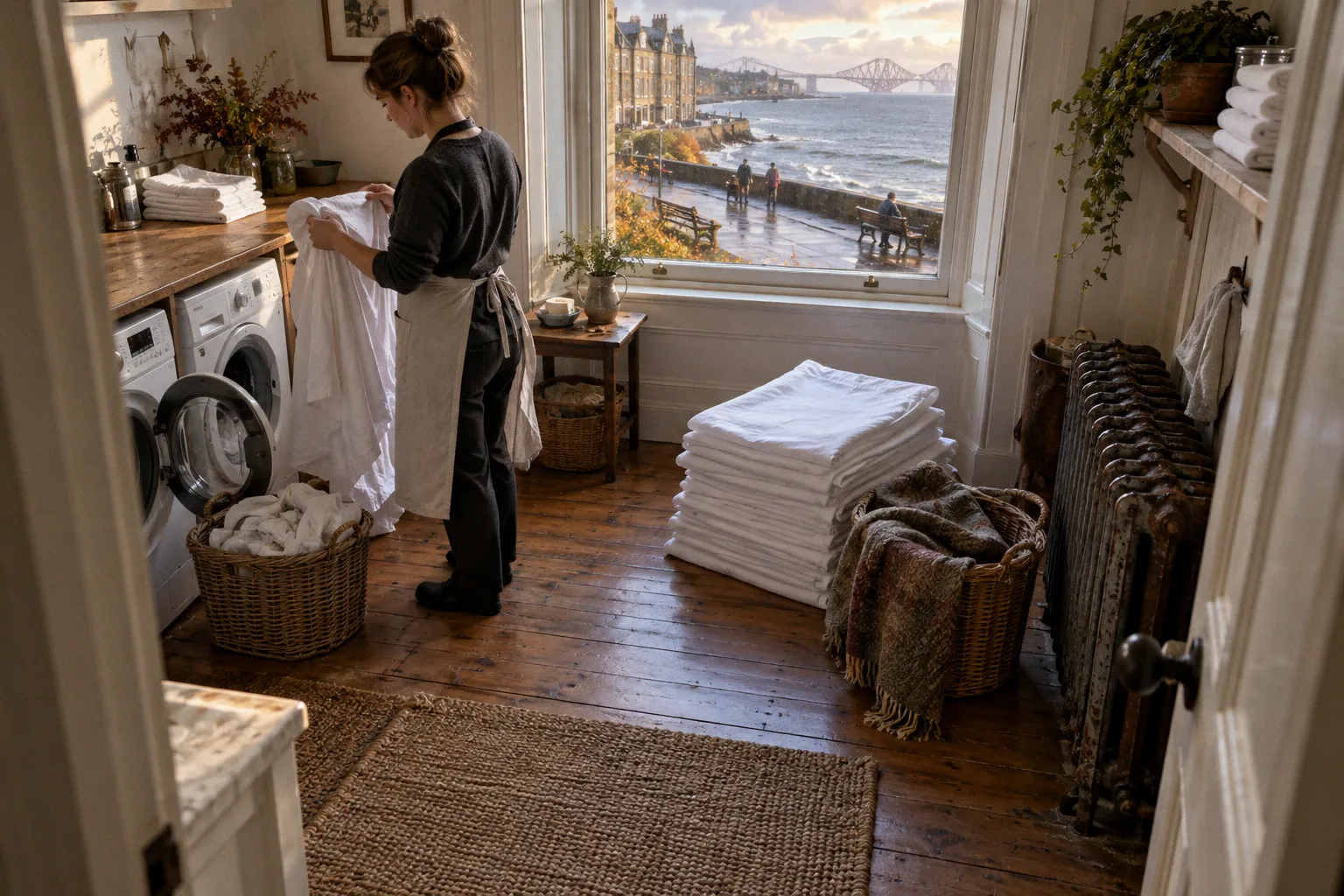
A strong coastal linen protocol begins before the wash cycle. Housekeeping staff should remove sand, hair and visible debris rather than allowing the washing machine to perform all the work. Sand is abrasive; repeated accumulation through the machine can affect both textiles and equipment.
The washing process should be specified with the laundry provider rather than assumed. Questions worth resolving include:
- Which temperatures are used for different textile compositions?
- How are sunscreen, body oils and salt residues pre-treated?
- How is detergent concentration controlled?
- Is the rinse process sufficient for the water quality and chemical load?
- What drying temperatures are used?
- How are damaged or visually downgraded pieces removed from guest-facing circulation?
Professional laundry services for Edinburgh B&Bs can be valuable when they provide consistency, traceability and textile advice rather than simply collecting bags and returning folded stock. The cheapest contract is not necessarily the most economical if it produces uneven finishing, unexplained shrinkage or a high rate of rejected linen.
A useful service relationship should make the process visible. The operator should know how pieces are counted, how losses are recorded and what happens when a stain cannot be removed. Without that information, the property cannot distinguish between ordinary wear, poor handling and preventable loss.
For broader guidance on reducing water and energy demand across accommodation operations, operators may also find this resource on sustainable hotel laundry practices useful as a starting point.
Mitigating the 20–30% annual inventory loss
Unmanaged linen loss from theft, misplacement and accelerated wear is reported at approximately 20% to 30% of annual inventory in hospitality operations. The figure should not be transferred mechanically to every Scottish guest house, but it illustrates the scale of an often unmeasured problem.
Loss does not always mean theft. A pillowcase may remain in a room after a long stay, be placed in a maintenance cupboard or be sent to an external laundry under the wrong room account. A duvet cover may be downgraded because of a stain but never removed from the inventory record. Over time, the stock count becomes aspirational rather than real.
A practical tracking system
The solution does not need to be technologically elaborate. A well-designed linen register can record:
- Item type and size.
- Quantity purchased and date received.
- Room or department allocation.
- Laundry movements.
- Pieces retired, damaged or sent for repair.
- Replacement dates and supplier details.
- Seasonal discrepancies between expected and actual stock.
For small properties, colour-coded labels or discreet embroidered identifiers can be sufficient. The aim is not to make the linen feel institutional. It is to create accountability without damaging the visual standard.
Rotation matters as much as counting. If new sheets are always issued first because they look best, older pieces may remain hidden until they are needed in a crisis. That produces uneven wear and makes the stock difficult to assess. A controlled first-in, first-out rotation gives the operator a clearer view of the true condition of the collection.
The same principle applies to room allocation. If one room consistently receives the most durable linen while another receives pieces nearing retirement, replacement patterns become impossible to interpret. Linen should move through the property in a deliberate cycle, with exceptions recorded rather than left to habit.
The guest experience remains the final measure
Operational discipline should not make a coastal guest house feel managed to death. The best linen system is almost invisible to the guest because it protects the sensory experience without flattening it into uniformity.
The sheet should feel dry and clean, not over-processed. The bed should hold its shape. Towels should not carry the faint stiffness of excessive heat. Storage should preserve the textile rather than imprinting it with cupboard odour. These are small signals, but hospitality is built from small signals.
Design-led rooms often ask linen to do several jobs at once: soften hard architectural lines, reinforce a heritage palette, frame the bed as a focal point and communicate the property’s level of care. That visual language only works when comfort is treated as part of the design brief. A beautifully layered bed that overheats guests, creases aggressively or relies on fragile fabrics is not a premium experience. It is an expensive styling exercise.
The strongest approach is therefore neither maximal luxury nor bare operational efficiency. It is curation with consequences in mind: selecting textiles that suit the room, the climate, the laundry system and the price paid for the stay.
A coastal guest house cannot remove salt from the air. It can remove the uncertainty from the way linen is specified, stored, washed, counted and retired. That is where the hidden cost becomes manageable—and where crispness stops being a visual promise and becomes a repeatable standard.