You glance at the page count, set it aside, and tell yourself you'll get to it after the weekend rush. Then the Scottish Fire and Rescue Service gives notice that an officer will be paying a visit, and the same document suddenly becomes the most important paper in your office. Not every audit comes with a courtesy warning — some inspections are unannounced, particularly where a concern has been flagged — but in either case the time you assumed you had can shrink fast.
I have walked through dozens of small guest houses across Edinburgh and the East Lothian coast as an accommodation assessor, and I can tell you the difference between operators who treat fire safety as an annual chore and those who treat it as the structural backbone of their business is visible in everything from the tidiness of their electrical cupboard to the calm of their morning breakfast service. The audit is not a trap, and it is not theatre. It is a structured conversation between a dutyholder and an enforcement officer, conducted under Part 3 of the Fire (Scotland) Act 2005 and the Fire Safety (Scotland) Regulations 2006, with the Scottish guest house fire risk assessment at the centre of every exchange. If you understand how the conversation works, you can walk into it with confidence rather than dread.
The Dutyholder's Legal Burden: Understanding Part 3 of the Fire (Scotland) Act
The owner or operator of a guest house sits in a position the legislation calls the "dutyholder," and this is not a courtesy title. Under Part 3 of the Fire (Scotland) Act 2005 and the Fire Safety (Scotland) Regulations 2006, the dutyholder carries personal responsibility for ensuring that an adequate fire risk assessment is completed, that it is reviewed when anything material changes, and that the actions flowing from it are actually carried out. The Scottish Fire and Rescue Service will not write that assessment for you. Statutory responsibility rests entirely with the dutyholder, and that line is drawn clearly in every piece of guidance the SFRS publishes.
What surprises many small operators, particularly those who have run a bed and breakfast for years without incident, is how broad "adequate" turns out to be. It is not enough to install a smoke alarm in the hall and call it done. The assessment must consider who is in the building, what they are doing there, where the ignition sources are, and how everyone inside — including a guest who has never visited Edinburgh before and cannot navigate your back staircase in the dark — would get out. The dutyholder has to think like a worst-case scenario planner, then write down the conclusion, then act on it.
A fire risk assessment is not a document you file away. It is the visible habit of thinking through what could go wrong, every season, in every room.
In practical terms this means the dutyholder has to identify a competent person within the business, or commission one from outside, to evaluate the premises. For small premises covered by Annex 2 of the Scottish Government's Practical Fire Safety Guidance, that competent person can often be the operator themselves, but only if they have the time and the willingness to learn the framework. For larger or more complex operations, the competent person is usually a third-party assessor with recognised credentials, and the cost of that engagement is a legitimate business expense that you should plan for as deliberately as you plan for replacement linen.
What happens when the dutyholder fails in that responsibility is worth understanding before it becomes personal. Enforcement action under the 2005 Act can range from an alterations notice, which requires the dutyholder to notify the SFRS before making changes to the premises, through to an enforcement notice that compels specific improvements within a set timeframe. In the most serious cases, the SFRS can issue a prohibition notice that restricts or halts the use of the building entirely. These are not theoretical instruments — they are used, and they land on the dutyholder's desk with real operational consequences. Understanding the weight of that responsibility early is far less expensive than learning about it through formal correspondence from an enforcement officer.
Anatomy of an SFRS Audit: What Officers Inspect on Site
The audit itself runs on a rhythm that you can prepare for once you have seen it in motion. An SFRS officer arrives, identifies themselves, and explains the purpose of the visit under the powers granted by the 2005 Act. The visit is not necessarily announced in advance; courtesy notifications are common for first-time visits and follow-up inspections, but some visits are unannounced, particularly where a complaint or a referral has triggered concern. Either way, the structure of the inspection follows a recognisable pattern.
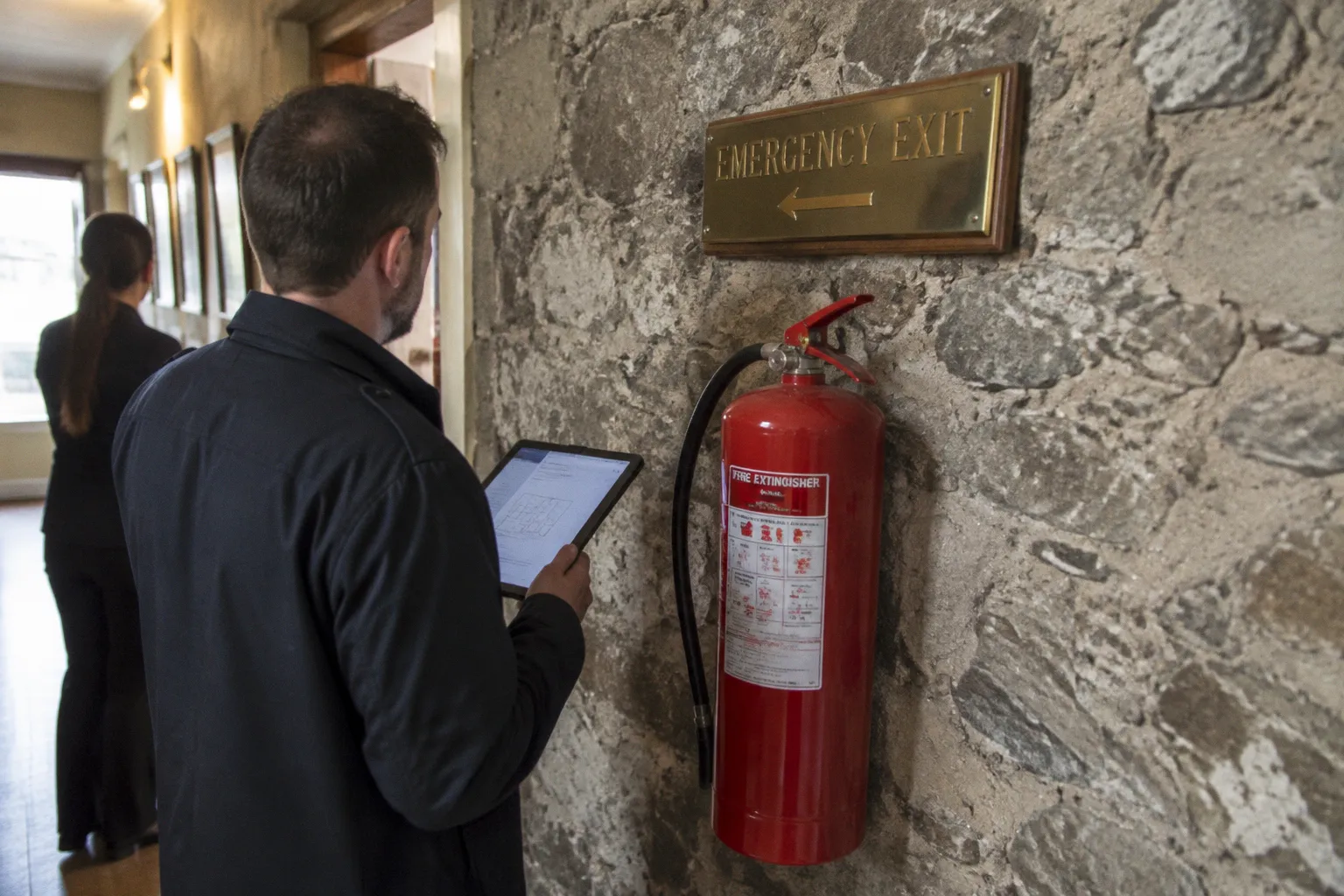
The officer walks the building with the dutyholder or a nominated representative. They look at the fabric of the premises first: the condition of fire doors, the integrity of escape routes, the placement and visibility of signage, the state of stairwells, and the storage arrangements in cupboards, cellars, and roof voids that are easy to forget about once the season is underway. They will open the electrical cupboard. They will check the kitchen. They will look at where you store your cleaning chemicals and your spare gas cylinders. Every one of these spaces is a potential ignition source or a route by which smoke and flame could spread, and the officer is trained to find the gap between what your fire risk assessment says and what your building actually looks like on a Tuesday morning in March.
Fire doors deserve particular attention here because they are the single element most commonly found wanting in small guest houses. The officer will check that self-closing devices function correctly, that intumescent strips and cold smoke seals are intact, that the door leaf and frame have not been modified or damaged in ways that compromise their fire resistance, and that nothing has been done to undermine their performance — a draught excluder stapled to the bottom of a fire-rated door, for instance, or a latch that no longer engages properly. The practical standard for guest house fire door standards is straightforward: doors on escape routes and between sleeping areas and the rest of the building must perform as designed, and the dutyholder needs to demonstrate that they are inspected routinely, not simply assumed to be fine.
The second half of the audit moves indoors to documentation. The officer will sit down with the dutyholder and walk through the written fire risk assessment, the emergency action plan, the false alarm log, the staff training records, and the maintenance history. They will want to see evidence of testing by a competent person for the fire detection and alarm system, the emergency lighting, portable appliance testing, electrical wiring, and firefighting equipment such as extinguishers and fire blankets. The bar here is not perfection. The bar is consistency: that you test, that you record, and that someone with authority looks at the records often enough to act on what they show.
At the end of the visit, the officer will typically outline their findings. Where the premises are broadly compliant, the conversation may be brief and informal. Where gaps have been identified, the officer will set out what needs to be done, by whom, and by when. The tone is professional, but the expectations are concrete — and the dutyholder who listens carefully to that close-out conversation leaves with a clear action list rather than a vague sense of unease.
Documentation Essentials: Proving Compliance Beyond the Physical Walkthrough
A clean physical inspection with a thin file of paperwork is, in the experience of most operators I have worked alongside, a more uncomfortable place to be than a slightly scuffed building with thorough documentation. The reason is straightforward: the legislation is concerned with what you can demonstrate, not what you remember. If your smoke alarms were tested last Tuesday but you cannot produce the log, the officer has to take the position that the test did not happen.
For a small B&B the documentation package typically includes:
- A written and dated fire risk assessment, reviewed within the last twelve months or whenever a material change occurred.
- An emergency action plan that explains what staff and guests should do if the alarm sounds, including evacuation routes and assembly points.
- Records of routine testing for fire alarms and emergency lighting, usually logged weekly or monthly depending on the system.
- Portable Appliance Testing (PAT) certificates for any electrical equipment used in the guest areas.
- An Electrical Installation Condition Report (EICR), which has a maximum inspection cycle of five years.
- Fire extinguisher and fire blanket servicing records from a competent person.
- Staff training records, including induction training for new team members and refresher sessions for existing staff.
- A log of any false alarms, with notes on cause and corrective action.
The form of these records matters less than their existence. A simple spreadsheet kept on the office computer, signed and dated by the dutyholder, will do the job. A handwritten log in a folder beside the boiler thermostat will do the job. A glossy binder assembled the night before the audit will not, because the officer will ask when each entry was made, and a binder assembled under pressure tends to fail that question.
Documentation is the receipt for everything you have already done correctly.
The most frequent documentation failure I encounter is not the absence of records but the gap between what the records claim and what the building reveals. A fire risk assessment written four years ago and never revisited, while the building has since gained a conservatory and lost a fire door to a renovation, is worse than no assessment at all — because it creates the illusion of compliance where none exists. The dutyholder who owns a genuinely current file, even if it identifies outstanding actions, is in a stronger position than the dutyholder whose paperwork is pristine on paper and out of date in practice.
Navigating Simplified Guidance for Small Resident-Operator Guest Houses
Not every guest house has to follow the same route through the regulations, and the Scottish Government has laid out a simplified framework specifically for the smallest operations. Annex 2 of the Practical Fire Safety Guidance for small accommodation fire safety in Scotland applies to premises that meet a defined profile: a resident-operator's own home hosting no more than eight guests, with no guest accommodation below ground level or above the first floor, and an internal storey floor area not exceeding 200 square metres. If your property sits comfortably within those parameters, the guidance is more proportionate and the language is less daunting than the full suite of fire safety documents.
The trade-off is that simplified guidance does not mean relaxed standards. It means the expectations are calibrated to the scale of the risk. A guest house in a converted townhouse in Edinburgh's New Town, with eight or fewer guests and a straightforward escape route down a single internal staircase, is in a different risk category from a sixteen-bedroom coastal retreat with a timber staircase and an adjoining cellar. The audit officer will apply the relevant level of scrutiny, and the dutyholder should know which category their property falls into before the visit begins.
For operators considering expansion, this is also where the conversation gets uncomfortable. Adding a fourth letting room, finishing the loft, or opening up the lower-ground floor for guest use can push the property out of Annex 2 territory overnight. When that happens the dutyholder has to commission a more detailed assessment from a competent person, often at meaningful cost, and the timeline for that work is governed by the licensing and planning process rather than by the operator's preference. The practical move is to revisit the Annex 2 thresholds before you commit to structural changes, because what looks like an incremental expansion in the trade press can be a regulatory category shift in practice.
Operators who find themselves outside Annex 2 should not panic, but they should understand that the shift is not merely bureaucratic. A more detailed fire risk assessment will examine compartmentation, travel distances, the fire resistance of structural elements, and the adequacy of fire detection coverage in a way that the simplified guidance does not require. These are technical considerations that benefit from professional input, and the cost of a third-party assessment — typically a modest outlay for a small guest house — is far smaller than the cost of retrofitting fire safety measures that a more thorough assessment might identify as necessary after the fact.
The Intersection of Short-Term Let Licensing and Fire Safety Enforcement
Since the introduction of mandatory short-term let licensing in Scotland, fire safety has become entangled with planning, licensing, and local authority oversight in ways that did not exist before. Local authorities now issue licences for short-term lets, and the Scottish Fire and Rescue Service acts as a statutory consultee in that process. What this means in plain terms is that when a host applies for a licence, the SFRS reviews the fire safety checklist they have submitted, and where risks or concerns are identified, the SFRS may conduct a targeted audit as part of the application.
The determination window for a short-term let licence can run up to nine months, which is a long time to operate in regulatory limbo. Operators who treat the fire safety documentation as a last-minute assembly exercise tend to find that window stretching further, because the SFRS is more likely to request additional information or to schedule an inspection if the checklist arrives sparse. Operators who keep their fire risk assessment current and accessible tend to find the licence determination moves faster, because the consultee review can be completed on the paperwork alone.
This is also where the relationship between the dutyholder and the SFRS shifts from occasional to ongoing. The licensing record creates a paper trail that the SFRS can return to in future years, and the fire safety audit at the point of application sets a baseline against which later visits are measured. A clean first licence application is, in effect, an investment in every audit that follows.
The practical reality for Edinburgh B&B safety compliance is that the short-term let licensing regime has created a second, parallel accountability channel. A guest house that has operated for years with an informal relationship with the SFRS now faces a formalised review process that connects fire safety directly to the right to operate commercially. The licence conditions themselves may include specific fire safety requirements — the provision of fire blankets in kitchens, the installation of interlinked smoke detectors, the display of emergency information in guest rooms — and failure to meet those conditions can trigger enforcement action from the licensing authority as well as from the SFRS.
How to Walk Into an Audit Without Panic
The operators who handle audits well share a few habits, and none of them involve heroic last-minute effort. They keep their fire risk assessment under annual review. They log every test, every alarm, every training session, and every maintenance visit in the same place, with dates and signatures. They walk their own building once a season with the eyes of an auditor, looking for the wedged-open fire door and the suitcase stored under the stair. They keep their escape routes genuinely clear, rather than clear in principle. And they treat the SFRS officer as a colleague with a difficult job rather than as an adversary, because the officer's job is the same as the dutyholder's: a guest house where everyone goes home safe at the end of the stay.
The audit is not the test. The audit is the receipt for the work you have already done. If you have built the habit of doing that work properly, the day an SFRS officer walks through your door is the day you find out how well your business is really constructed, and the answer, more often than not, is reassuringly close to what you hoped it would be.