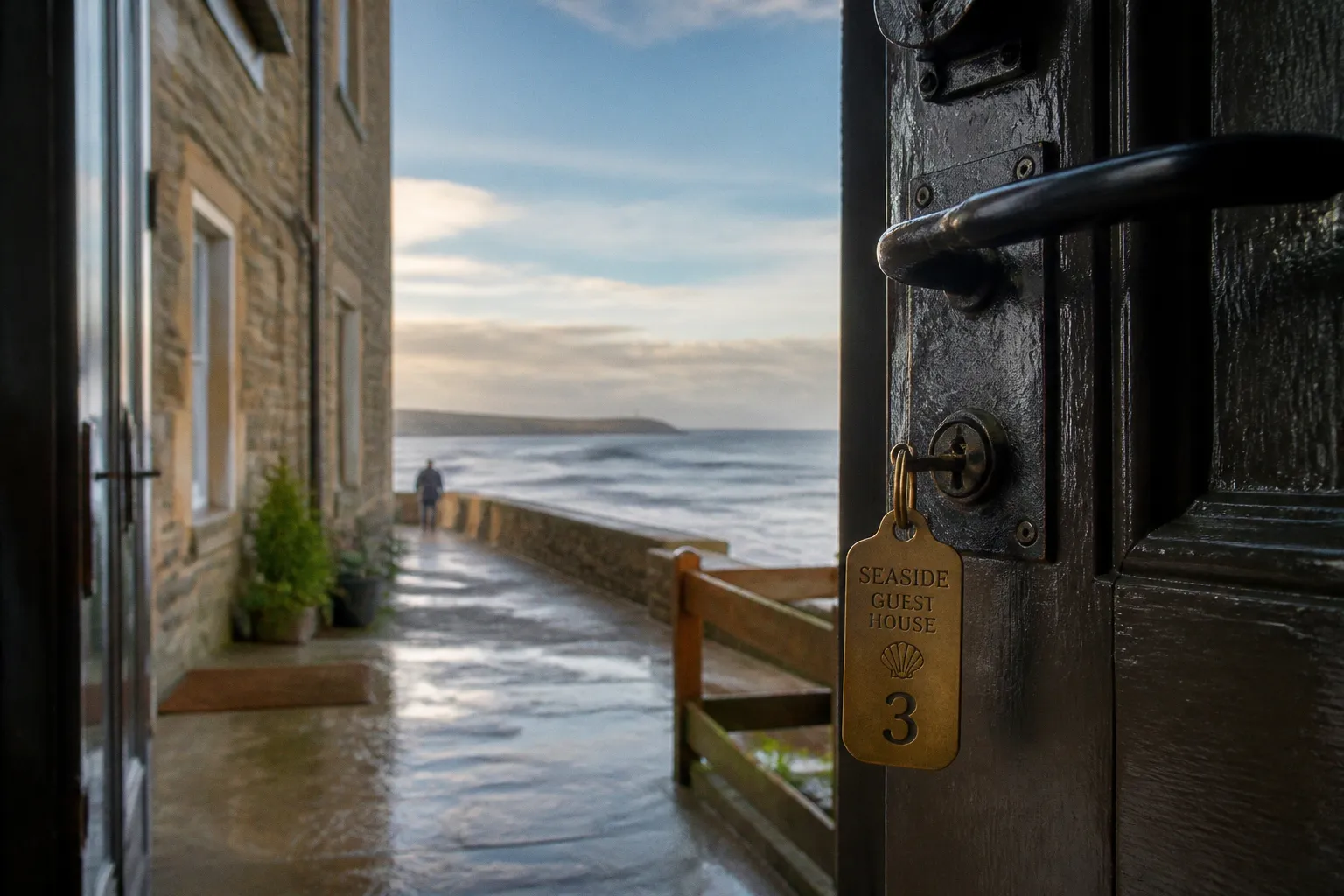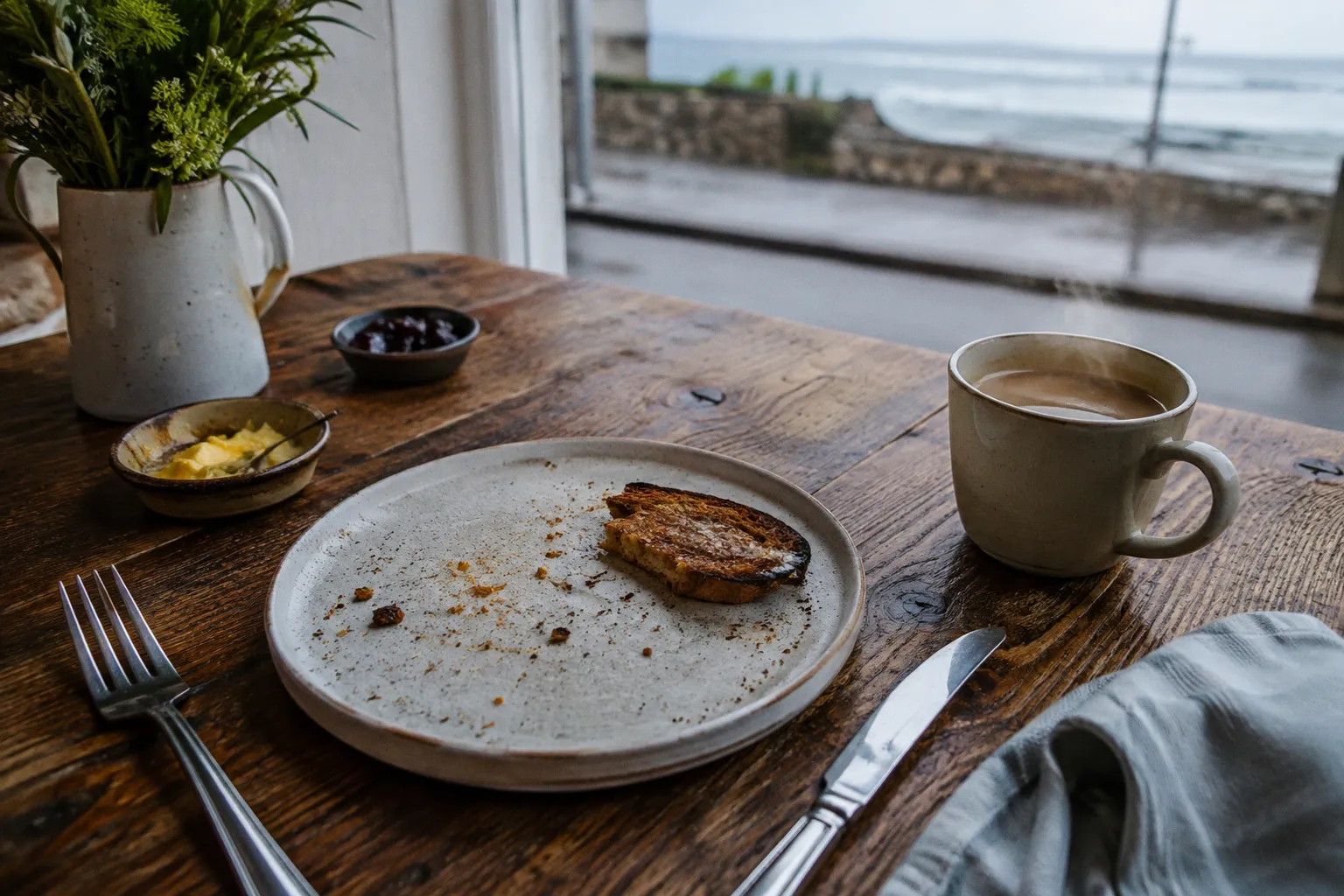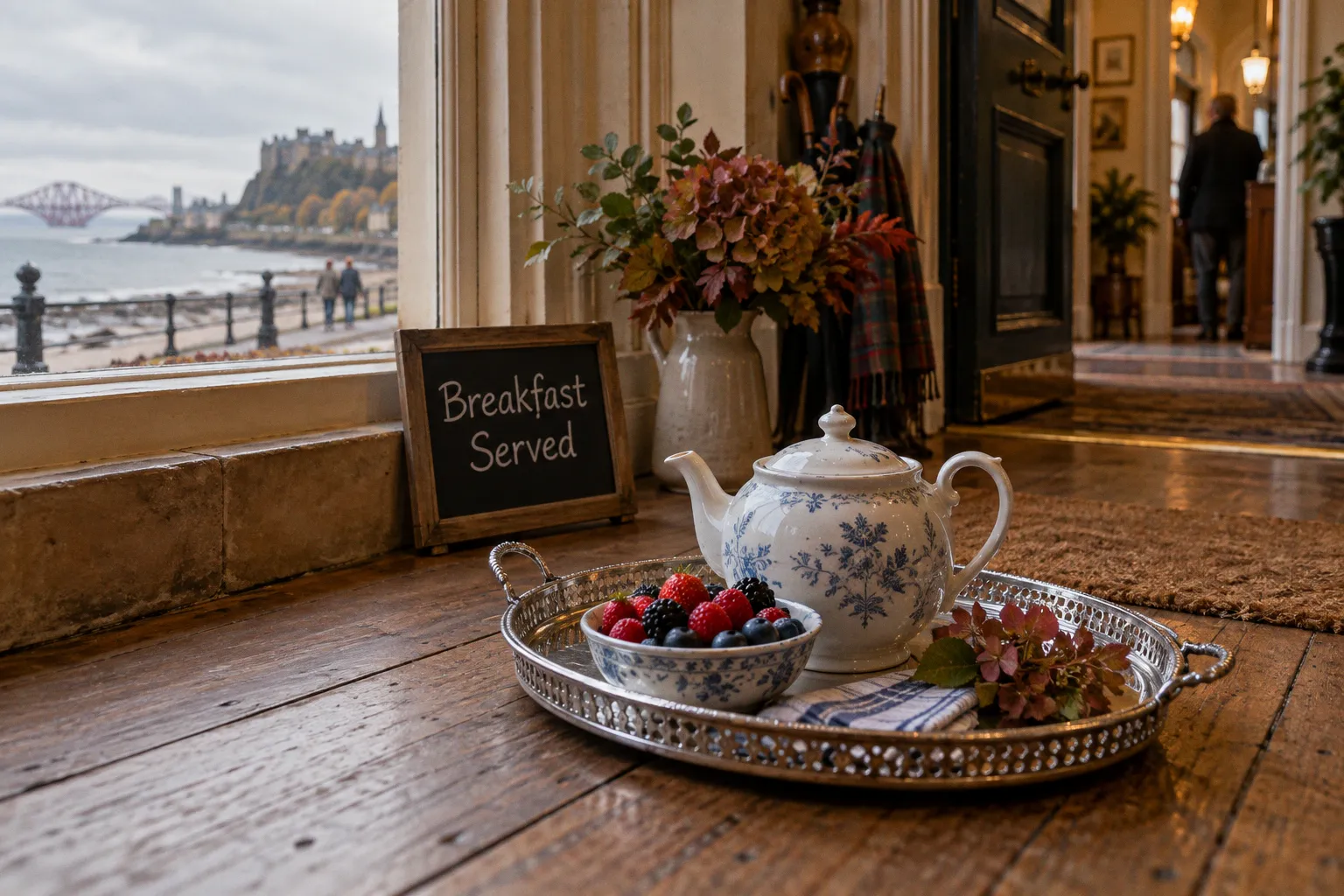
But a growing number of independent operators around Edinburgh’s coast are questioning whether a full hot service is always the best use of their kitchen, staff or guest experience.
That shift is not about serving less. It is about curating breakfast with more precision. A smoked salmon plate, a well-made pastry, fruit selected for freshness and coffee that arrives before the second glance at the clock can feel considerably more premium than an overextended buffet or a breakfast room running on apology. For coastal guest houses, where guests may be leaving early for a walk, a golf tee time, a train or the airport, flexibility has become part of hospitality rather than a concession.
The most effective breakfast service models for Edinburgh coastal guest houses are therefore not defined by whether they include bacon. They are defined by how convincingly they connect food, timing, design, labour and value.
The cooked breakfast is a choice, not a legal obligation
There is a persistent assumption that a British bed and breakfast must provide a cooked breakfast. That is not generally the case. A guest house is not legally obliged to serve a hot cooked meal, provided its breakfast offer is accurately described to guests before they book.
That final point matters. A continental breakfast, an in-room hamper, a breakfast-excluded rate or a limited pre-order menu can all be legitimate commercial models. The difficulty begins when the description is vague enough to imply one experience and the property delivers another.
A listing that promises breakfast should make the format legible. Guests need to know whether they are booking:
- a full cooked breakfast served at a set time;
- a hybrid service with a cold buffet and cooked dishes available to order;
- a continental breakfast with pastries, fruit, cereals and drinks;
- an in-room basket or breakfast hamper;
- a breakfast-excluded room rate;
- or a restricted early-morning option designed around departures.
This is not merely a matter of avoiding complaints. Breakfast is one of the most visible expressions of the price-to-value ratio. If a room commands a premium because of heritage architecture, sea views or a carefully restored interior, the morning offer must feel considered rather than absent. Equally, a property that explains its breakfast model with confidence can avoid the awkwardness of presenting a reduced service as though it were an unfortunate temporary compromise.
A breakfast model is not a retreat from hospitality. It is a decision about where hospitality should be most visible.
For operators, the strategic question is more useful than the traditional one. Instead of asking whether guests expect a cooked breakfast, ask when a cooked breakfast improves the stay enough to justify its labour, food cost, scheduling pressure and operational complexity.
Five breakfast models, and what each one signals
There is no single best format for an independent seaside guest house. The right model depends on the scale of the property, the kitchen layout, arrival patterns, staffing, room rate and the kind of experience the property is trying to stage.
Made-to-order cooked breakfast
This is the classic model: guests choose from a menu and receive a freshly prepared plate at a defined service window. It can include familiar Scottish components alongside lighter or vegetarian dishes, with the menu adapted to the identity of the house.
At its best, made-to-order breakfast creates theatre without becoming theatrical. The sound of coffee being prepared, the arrival of a hot plate and the ability to adjust portion or dietary preference all communicate attentiveness. It is particularly powerful in a small guest house where the owner or host is visible and the dining room has enough spatial calm to support a slower start.
Its weaknesses are equally clear. The kitchen becomes dependent on punctuality, the service window can create a rush, and a small team may spend the most demanding part of the morning moving between cooking, clearing and guest interaction. Waste can also increase when the menu is broad but occupancy is unpredictable.
The model is most convincing when the menu is concise. A short selection of properly executed dishes has more authority than an ambitious list that pushes the kitchen into uneven timing.
Continental buffet
A continental breakfast can be beautifully done, but it requires more curation than its name implies. A buffet of anonymous packaged goods does not become premium simply because it is arranged on a marble counter.
The strongest versions use a limited number of tactile, recognisable elements: good bread, well-presented pastries, fruit, cereals, yoghurt and carefully chosen preserves. The design of the display matters because guests read the buffet before they taste it. Scale, spacing, vessel choice and replenishment all affect the sense of freshness.
This model offers operational flexibility. Guests can arrive across a broader period, serve themselves quickly and choose an amount that suits the day. For a coastal property, it can work particularly well when guests have different plans: an early walk along the shore, a leisurely Edinburgh itinerary or a later departure.
The risk lies in overproduction. A buffet that has been sitting too long becomes a visual record of declining quality. The solution is not simply to add more options. It is to reduce the offer, replenish intelligently and keep the presentation precise.
Hybrid buffet and cooked-to-order service
For many independent guest houses, the hybrid model offers the best balance between flexibility and occasion. Guests can help themselves to cereals, fruit, pastries and drinks, then order a hot dish such as smoked salmon with scrambled eggs or vegetarian haggis.
This format is already visible in high-end Edinburgh guest houses because it separates the two kinds of breakfast demand. The cold offer handles speed and choice; the kitchen reserves its attention for food that benefits from being prepared at the point of order.
The hybrid model also supports a more sophisticated menu architecture. A property does not need to replicate a large hotel buffet. It can give the cold selection a strong local and visual identity, then use two or three cooked dishes to establish the character of the house.
The operational detail is in the handover. Guests must understand what is self-service and what is ordered. Staff need a clean system for recording hot choices, managing table numbers and communicating wait times without making the dining room feel procedural.
In-room hampers
Breakfast hampers are often dismissed as an inferior substitute for dining-room service. That is a mistake, provided the hamper is designed as an experience rather than a container of leftovers.
In-room service can suit guests who value privacy, early departures or a slower start without formal dining. It also creates a direct relationship between breakfast and the room itself. The tray or basket becomes part of the property’s spatial language: linen, ceramics, a small carafe, a bakery item that does not collapse under packaging, and food that remains appealing outside the kitchen.
The challenge is temperature, timing and expectation. A hamper should not quietly imply a hot breakfast if it contains only chilled or ambient items. It must also be practical to eat. A delicate pastry, fruit, yoghurt, bread and a good drink may travel well. Foods that require complicated assembly or arrive with excessive packaging tend to make the experience feel improvised.
Hampers are particularly useful as an additional tier rather than the only option. They can serve early departures while the main breakfast operates normally, or offer a private alternative for guests who do not want a communal dining room.
Breakfast-excluded rates
A breakfast-excluded room rate can be commercially sensible, especially where the surrounding area offers strong cafés, bakeries or transport-linked food options. It may attract guests who prefer to choose their own morning routine and prevents operators from including a service that a significant part of the audience will not use.
The presentation is crucial. A breakfast-excluded rate should be positioned as a deliberate choice, not as a stripped-back version of the proper room. The room description can explain what is available nearby or offer breakfast as an add-on where capacity allows.
This model works best when the property has a clear point of view about the local food landscape. Simply removing breakfast shifts the decision to the guest. Recommending a few reliable morning options, with honest information about opening times and distance, preserves the role of the host as a useful local editor.
| Service model | Strongest advantage | Main operational pressure | Best fit |
|---|---|---|---|
| Made-to-order cooked breakfast | Personal service and a sense of occasion | Labour, timing and kitchen capacity | Small properties with a strong host presence |
| Continental buffet | Flexible arrival times and simpler service flow | Freshness, waste and visual presentation | Guest houses with varied departure schedules |
| Hybrid buffet and cooked dishes | Choice without a full hotel-scale operation | Clear ordering and coordination | Premium independent properties |
| In-room hamper | Privacy and early-departure flexibility | Packaging, temperature and delivery timing | Design-led rooms and mixed guest routines |
| Breakfast-excluded rate | Lower service burden and guest autonomy | Risk of feeling like reduced value | Locations with credible nearby food options |
Design is part of the breakfast service
Breakfast design is not a decorative afterthought. It changes how guests move, wait, choose and perceive value.
A dining room with hard acoustics, poor lighting and narrow circulation can make even excellent food feel functional. By contrast, a modest menu becomes more generous when the room has spatial harmony: tables that do not force guests into one another’s conversations, light that flatters the food rather than flattening it, and tableware with enough weight to feel deliberate.
The morning light of a coastal property can be an asset, but large windows also reveal every neglected surface. Breakfast rooms need a different level of visual discipline from evening spaces. Crumbs, condensation and half-cleared plates become part of the guest’s first impression of the day.
Three sensory touchpoints deserve particular attention.
Lighting
Cool overhead lighting makes a breakfast buffet look institutional and can exaggerate the appearance of stainless steel, plastic packaging and tired pastries. Layered lighting is more forgiving: natural light where possible, discreet ambient fixtures and focused illumination over the buffet or serving surface.
The aim is not darkness. Guests need to read labels, assess food and move safely. The aim is to avoid the clinical glare that removes all sense of ceremony from the room.
Textiles and surfaces
Linen napkins, washable runners, timber, stone and glazed ceramics each communicate a different level of care. The materials do not need to be expensive, but they should feel coherent with the guest house.
Heritage tones can work particularly well in Edinburgh properties: muted greens, mineral blues, warm creams and dark woods that echo the surrounding architecture without turning the dining room into a themed set. A coastal identity is more convincing when it comes through texture and proportion than through literal shells, rope or nautical signage.
Textiles must also survive the reality of breakfast service. A fabric that looks beautiful in a styling photograph but stains permanently after one serving of berry compote is not a design success. Hospitality materials need to carry beauty and maintenance at the same time.
Vessels and presentation
A small bakery partnership loses its impact when pastries arrive in generic plastic trays. The same applies to preserves, butter, fruit and cereals. Vessels create hierarchy. A ceramic bowl can make a simple ingredient feel composed; an oversized display can make a small breakfast look depleted.
This is where bespoke does not necessarily mean costly. A consistent set of plates, a well-chosen bread board and properly labelled preserves can achieve more than a collection of expensive but unrelated objects.
The result should feel edited. Too much choice weakens the visual field and increases waste. Too little choice can feel ungenerous. The point is not abundance for its own sake, but a breakfast that makes the room and the rate feel aligned.
Local bakery partnerships need more than a good story
A local bakery partnership is an obvious way to bring texture and place into the breakfast offer. Fresh bread and pastries can give a guest house a stronger identity than a long list of nominally Scottish products sourced from anonymous wholesalers.
But local sourcing is not automatically a premium proposition. The arrangement needs to work operationally. Delivery times, minimum orders, shelf life, packaging, allergen information and contingency planning all matter. A bakery that produces exceptional sourdough but delivers after the breakfast service begins is not a functional partner.
Operators should look for a relationship that supports the actual rhythm of the property. That may mean a smaller daily delivery, a fixed pastry selection, or a standing order adjusted according to occupancy. Communication is especially important during quiet periods, when over-ordering becomes expensive and food waste becomes visible.
There is also a design opportunity. Bakery products can create a recognisable signature without turning breakfast into a marketing display. A particular loaf, a seasonal pastry or a house toast service can become part of the property’s memory for guests. The effect is strongest when the item is served well and described simply rather than over-explained.
Sustainable breakfast sourcing follows the same principle. Guests tend to respond to credible, specific decisions: fewer disposable portions, sensible ordering, seasonal fruit, reusable vessels and a menu that does not pretend every ingredient is available in every season. Sustainability becomes more persuasive when it is built into the service rather than announced as a slogan.
Food safety does not disappear when breakfast becomes simpler
One of the most important operational misunderstandings is that a continental or hamper-based breakfast avoids the obligations attached to food service. It does not.
Bed and breakfast and guest house operators in Scotland must register their establishment with the local environmental health department under the relevant food hygiene requirements. Food Standards Scotland provides CookSafe, a system designed to help catering businesses create written food safety management procedures based on Hazard Analysis Critical Control Point principles.
The format of breakfast may change the hazards and the controls, but it does not remove the need for a system.
A cooked breakfast brings obvious controls around raw ingredients, cooking temperatures, cross-contamination, chilling and service time. A cold buffet introduces its own concerns: refrigeration, replenishment, utensil handling, product dating and the length of time food remains available. Hampers create different questions around assembly, storage, delivery to rooms and the separation of ready-to-eat foods from other items.
The Food Hygiene Information Scheme database records 2,996 registered hotel, bed and breakfast and guest house premises in Scotland. That figure is a useful reminder of the scale of the sector, but registration is not a badge that replaces day-to-day discipline. The quality of the system is seen in the small decisions made before the first guest enters the breakfast room.
A practical written procedure should cover, in language the team can actually use:
- how food is received, checked and stored;
- how chilled items are monitored and protected;
- how raw and ready-to-eat foods are separated;
- how buffet items are replenished without contaminating service utensils;
- how breakfast hampers are assembled and labelled;
- how allergens are communicated;
- how cleaning tasks are scheduled and recorded;
- what happens when equipment fails or a delivery is late;
- and how staff respond when a guest raises a food safety concern.
The best system is not the longest document. It is the one that reflects the real breakfast model rather than an idealised version of it.
Pets, food preparation and the invisible boundary
A particularly relevant rule for small guest houses concerns domestic animals. Regulation (EC) 852/2004 Annex II requires adequate procedures to prevent domestic animals from accessing places where food is prepared, handled or stored.
For properties that welcome dogs in bedrooms or shared areas, the separation needs to be operationally clear. A pet-friendly guest house cannot allow the kitchen, breakfast preparation area or food storage space to become an extension of the general communal environment.
This is not an argument against welcoming animals. It is an argument for better spatial planning. Doors, storage, preparation surfaces and service routes should make the boundary obvious to staff and guests. If the property offers in-room hampers, the assembly area still needs to be protected from animal access.
In design terms, hygiene boundaries should be discreet but firm. A premium experience is not created by making regulations visible at every turn; it is created by designing the operation so that compliance does not depend on constant improvisation.
The commercial case for flexibility
Breakfast is often treated as a hospitality obligation rather than a product with its own economics. That makes it difficult for operators to judge whether a service model is genuinely working.
The useful comparison is not simply ingredient cost. A cooked breakfast uses staff time, kitchen energy, table turnover, washing-up capacity and supervision. A buffet reduces some service pressure but may increase waste. Hampers can reduce dining-room labour while adding packaging, assembly and delivery. A breakfast-excluded rate may simplify operations but alter the perceived value of the room.
The model should be judged against the property’s actual booking pattern. A guest house with many one-night stays and early departures may find that a large cooked service creates waste and frustration. A smaller design-led house with guests staying several nights may benefit from a more personal breakfast because the morning relationship becomes part of the property’s character.
The answer may be a tiered structure:
1. A core breakfast offer that is available consistently and described with precision.
2. A cooked upgrade or limited menu for guests who value a hot dish.
3. An early-departure option that can be prepared without opening the full dining room.
4. A breakfast-excluded rate for guests who prefer autonomy.
5. A seasonal adjustment when occupancy, staffing or local supply changes.
This does not mean presenting guests with a confusing matrix of supplements. The booking journey should remain simple. Complexity belongs behind the scenes, where it helps the operator match labour and food to real demand.
Price-to-value is also affected by the emotional quality of the service. A modest breakfast that arrives with clear information, good ingredients and visual restraint can feel more generous than a larger meal that is poorly timed or inconsistently replenished. Guests remember friction as readily as they remember food.
A breakfast model should belong to the property
The most successful coastal guest houses do not copy hotel breakfast service. They translate their own architecture, location and guest rhythm into the morning.
A restored townhouse near Edinburgh may suit a polished hybrid buffet with heritage tones, strong coffee and a concise cooked menu. A smaller seaside retreat may be better served by a carefully assembled hamper, a limited breakfast room service and trusted bakery products. A property positioned around walking, golf or early coastal excursions may need a practical early option more than an elaborate two-hour dining window.
The central decision is not whether the breakfast is traditional. It is whether the service is coherent.
Coherence means the booking description matches the physical experience. It means the food offer respects the staffing model. It means design supports movement and comfort rather than merely providing a photogenic backdrop. It means sustainability is visible through sensible choices, not a paragraph of claims. And it means food safety procedures are built into the operation from the start, regardless of whether breakfast arrives as a plated meal, a buffet or a basket beside the bed.
The premium breakfast is not the largest one. It is the one in which every detail appears to have earned its place.
For independent operators, flexibility is now a form of discernment. The cooked Scottish breakfast remains a valuable part of the guest house tradition, but it should be offered because it improves the stay, not because habit has mistaken it for a legal requirement.
A well-designed breakfast service can be warm without being overfamiliar, local without becoming performative and efficient without feeling stripped back. That balance is where independent hospitality earns its advantage: not through abundance, but through curation that guests can feel from the first cup of coffee to the final cleared plate.