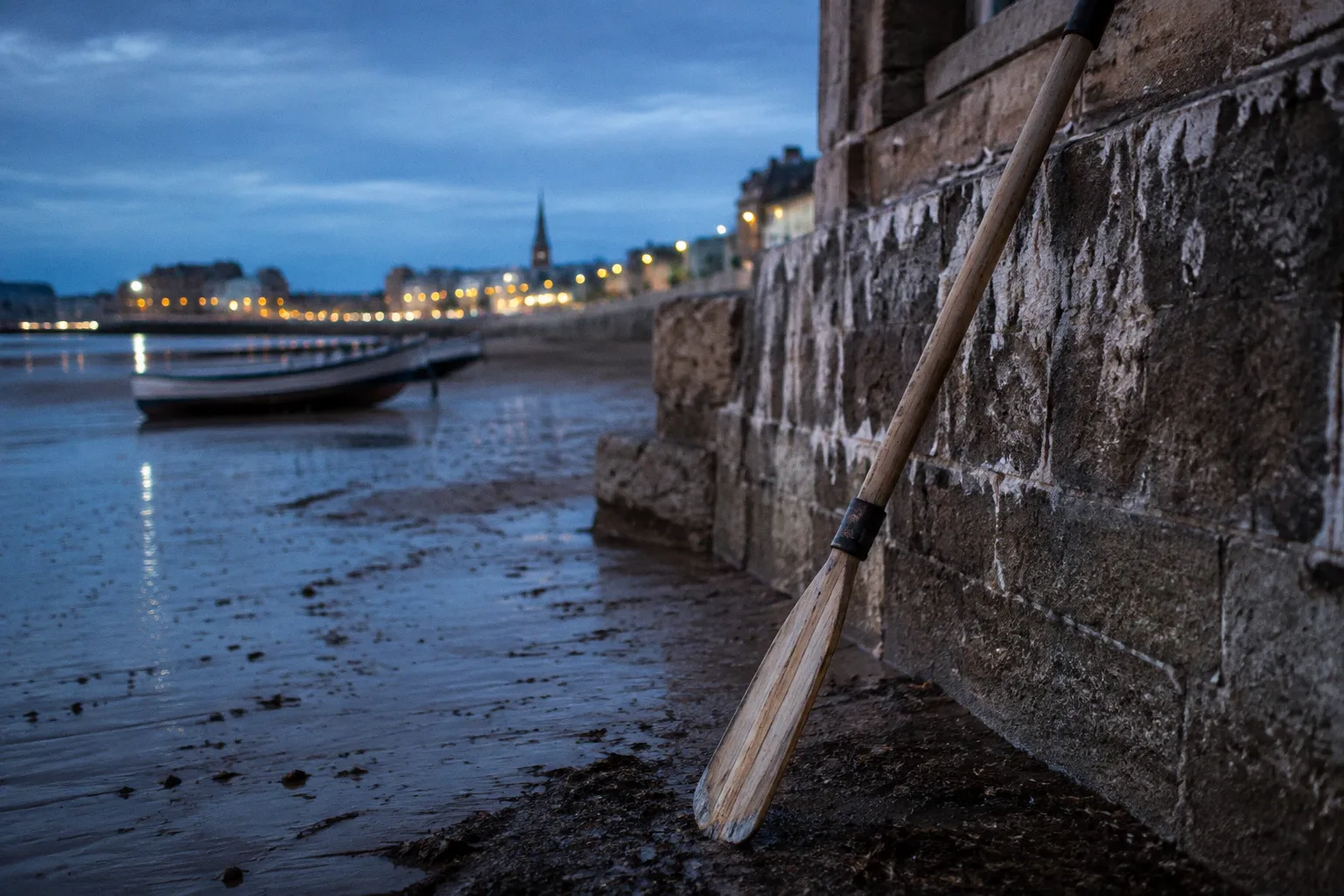
Standing on the promenade near the old bandstand at Joppa, watching a crew of five slide a long, narrow hull across the wet sand, you notice things: the careful choreography, the calloused hands gripping the gunwale, the syncopated rhythm of bodies settling into seats. These are not tourists renting paddleboards for Instagram. This is something older, something chosen with deliberation. The revival of coastal rowing in Portobello—and the meticulous craft behind the vessels that carry it—tells us something important about what a shoreline community decides to keep, and why.
From Victorian Heritage to Modern Revival
Portobello's relationship with competitive rowing stretches back to the 1870s, when the first club took shape along this same stretch of coast. By the 1890s, two distinct organisations—Portobello Amateur Rowing Club and Eastern Amateur Rowing Club—held regular races on the Firth of Forth, their crews pulling through Scottish waters that could shift from glassy calm to vicious chop within an hour. The tradition endured for nearly a century before fading in the 1980s, another casualty of changing leisure habits and an era that seemed to value speed over craft.
For decades, the shoreline culture that had once defined this corner of Edinburgh lay dormant. Then, in 2009, something stirred. A community project began constructing a St Ayles Skiff—dubbed Ice Breaker—and the tactile ritual of boatbuilding returned to Portobello. The following year brought formal structure: the Scottish Coastal Rowing Association was founded in May 2010, providing a national framework for what was rapidly becoming a grassroots maritime movement. By April 17, 2011, a second skiff—Jenny Skylark—was launched from Joppa bandstand, carried along the promenade to Bath Street and eased into the water to the applause of an assembled crowd.
The revival of coastal rowing in Portobello is not a museum exercise—it's a deliberate, tactile insistence that the sea belongs to those who show up for it.
The timing was not accidental. A decade of digital saturation had produced, in certain quarters of Scottish coastal life, a hunger for something embodied and exacting. Coastal rowing offered both. No engines. No screens. Just four sweep rowers, a coxswain, and twenty-two feet of wood moving through salt water under human power alone. For a guest house operator watching from the promenade, the appeal was immediately legible: modern guests were no longer satisfied with passive sea views. They wanted proximity to the active, the crafted, the genuinely local. Coastal rowing delivered all three.
Anatomy of the St Ayles Skiff
The boats themselves deserve close inspection, because their design philosophy mirrors the sensibility that defines Portobello's best shoreline establishments: heritage tones rendered with contemporary precision.
The St Ayles Skiff was commissioned from naval architect Iain Oughtred by the Scottish Fisheries Museum in Anstruther, drawing inspiration from the traditional Fair Isle yoal—a working boat built for hard North Sea conditions. But Oughtred's interpretation is distinctly modern. These are not Victorian relics replicated in heavy timber. They're constructed from marine plywood using clinker techniques—overlapping planks that create a distinctive, textured hull surface catching light and shadow as the boat moves.
At twenty-two feet long with a beam of five feet eight inches, the proportions are disciplined. The double-ended hull—pointed at both bow and stern—gives the skiff a balanced visual weight whether it's resting on the sand or cutting through chop. There's a spatial harmony to the design that rewards sustained observation: clean sheerline, minimal freeboard, seats positioned for optimal weight distribution rather than comfort alone.
Building one is a communal act. The estimated cost of completing a St Ayles Skiff kit hovers around three thousand pounds, though the true investment is measured in hours—the accumulated labour of volunteers learning to steam-bend frames, fit garboards, and fair a hull to tolerances that matter when you're asking the sea to carry you. The result is a vessel that feels, in the hand and under the body, like something made with genuine care. The oar leathers are worn to the grip of specific palms. The paint scheme—typically a crisp waterline against natural timber or heritage hues—is chosen by committee, which means it carries the visual identity of its community.
For anyone who appreciates the tactile dimension of well-made objects, sitting in a St Ayles Skiff is a revelation. You feel the water through the hull. The clinker construction transmits vibration—subtle, constant, oddly reassuring. The boat is responsive in a way that fibreglass never achieves, each stroke of the oars producing a direct, measurable result. This is not recreational equipment designed to forgive. It's a tool that rewards competence.
Two Clubs, One Shoreline
What makes Portobello's coastal rowing scene distinctive—beyond the quality of its vessels—is the presence of two separate organisations operating from the same stretch of beach. Understanding the difference between them is essential for anyone curious about joining this world.
Rowporty functions as the coastal rowing arm of the Portobello Sailing, Kayaking and Rowing Club (PSKC), a broader water sports organisation with a presence on the promenade. They built Ice Breaker and Jenny Skylark, and their identity is rooted in community accessibility—welcoming rowers of varying experience levels for exercise, social outings, and competition. The club maintains a deliberately open posture: sessions are designed to be inclusive, with experienced members guiding newcomers through the basics of stroke technique and boat handling.
The Eastern Amateur Coastal Rowing Club, established in 2015, operates as an independent entity with its own character. While both clubs share the same waters and the same boat class, their internal cultures have developed distinct textures. Members of both occasionally train together and compete at the same regattas, but each club maintains its own fleet, its own schedule, and its own traditions.
There is a particular discipline to coastal rowing that separates it from every other watersport: the boat demands consensus. You cannot row a skiff well as five individuals.
This dual structure creates a richness that a single club could not achieve. It means more boats on the water, more sessions available, more perspectives on what makes a good rowing stroke. It also means healthy competition—not hostile, but sharpening. When two crews from the same beach meet at a regatta, the stakes are personal in a way that a race against strangers from another coast can never replicate.
Joining the Crew
If this has stirred something—an inclination to be part of rather than merely observe—the practicalities are straightforward and, by any measure, remarkably accessible.
Adult membership in PSKC costs forty pounds per year for those over twenty-five, with no joining fee. Young adults between eighteen and twenty-five pay twenty pounds, and juniors under eighteen pay ten. The membership year runs from April 1, which aligns nicely with the coastal rowing season as the water begins to warm and daylight extends. The Eastern Amateur Coastal Rowing Club operates its own membership structure independently.
But the fee is merely the formal threshold. What newcomers discover is that the real currency is time and willingness. Coastal rowing has no shortcuts. The stroke looks simple—it isn't. Timing with three other rowers while a coxswain calls commands requires a particular kind of attention, a surrender of individual rhythm to collective cadence. The crew learns to move as a single organism, each body's power translated through oar shafts and blade faces into unified propulsion.
There is something profoundly democratic about the arrangement. On the water, the accountant and the retired teacher and the university student are equals, measured by the same metric: can you hold the catch, drive through the stroke, and recover without disrupting the set? Status, profession, age—all of it dissolves into the rhythm of the oars.
Regatta Season and the Life of the Beach
The annual regatta circuit transforms coastal rowing from a local practice into a connected, competitive culture. Clubs from across Scotland's coastline host races, and the St Ayles class—standardised boat, standardised crew of four rowers and a coxswain—ensures that outcomes are determined by preparation and execution rather than equipment advantage.
Portobello's regattas occupy a particular niche in this circuit. The beach provides natural amphitheatre seating, the promenade offers vantage points, and the proximity to Edinburgh's centre means that spectators who've never held an oar can witness the sport at close range. The atmosphere is distinctly informal—families picnic on the sand, dogs investigate the boat trolleys, and the competitive tension manifests not in aggressive rhetoric but in the quiet, focused intensity of crews warming up on the beach before launch.
Winter does not halt the activity entirely, though it transforms its character. The light retreats, the water temperature drops, and the Firth of Forth reveals its more demanding personality. Rowing in cold conditions produces a different kind of satisfaction—the visceral relief of returning to shore, the slow warming of fingers and forearms, the shared knowledge that you've done something most people would choose to avoid.
What the Shoreline Keeps
Standing at the water's edge on any given morning—watching a crew haul a skiff from its beach rack, hearing the muffled clatter of oars being fitted to thole pins—you're witnessing something that could easily have vanished. Portobello's rowing tradition was interrupted for decades. Its revival is not nostalgic sentiment but a pragmatic, community-driven decision to maintain a living connection between this shoreline and the sea.
In a coastal culture increasingly defined by consumption—by the café, the ice cream, the sunset photograph—coastal rowing insists on production. You make the movement. You generate the power. You bring the boat home.
The St Ayles Skiffs sit on Portobello's sand like arguments for a different kind of coastal economy—one built on craft rather than commerce, on participation rather than spectatorship. They're not beautiful in the precious, untouchable sense. They're beautiful the way a well-used workshop is beautiful: scarred, functional, saturated with accumulated purpose.
For those of us who live and work along this coastline—welcoming guests to experience what makes this stretch of the Firth of Forth genuinely distinctive—coastal rowing offers something irreplaceable. It's not a feature you can replicate with clever interior design or a curated breakfast menu. It's the sound of oars in water at first light, the sight of a wooden hull against pewter sea, the knowledge that the traditions defining this shoreline are being actively chosen, season after season, by the people who call it home.