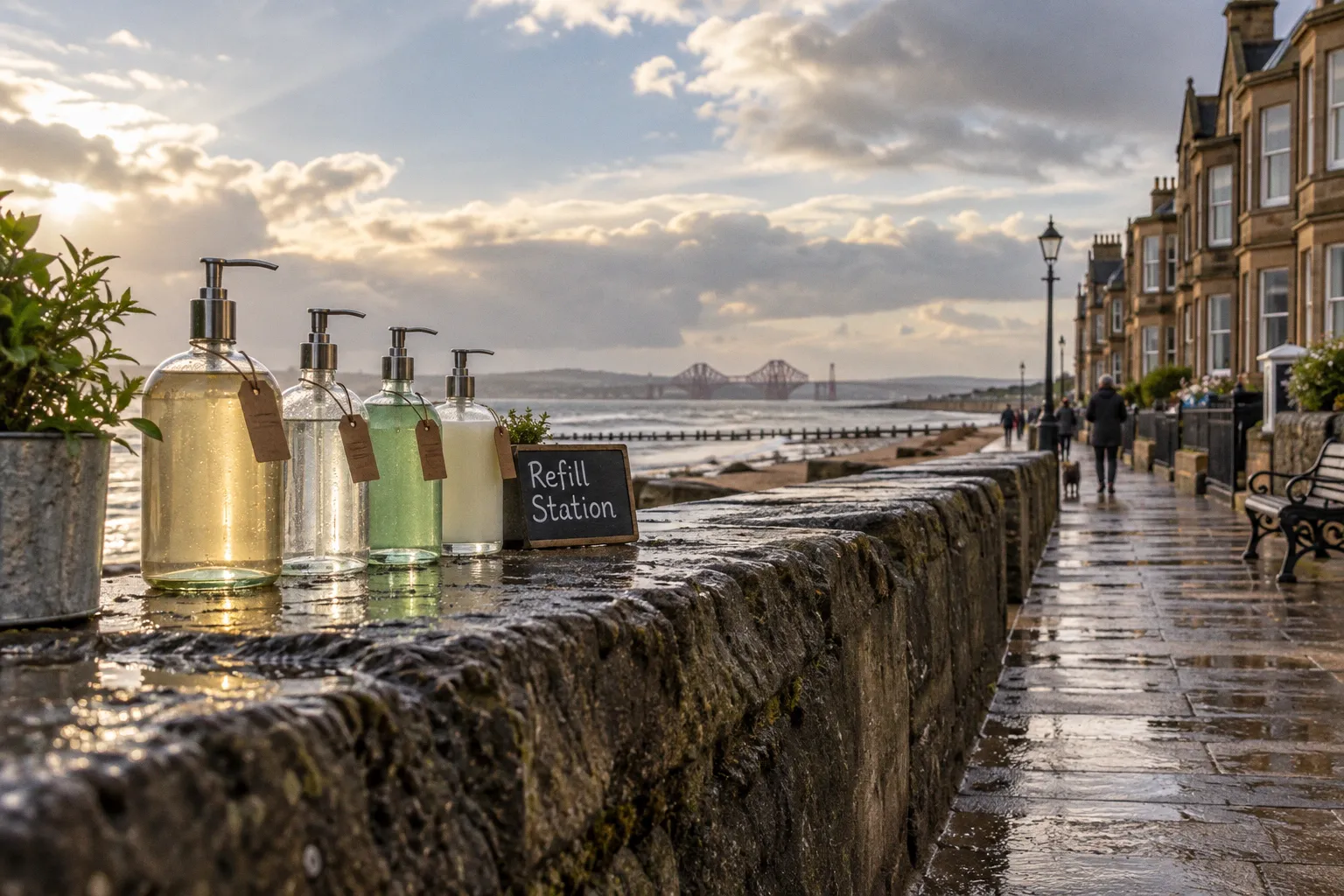
The Firth of Forth is unforgiving. A guest house within a stone's throw of the Portobello or Cramond tide line does not merely battle salt corrosion on its window frames and sand-tracked lobby tiles — it carries a quiet obligation every time a housekeeper reaches for a spray bottle. What rinses down a basin in Leith eventually passes through municipal drainage and into the same water that defines the property's morning view. Chlorine bleach, phthalates, synthetic fragrances, and petroleum-based surfactants leave a residue no sea wall can filter. The conventional housekeeping kit was engineered for porcelain shine, not for what happens after the water leaves the building.
That tension — between the hygiene rigour a paying traveller expects and the marine ecosystem a coastal property physically depends on — now sits at the centre of every operational decision an independent innkeeper makes along the Lothian shore. The shift toward sustainable cleaning products for coastal guest houses is no longer framed as ideology. It is a commercial calculation, a guest-facing signal, and a quietly necessary adjustment to the reality of operating within a tidal catchment.
The runoff that ends up in the Forth
Conventional domestic and commercial cleaners share a familiar core of ingredients, and most of them behave badly once they leave the premises. Chlorine bleach, the workhorse of bathroom sanitising, reacts with organic matter to form trihalomethanes — compounds that municipal treatment plants do not fully strip. Phthalates, used to carry synthetic fragrance, persist through wastewater and have been measured in marine sediments across European coastlines. Synthetic musks and fragrances, the olfactory signature of a "freshly cleaned" room, do not biodegrade cleanly; they bioaccumulate. Petroleum-derived surfactants, the foaming agents in nearly every spray-and-wipe, are toxic to aquatic invertebrates at concentrations a few parts per million above background levels.
For a guest house three streets back from the beach, this is not an abstract environmental concern. The same drainage infrastructure serves the kitchen prep surfaces, the linen storage, the en-suite bathrooms, and the public areas. Each room turnover routes water — and whatever rides in it — toward the outfall. The volume is modest compared to a hotel laundry, but the cumulative effect of dozens of small properties discharging into a shared coastal catchment is precisely the kind of low-level, distributed pollution that regulators struggle to police and that ecosystems absorb without obvious protest until they do not.
The honest framing: the problem is not that any single spray is catastrophic. It is that the entire category was designed without the sea in mind, and coastal operators are the first ones whose geography catches them out.
Coastal housekeeping is not interior design. It is geography with a spray bottle in its hand.
What Green Tourism actually audits
Scotland has had a formal scheme for sustainable accommodation since 1997, when the Green Tourism Business Scheme launched to give environmentally conscious operators a credible third-party badge. The scheme awards Bronze, Silver, and Gold accreditations based on a wide-ranging audit of operational practice, and it has become the de facto standard for independent guest houses, B&Bs, and self-catering properties that want their sustainability claims to mean something beyond a footer line on their website.
For coastal hosts, the cleaning audit is among the most concrete scoring categories. Green Tourism assessors look for phosphate-free formulations, refillable concentrate systems rather than single-use plastic bottles, biodegradable surfactants, and clear waste-stream segregation. They do not require — and this matters for the skittish operator — that a property throw out its existing chemical stock overnight. The scheme is a graduated accreditation, not a confession booth. Bronze is achievable on a tight budget; Gold asks for measurable reductions year on year.
The commercial logic is straightforward. Green Tourism is voluntary. There is no Scottish hospitality law that mandates eco-friendly cleaning products across all B&Bs, and the regulatory specifics around septic tank discharge in coastal zones are governed by SEPA drainage permits rather than a blanket ban. What the scheme does is translate environmental performance into a booking filter. The major OTAs surface Green Tourism badges. Direct-booking engines use them. For a small operator trying to differentiate from a chain competitor, that little gold mark carries more weight than a paragraph of copy about caring for the planet.
Does plant-based actually clean?
The reflexive objection from a housekeeper who has spent twenty years reaching for the bleach is reasonable: do these gentler formulations actually kill what needs killing? The answer, in commercial-grade plant-based chemistry, is increasingly yes — with the necessary caveat that a guest house kitchen is not the same product category as a guest bathroom.
Specialist UK suppliers such as Delphis Eco formulate plant-based housekeeping products specifically engineered to eliminate the dangerous impacts on aquatic life when washed down drains. The active chemistry relies on surfactants derived from sugarcane and coconut, on enzymes, on citric acid, and on essential-oil-based sanitisers rather than quaternary ammonium compounds. On glass, tiles, hardwood, and most bathroom surfaces, the performance gap between a plant-based spray and a traditional one is, in practical housekeeping terms, negligible. The visual result — a streak-free mirror, a properly degreased hob — is identical. The olfactory result is markedly different: no synthetic musk, no chemical edge, just the faint botanical signature of the formulation itself.
Two things worth being precise about. First, the vinegar-and-baking-soda recipes circulating on lifestyle blogs are not a substitute for commercial sanitisers in a regulated food prep environment. A 1:1 white vinegar to water dilution handles glass and chrome competently enough for a daily turnover, but it does not clear the food-prep bar; UK food hygiene regulations require sanitisers that meet specific biocidal standards, and any operator tempted by the cost savings should be candid about which surfaces that approach is appropriate for and which it is not. Second, "eco" is not a synonym for "weak." The performance of a refill concentrate dissolved in water at the correct ratio is comparable to a standard ready-to-use spray; the difference is the volume of water shipped to the property and the volume of plastic that does not arrive in the first place.
"Eco" is not a synonym for "weak." The right concentrate, diluted correctly, performs like the bottle it replaces.
Refills, tablets, and the architecture of waste
The aesthetic logic of refill systems appeals to design-conscious operators for reasons that go beyond the eco-credit. A back-of-house cupboard lined with identical amber glass bottles, each labelled and decanted from a concentrate, reads as curated. A stack of single-use plastic trigger sprays awaiting recycling does not. Refill systems reconcile housekeeping storage with the visual sensibility the rest of the property is curated to express.
UK refill brands have matured into a credible commercial category. Ethical Consumer's December 2024 assessment ranked household eco-cleaning brands on a 100-point sustainability scale, with refill specialists scoring at the top of the field.
| Brand | Ethical Consumer score | Format | Best fit |
|---|---|---|---|
| SESI | 98/100 | Concentrate refill, UK-made | Whole-property housekeeping |
| Fill Refill | 94/100 | Refill-by-weight store network + concentrate | Urban properties near refill hubs |
| Greenscents | 89/100 | Concentrate + refill | Smaller operations prioritising fragrance-sensitive rooms |
The table is not exhaustive, but it captures the tier of brand that small operators are actually specifying. SESI's near-perfect score reflects a tightly controlled supply chain and genuinely minimal packaging. Fill Refill's slightly lower score reflects the carbon cost of a customer travelling to a refill point, which is a meaningful consideration for a coastal property where the nearest refill hub may be a city-centre detour. Greenscents occupies a useful middle ground for operators who want a credible eco-credential without committing to a single brand across every category.
Dissolvable cleaning tablets solve a different problem: transport emissions and storage footprint. A single flat-packed tablet, dropped into a refillable spray bottle of water at the property, replaces a 750 ml ready-to-use spray that would otherwise have been manufactured, filled, shipped, used once, and recycled. Hospitality suppliers such as Out of Eden stock UK-made, vegan, biodegradable tablet ranges engineered for exactly this workflow. For multi-room properties with limited back-of-house space, the reduction in plastic volume and in delivery frequency is a practical gain, not just a sustainability one. The tablets address the two objections small operators raise most often — bulk storage and per-unit cost — without compromising the audit criteria Green Tourism assessors are looking for.
The 62.5% factor
Sustainability is, in the end, a market position. The moral argument and the marine ecology argument carry weight with operators who already care about them; what shifts an entire category is when guest behaviour changes. According to a survey cited by Faith In Nature, 62.5% of respondents stated they would think higher of hotels or B&Bs that provide sustainable or eco-friendly products for guest use. That figure is not a niche preference. It is roughly two out of three travellers assigning a positive value to a credential the property can verify and display.
The implication for coastal operators is not subtle. The same guest who notices the heritage-toned wall colour and the linen-upholstered headboard also notices the refillable shower dispensers in the wet room, the unbleached paper packaging on the complementary soap, the absence of the synthetic air-freshener plug-in under the basin. They notice because the property has been curated to make them notice — that is the design contract a boutique operation sets with its guest. Sustainable cleaning products have become a layer of the same considered aesthetic the rest of the interior is built on, and the booking engines are beginning to reflect it.
The price-to-value calculation, the one detail no glossy brochure will print, runs roughly as follows. Concentrate refills and dissolvable tablets carry a slightly higher per-use unit cost than the cheapest own-brand chemical sprays, but the gap narrows sharply once delivery frequency, recycling labour, and storage space are priced in. A small three-to-six room property doing daily turnovers can offset most of the premium through logistics alone, and the remainder is recoverable through the direct-booking premium a credible eco-badge commands. The honest version of the math is that eco-cleaning is no longer a money-losing virtue signal. It is a marginal-cost decision with a measurable return on the booking page.
The position
The question Edinburgh's coastal guest houses are answering in 2026 is not whether to switch. Most have already moved, at least partway. The question is how credibly they can document it — to themselves, to a third-party assessor, and to the traveller who is increasingly unwilling to take a property's marketing at its word.
The answer is to choose suppliers who publish their formulations, to specify refill systems that hold up under audit, to retire the synthetic air-freshener alongside the rest of the dated housekeeping vocabulary, and to treat the cleaning cupboard with the same design discipline applied to the front-of-house. The Forth is not an abstraction. It is the view from the breakfast room. The chemistry that leaves the building should befit a property that has chosen to sit beside it.