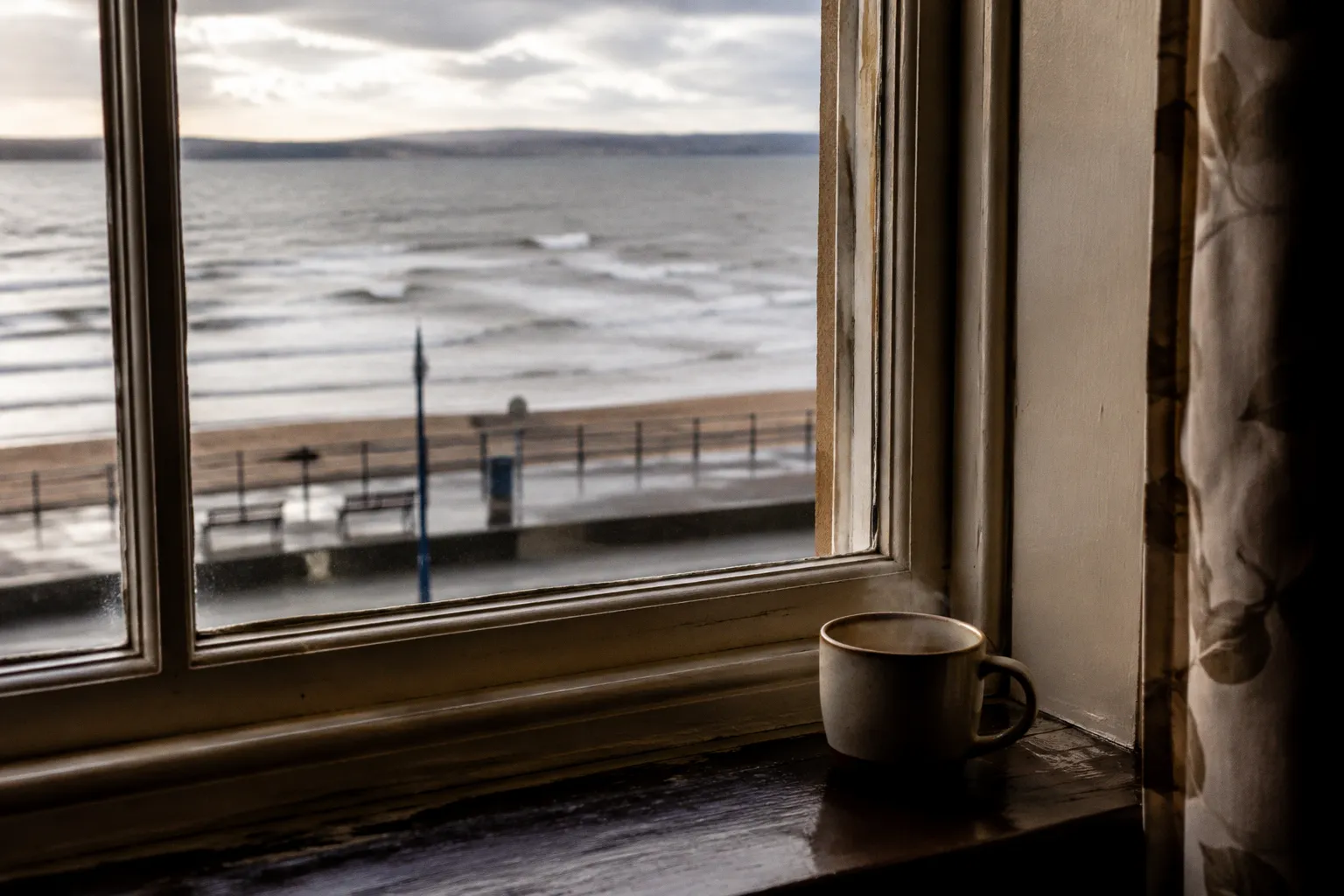
A pale wall develops small bubbles near the window reveal. A kettle leaves a faint orange mark on the shelf beneath it. Upholstery feels slightly clammy after a windy night.
This is the central problem in coastal guest house interior design for salt air: the damage is often gradual, practical and easy to dismiss until a room no longer feels properly maintained. At a property near Edinburgh’s shore, exposure is not limited to an occasional sea mist. Open windows, wet coats, damp shoes, drying towels and salt carried in on luggage all add to the interior environment. The building has to work hard between bookings, and its finishes have to do more than photograph well.
I assess a coastal room from the guest’s position. Can you open the window without fighting a corroded catch? Does the wardrobe door close cleanly? Is the mattress firm enough to support you after a day on the promenade? Is there somewhere sensible to dry a wet coat without placing it over a radiator or against a painted wall? These details tell you much more about the quality of a seaside stay than a carefully arranged vase.
The invisible enemy inside a seaside room
Salt damage is not confined to the exterior elevation facing the water. Salt is hygroscopic, which means it attracts and holds moisture from the air. In a guest house, it can settle on metal fittings, painted surfaces, window frames and furniture, then remain active whenever humidity rises.
A room with an open sea-facing window is especially exposed, but even a sheltered room receives salt through ordinary use. A guest comes back from the beach with damp clothing. A dog shakes out a coat in the hallway. A towel is hung near a poorly ventilated bathroom. Windows are closed overnight, leaving moisture in the room rather than allowing it to disperse. None of these actions is unreasonable. A robust coastal interior has to accommodate them.
The trouble is that salt and moisture work together. Salt deposits can accelerate oxidation, while trapped humidity contributes to paint bubbling, swelling timber and musty textiles. In a property that is not managed carefully, the visual symptoms appear before the underlying problem is understood.
What you notice first
The most revealing signs are usually at points of contact and transition:
- Door handles become dull, rough or marked with small rust-coloured spots.
- Hinges squeak, stiffen or leave residue around the screw heads.
- Window catches develop tea-staining or pitting, particularly on exposed elevations.
- Paint near sills and corners blisters or begins to chalk.
- Curtains and upholstered chairs retain a damp smell even after the room has been aired.
- Timber skirting swells where wet shoes, umbrellas or cleaning water collect.
- Metal legs on bedside tables mark the floor or begin to corrode at their lower edges.
These are not merely cosmetic annoyances. A dragging bathroom door is an accessibility issue if the user has limited grip strength. A stiff window catch can prevent proper ventilation. A loose hinge can turn a quiet bedroom door into a heavy, noisy barrier. The practical condition of the room affects comfort, safety and the sense that the accommodation is being looked after.
In a coastal guest house, maintenance is not separate from hospitality. The handle you can turn easily at midnight is part of the service.
The distinction between indoor and outdoor materials is also less useful than many owners assume. A sheltered interior fitting may face a gentler environment than a gate beside the sea, but it is still exposed to chloride-laden air and repeated humidity changes. Coastal sites are commonly associated with high atmospheric corrosivity categories under ISO 9223, ranging from C4 to C5 in many exposed settings. That does not mean every room experiences the same conditions. It does mean that ordinary inland specifications deserve scrutiny.
Why the small metal fittings deserve serious attention
The most effective coastal interior design decisions are often made in the least glamorous parts of the room. A designer may spend time choosing a headboard fabric, while the real failure point is the inexpensive hinge hidden behind it.
Standard 304 stainless steel is widely used and performs well in many indoor environments. Its composition includes approximately 18% chromium and 8% nickel, which gives it useful resistance to oxidation. Near salt air, however, it has limits. Chlorides can produce tea-staining, pitting and corrosion around joints or areas where moisture remains.
For more demanding coastal applications, 316 marine-grade stainless steel is the stronger specification. It includes roughly 2–3% molybdenum alongside chromium and nickel. That addition significantly improves resistance to pitting and crevice corrosion, particularly on door hardware, window fittings and exposed fixings.
The difference is not a promise that 316 steel will never mark or corrode. Dirt, standing moisture, harsh cleaning products and neglected joints can still damage it. But the material gives the host a better margin for error, which matters in accommodation where multiple guests use the same fittings and cleaning time is limited.
| Interior element | More vulnerable choice | More suitable coastal specification | What the guest experiences |
|---|---|---|---|
| Bathroom and bedroom handles | Unprotected plated metal or poorly maintained 304 steel | 316 marine-grade stainless steel with simple, cleanable geometry | A handle that remains smooth and easy to operate |
| Window catches | Decorative hardware with narrow crevices | Corrosion-resistant fittings with accessible fixing points | Reliable ventilation and fewer stiff or seized catches |
| Door hinges | Standard hinges hidden from routine inspection | Marine-grade or suitably protected hinges checked during turnover | Doors that open quietly without dragging |
| Bedside table legs | Thin painted steel with exposed lower joints | Powder-coated, stainless or sealed legs with floor protection | Less staining and easier cleaning around the bed |
| Bathroom shelving | Untreated metal or porous timber close to splash zones | Stainless steel, sealed compact laminate or properly coated timber | Shelves that do not swell, flake or retain damp smells |
Material choice must be matched by design. A 316 handle with deep decorative grooves is harder to clean than a plain lever. A marine-grade hinge placed where condensation collects can still fail if no one wipes or inspects it. Smooth profiles, accessible screws and minimal crevices make maintenance realistic rather than theoretical.
I am also wary of overusing black metal in coastal rooms. It can look crisp when newly installed, but scratches expose the substrate and salt deposits show readily on dark surfaces. That does not make black hardware unsuitable. It means the coating system, edge quality and maintenance plan matter more than the colour alone.
The room-by-room hardware test
When assessing a bedroom, I work through the parts of the room in the order a guest uses them.
First comes the entrance. The door should open without a sudden catch, and the handle should not feel gritty or tacky. A guest arriving with luggage needs a clean movement, not a negotiation with swollen timber or a stiff latch.
At the wardrobe, the hinges and runners deserve attention. A wardrobe that does not open fully forces guests to work around it, especially if the room is compact. Coats and wet outer layers should have somewhere to hang without pressing against a damp wall. If the wardrobe smells closed or the metalwork leaves marks on clothing, the storage has failed regardless of how attractive its doors appear.
At the bed, I look at the spatial flow. Can you reach both sides without turning sideways around a chair? Are bedside sockets accessible? Does the table remain stable when you place a glass or phone on it? Coastal weather often keeps guests indoors for longer, so small shortcomings become more noticeable over a two- or three-night stay.
In the bathroom, water pressure, extraction and hardware work as one system. A strong shower with poor ventilation leaves the room wetter than it needs to be. A good extractor with a corroded switch or stiff shower control still creates frustration. The most carefully selected tile will not compensate for a door that sticks because moisture has entered the frame.
Paint is a working surface, not a backdrop
Coastal interiors often use pale colours: chalky whites, sea greens, soft blues and warm neutrals. These shades can make a small room feel open, but they also expose bubbling, chalking and tide marks quickly. The choice of paint is therefore part of the building’s maintenance strategy.
Standard interior paint may tolerate ordinary domestic humidity, yet a seaside guest house faces a more persistent combination of salt, moisture, cleaning and thermal cycling. Walls warm and cool. Windows are opened and closed. Bathrooms release bursts of steam. Furniture rubs against corners. Salt deposits can remain on the surface and contribute to deterioration over time.
100% acrylic latex and elastomeric coatings with mould-resistant additives are better suited to this environment than a basic decorative emulsion. They have more flexibility as surfaces expand and contract, and they resist salt-air chalking for longer. The finish still has to be applied over a sound, dry and properly prepared surface. No coating can conceal damp behind plaster or compensate for failed ventilation.
This is where many attractive refurbishments go wrong. A wall is repainted because it looks tired, but the cause of the failure is left in place. If the affected area is near a window, the frame, seal, sill and surrounding humidity need attention. If bubbling appears behind a bed or wardrobe, the furniture may be preventing air movement. If mould returns in a bathroom corner, repainting without improving extraction is only a temporary visual repair.
Where a durable coating earns its keep
The highest-wear areas are not necessarily the ones with the most dramatic sea views. They are the places where guests and staff repeatedly touch, lean, carry or clean:
1. Window reveals and sills receive condensation, open-window exposure and occasional water from plants or cleaning.
2. Hallway corners collect luggage contact, damp coats and repeated trolley or vacuum impact.
3. Bathroom ceilings and upper walls experience steam and slower drying.
4. Behind bedside tables and headboards can have poor air movement, allowing moisture to linger.
5. Skirting boards near entrances meet wet shoes, umbrellas and mopping water.
6. Kitchen splash zones face steam, grease, salt residue and frequent wiping.
A washable finish is useful, but “washable” should not be interpreted as indestructible. Aggressive scrubbing can polish a matt surface, damage a weak coating or spread moisture into a vulnerable joint. Staff need cleaning products and methods appropriate to the specified finish. The best paint system can be undermined by a harsh chemical used because it is convenient.
The repaint cycle also needs to be realistic. Coastal maintenance may require repainting in roughly five to seven years, while an inland property might achieve a longer interval under similar use. The actual timing depends on exposure, construction, ventilation, surface preparation and cleaning. A host should plan for local touch-ups before a full redecorating project becomes unavoidable.
Fabrics, furniture and the problem of drying space
Salt-resistant interior design is often discussed as though the main decision were between one type of metal and another. Textiles are just as important. A room can have impeccable fittings and still feel unhealthy if curtains, rugs and upholstered furniture hold moisture.
For coastal accommodation, I favour fabrics that can withstand frequent cleaning and dry reasonably quickly. Dense, loosely maintained textiles may feel comfortable at first but can retain odours and fine salt residue. Delicate decorative fabrics can also be difficult to clean without visible wear. The answer is not to make every room hard and clinical. It is to choose durable upholstery, washable covers where practical, tightly woven curtains and rugs that do not become permanent moisture traps.
The guest needs somewhere to put wet things. This is a functional requirement, not an optional extra.
A narrow row of hooks near the entrance can be more useful than a decorative console. A ventilated boot tray prevents wet soles from marking timber or laminate. A heated towel rail that actually warms the towels, rather than merely occupying wall space, helps the bathroom dry between uses. In a dog-friendly property, a washable mat and a clear place for drying a lead or coat save the guest from improvising with a chair.
You should be able to move through the room without brushing damp fabric against the bed or blocking the radiator. That is spatial flow in practical terms. Good furniture placement supports drying, cleaning and circulation at the same time.
Furniture specifications that survive coastal use
For corrosion resistant furniture for seaside homes and guest houses, I look for a combination of material, geometry and repairability:
- Sealed timber edges rather than exposed end grain near windows or bathrooms.
- Powder-coated or stainless frames with protected feet.
- Replaceable glides and pads, so floor protection does not become a permanent hidden failure.
- Upholstery that tolerates regular vacuuming and spot cleaning.
- Tables with enough surface area for a mug, book and phone without forcing guests to use the windowsill.
- Bed bases that allow cleaning beneath them without moving heavy furniture.
- Curtains and blinds that can be removed or wiped without specialist intervention.
Natural timber can work beautifully in a coastal room. It simply needs a finish appropriate to the location and a maintenance plan that includes edges, joints and undersides. A sealed oak bedside table is not protected if its cut edge around a cable outlet remains raw. A painted chair is not durable if moisture repeatedly enters through a chipped foot.
The same principle applies to decorative objects. Ceramics, glass and solid timber usually tolerate the environment better than fragile plated ornaments or untreated metal sculpture. Less clutter also gives cleaners access to the surfaces where salt settles. That is a practical gain, not an aesthetic doctrine.
The best coastal room is not the one with the most nautical decoration. It is the one that gives moisture fewer places to hide.
Ventilation and humidity: the part guests feel without naming
A well-specified finish cannot carry a room with poor air movement. Ventilation determines how quickly steam, damp clothing and overnight moisture leave the space. It also affects the smell guests notice when they first enter.
In a bedroom, controllable ventilation is preferable to a window that is technically available but difficult to operate. If the catch is stiff, the sash is heavy or the opening is blocked by furniture, guests are unlikely to use it. In a bathroom, extraction should continue long enough to remove moisture after a shower, and the air path should not be obstructed by a tightly closed door with no undercut or transfer route.
Humidity controls need to work with the way people actually stay. Guests may close windows because the weather turns cold. They may dry swimwear in the room. They may return late and avoid running a noisy extractor. The room should remain reasonably resilient under those conditions.
For a host, the daily routine can be simple but disciplined:
- Air rooms during turnover when weather and security allow.
- Leave bathroom doors and ventilation paths in the position that supports drying.
- Wipe visible condensation from vulnerable sills and frames.
- Inspect behind furniture rather than only looking at the centre of the wall.
- Check that extractor fans are clean and operating properly.
- Look for early corrosion around fittings before it becomes a replacement job.
- Keep wet cleaning to the minimum needed and allow surfaces to dry fully.
- Record recurring trouble spots so they are not treated as isolated accidents.
The exact indoor humidity level for a particular guest room cannot be assumed without measurement. That is why a host should avoid false precision and instead watch the evidence: condensation patterns, odour, paint condition, textile drying time and the return of mould. A basic humidity monitor may help identify trends, but it does not replace inspection or ventilation maintenance.
In Joppa and other coastal parts of Edinburgh, the challenge is not simply proximity to the water. Weather changes quickly, buildings vary in age and construction, and heritage details may limit what can be altered. A sash window, stone reveal or listed interior needs a more careful approach than a modern flat with sealed frames and mechanical ventilation. The principle remains the same: the room needs a controlled way to release moisture without sacrificing comfort.
Planning the five-to-seven-year cycle
Coastal maintenance works best when it is planned as a cycle rather than treated as a series of emergencies. A host who waits for a handle to seize or a wall to blister will spend more, inconvenience guests and often replace adjacent materials unnecessarily.
The five-to-seven-year repainting interval is a useful planning reference for exposed coastal interiors, not a fixed rule. Some corridors may need attention sooner because luggage and cleaning create heavy wear. A sheltered bedroom with sound preparation may remain presentable for longer. Hardware can fail earlier than paint, particularly where salt settles in crevices or cleaning water is left on the fitting.
I would divide the work into three levels.
Every turnover
This is the guest-facing condition check. Handles should turn smoothly, doors should close without force, window catches should operate and no fresh damp smell should remain. Look under kettles, around shower screens and beside the entrance. These are the places where small failures announce themselves first.
Each season
Seasonal inspection should include window and door hardware, skirting, bathroom extraction, curtain hems, furniture feet and the backs of larger pieces. Salt accumulation may be obvious on an exposed frame but invisible beneath a bedside table. Clean deposits with a method suitable for the material and dry the area afterwards.
Before a planned refurbishment
A larger review should consider whether the specification itself is causing repeated repairs. If the same hinge fails every year, replacing it with an identical hinge is not maintenance; it is repetition. If a wall behind a wardrobe needs frequent repainting, change the air movement or furniture layout. If a fabric cannot be cleaned without looking tired, select a more forgiving textile at the next renewal.
The most useful record is not necessarily a complicated spreadsheet. It is a clear note of what failed, where it failed and what environmental condition accompanied it. Over time, patterns emerge. One bedroom may face prevailing wind. One bathroom may have weak extraction. One entrance may receive more wet-footfall than the others. That information makes future spending more intelligent.
A coastal guest house also benefits from keeping replacement parts consistent. If every bedroom has a different handle, hinge or curtain track, repairs become slower and stock becomes harder to manage. A small range of properly specified components is easier for staff to recognise and easier to replace without disturbing the rest of the room.
The difference between a convincing coastal room and a staged one
There is a temptation in seaside accommodation to make the room announce its location through colour, rope, shells and framed views. Those signals are easy to add. The harder work is making the property behave well when the weather is wet, the windows are salty and the guest has arrived with a suitcase, a dog or limited mobility.
A convincing coastal interior does not hide its practical decisions. The handle feels solid. The floor is easy to clean. The bed has the right firmness rather than merely a photogenic cover. The shower has dependable water pressure. The kitchen inventory includes enough glasses, pans and utensils for the advertised occupancy. The room offers drying space without forcing you to drape wet clothing over furniture. The path from entrance to bed to bathroom is clear.
That is the real measure of maintaining guest house decor near the sea. Decorative durability matters, but functional durability matters more. A beautiful finish that fails after a season is expensive theatre. A restrained finish that stays clean, operable and comfortable is good accommodation.
For hosts, the practical conclusion is straightforward. Specify 316 marine-grade stainless steel where chloride exposure is likely. Use flexible, mould-resistant acrylic or elastomeric coatings. Design for ventilation and drying rather than assuming guests will manage moisture perfectly. Choose fabrics and furniture that tolerate repeated cleaning. Inspect the hidden edges, undersides and junctions, not only the surfaces shown in photographs.
For guests, these choices reveal themselves in quiet ways. You notice when a window opens easily, when the bathroom clears after a shower and when a wardrobe does not smell damp. You notice when the room supports the weather instead of asking you to work around it.
The coast will always be hard on buildings. The goal is not to pretend otherwise. It is to specify, arrange and maintain the interior so that salt air remains a manageable condition rather than becoming the guest’s first impression.