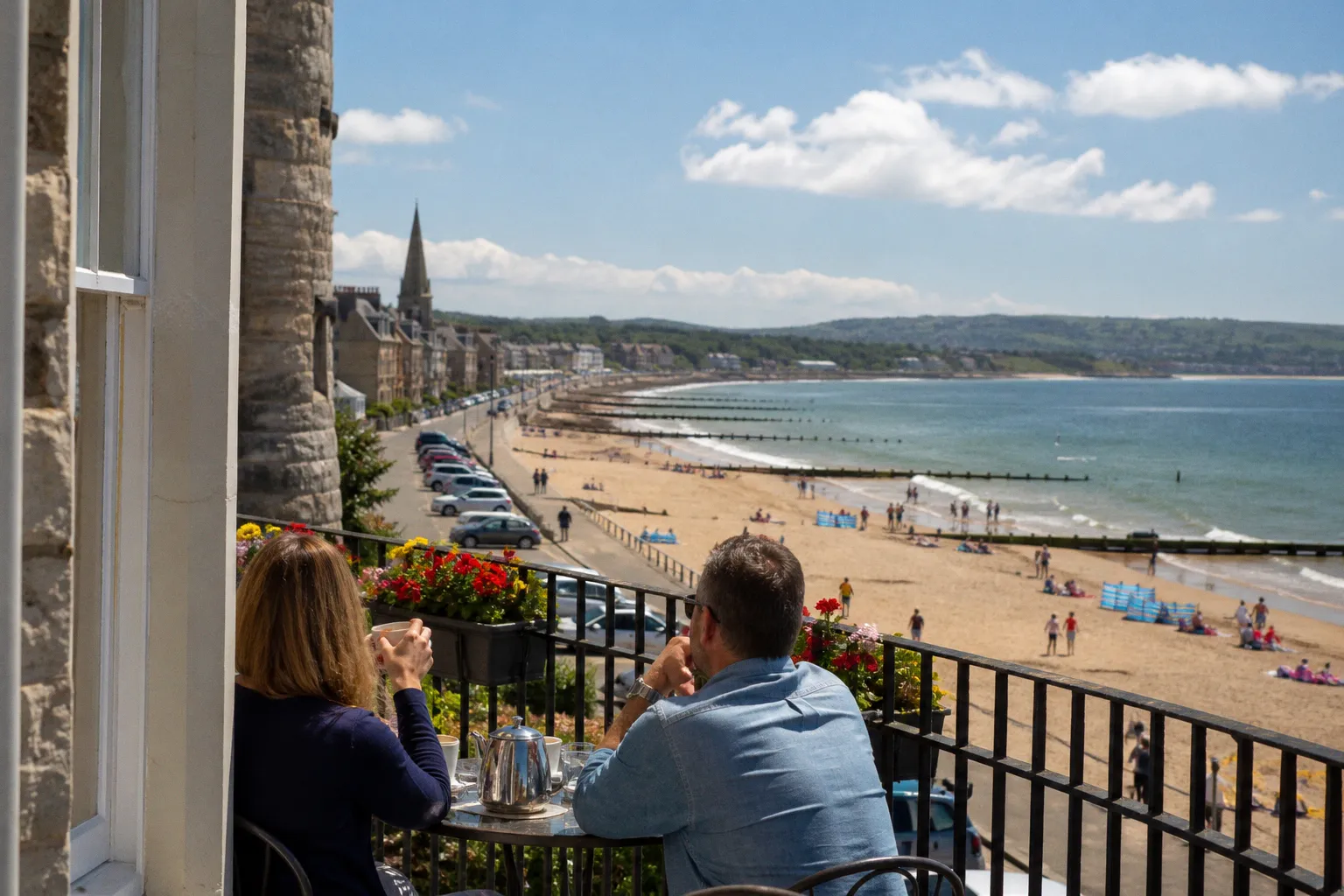
A Musselburgh bed and breakfast coastal stay works because it solves a practical problem: how to remain within reach of Edinburgh without paying for a city-centre address or spending the entire weekend inside the city itself.
Musselburgh sits on the East Lothian coast of the Firth of Forth, approximately eight miles east of Edinburgh city centre and around two miles from Portobello. That position creates a distinct accommodation proposition. Guests can use the town as a base for Edinburgh, but the stay is shaped by the coast, Fisherrow Harbour, the River Esk, local links and the open space around Levenhall Links.
The distinction matters. Musselburgh is not Edinburgh’s central district with a beach attached. It is an East Lothian coastal town bordering the capital, with its own transport pattern, accommodation stock and daily rhythm. Choose it for the right reasons and it is efficient. Choose it expecting a second version of the Old Town and the value disappears.
The coastal base is the product
For many visitors, the decision is framed as Edinburgh versus the coast. That is too crude. The more useful comparison is between a city-centre room and a coastal base that adds a manageable journey while changing the structure of the weekend.
Musselburgh offers access to several different types of stay:
- traditional guest houses and bed and breakfasts;
- inn-style accommodation;
- rooms positioned near Musselburgh Old Links and the racecourse;
- properties suited to visitors combining Edinburgh with Portobello, Fisherrow or the wider East Lothian coast;
- coastal accommodation with a quieter evening environment than the central city.
The commercial point is straightforward. Location is not just a line on a map. It determines how guests use the property between arrival and departure. A city-centre visitor may spend little time in the accommodation other than sleeping. A guest staying in Musselburgh is more likely to assess the room as a base: Is the route into Edinburgh predictable? Can the coast be reached on foot? Is breakfast aligned with the day’s plans? Is there enough local activity to justify staying outside the centre?
Those questions are more important than the generic promise of a sea view.
Musselburgh sells proximity to Edinburgh, but the reason to stay is the combination of access and separation.
The strongest booking decisions usually come from matching the property’s actual operating model with the guest’s itinerary. A visitor focused on museums, restaurants and late-night events may place a high value on central access. Someone planning a mixed weekend of Edinburgh, Portobello and East Lothian may get more from Musselburgh, particularly if the accommodation provides a clear transport plan and accurate information about local distances.
What kind of accommodation is available?
Musselburgh’s coastal lodging is not a single category. Two properties can both appear in a search for Musselburgh seaside guest houses while offering materially different stays.
A traditional B&B may be owner-managed, room-led and oriented around a direct relationship with the host. An inn may put greater emphasis on an on-site food-and-drink operation. A golf-side guest house may attract visitors attending events, following racing or looking for a practical overnight base rather than a full-service hotel environment.
Arden House B&B illustrates one version of the model. It is on Linkfield Road, directly opposite Musselburgh Old Links golf course and racecourse. Its breakfast is a continental meal delivered to guest rooms rather than a full cooked service in a dining room. That is not a minor detail. It changes the morning routine, staffing requirement and suitability for different types of guest.
The relevant question is not whether a property uses the label “B&B”. It is what the label means in practice.
| Operating feature | Traditional guest house | Inn-style accommodation | Room-delivered breakfast model |
|---|---|---|---|
| Main appeal | Personal service and a residential setting | Accommodation combined with a local food-and-drink venue | Privacy and a low-contact morning |
| Breakfast pattern | May be served in a shared dining area | Often linked to the inn’s service hours | Delivered to the room, commonly continental |
| Best fit | Guests who value host knowledge and a conventional B&B format | Visitors who want an evening venue on site or nearby | Early starters, independent travellers and guests who prefer flexibility |
| Potential limitation | Service may follow fixed house routines | Evening activity can create noise or reduce privacy | Less suitable for guests specifically seeking a cooked breakfast |
| Booking question | What are the check-in and breakfast arrangements? | What facilities operate at the time of stay? | What is included, and when is it delivered? |
The table is deliberately operational. Breakfast format, check-in method and evening service affect the experience more reliably than broad descriptions such as “seaside retreat” or “boutique stay”.
A golf-side location is not a beach location
Arden House is opposite the Old Links golf course and racecourse, not directly on the beach. A property can be coastal in the wider sense while still requiring a separate journey to Fisherrow Beach, Portobello or the harbour.
This is where accommodation descriptions often create avoidable confusion. “Near the coast” may mean a short walk, a local bus ride or simply a position within the same town. For a weekend itinerary, those distinctions determine whether a morning shoreline walk is realistic or whether it needs to be planned around transport.
Guests should assess the address against the places they actually intend to visit:
- Fisherrow Harbour;
- Fisherrow Beach;
- Portobello Beach;
- the River Esk;
- Musselburgh Lagoons at Levenhall Links;
- Musselburgh town centre;
- the Edinburgh city centre.
The map should be read as an itinerary, not as a marketing image.
Staying in Musselburgh near Edinburgh: the transport calculation
The main objection to a Musselburgh stay is predictable: it is outside the city centre. The answer depends on whether the transport link is acceptable for the specific weekend.
Direct public buses connect Musselburgh’s main street with Edinburgh city centre at Princes Street. The service runs every 20 minutes, with an official journey time of around 38 minutes. That is a useful connection, but it is not the same as stepping out of a central hotel onto the Royal Mile.
The difference becomes practical in three situations:
1. Fixed-time bookings.
Theatre performances, restaurant reservations and early tours leave less room for an unplanned delay. A guest staying in Musselburgh should work backwards from the booking time, rather than relying on an optimistic map estimate.
2. Late returns.
A coastal base is easier to manage when the evening schedule is known. Guests planning late nights in Edinburgh need to confirm the return options instead of treating the daytime bus frequency as evidence of an all-night service.
3. Multiple daily journeys.
If the itinerary involves repeated trips into central Edinburgh, the cumulative travel time becomes part of the accommodation decision. One return journey may be immaterial. Several can change the economics and convenience of the stay.
A 38-minute official bus journey is reasonable for many visitors, particularly when the room rate, setting and access to the coast justify it. It is less compelling for a guest who wants to return to the room between every activity or who has no interest in Musselburgh beyond the overnight address.
The value is in the combined itinerary
Musselburgh works best when the travel plan has at least two components: Edinburgh plus the coast, or Edinburgh plus East Lothian. It is less efficient when every hour is allocated to the city centre.
That makes the town useful for:
- a weekend divided between Edinburgh sightseeing and Portobello;
- visitors attending events near the racecourse or Old Links;
- travellers extending a city break into East Lothian;
- guests who prefer a town-based evening after a day in Edinburgh;
- short stays where the accommodation itself is part of the location choice rather than a bed used only between city activities.
Portobello is approximately two miles from Musselburgh, which gives the two coastal areas a practical relationship. They are close enough to combine, but not so close that guests should assume every property offers direct beach access.
Fisherrow, the River Esk and Levenhall Links
Musselburgh’s shoreline is not one continuous attraction with a single entrance. It is a sequence of places with different uses and different levels of activity.
Fisherrow Harbour gives the coast a working, local reference point. Fisherrow Beach is the obvious destination for guests looking for shoreline access. The River Esk cuts through the town and adds a separate walking route, while the Musselburgh Lagoons at Levenhall Links provide a more open landscape around the coast.
This variety is useful for accommodation operators because it broadens the reason to stay. The property does not have to compete solely on direct sea frontage. It can act as a base for a set of short outings, provided the information given to guests is precise.
A good local guide should distinguish between:
- a harbour visit and a beach visit;
- a town walk and an open shoreline walk;
- a route suitable for a short morning outing and one requiring more time;
- a place that works in poor weather and one that depends on clear conditions;
- a destination reachable on foot from the property and one better approached by bus or car.
That level of detail is more valuable than a long list of attractions. It reduces the gap between what the guest expects and what the property can deliver.
For visitors, the useful test is whether the accommodation gives them enough local information to build a realistic day. If the description names Fisherrow Harbour, Levenhall Links and Portobello but does not explain their relationship to the address, the research is incomplete.
A coastal address is only an advantage when the guest can convert it into a workable day without repeatedly solving the same logistics.
The breakfast question is operational, not decorative
Breakfast remains one of the clearest dividing lines between different B&B models. It also exposes the difference between a property’s name and its actual service.
Some guests book a bed and breakfast expecting a cooked Scottish breakfast at a fixed time. Others want coffee, bread, fruit and an early departure. Neither preference is inherently superior, but the mismatch creates immediate dissatisfaction.
Arden House’s room-delivered continental breakfast is a useful example of how the traditional model is changing. The service provides convenience and reduces the need for a staffed breakfast room, but it will not satisfy a guest who selected the property specifically for a hot cooked meal.
The booking information should answer five practical questions:
- Is breakfast continental, cooked or a combination?
- Is it served in a dining room or delivered to the room?
- What time is it available?
- Can an early departure be accommodated?
- Are dietary requirements handled in advance?
These are not minor service notes. They affect the guest’s first decision of the day, particularly when the itinerary includes an early bus into Edinburgh, a golf booking, a race meeting or a coastal walk.
For owners and managers, breakfast format also has an effect on occupancy economics. A cooked service requires food preparation, staff coverage, equipment and a defined service window. A room-delivered continental arrangement changes that labour profile and can support a more flexible operating pattern. It may also alter the type of guest attracted by the property.
The commercial mistake is to treat a breakfast change as a purely internal decision. It needs to be reflected in every customer-facing description. A property that advertises itself as a conventional B&B but gives guests a room-delivered continental breakfast without making that clear has created a preventable expectation problem.
Seasonal fluctuation and the coastal demand pattern
Musselburgh’s demand is shaped by two overlapping markets: visitors using the town as an Edinburgh base and visitors choosing the East Lothian coast on its own terms.
That combination can smooth demand, but it does not remove seasonal fluctuation. Edinburgh’s event calendar, school holidays, summer travel, race meetings and weekend patterns will all influence booking behaviour. Coastal demand may be more sensitive to weather and daylight, while city demand can remain strong for reasons unrelated to the shoreline.
Property owners should avoid treating every weekend as interchangeable. The commercial profile changes according to:
- whether Edinburgh is drawing high visitor volumes;
- whether a local event is taking place near the racecourse or Old Links;
- whether guests are booking for the beach and outdoor routes;
- the length of stay;
- the proportion of direct bookings versus platform bookings;
- the amount of notice between search and arrival.
Yield decisions should reflect the property’s actual demand sources. A room with a golf-course or racecourse position may perform differently from one marketed primarily as a beach base. A room with a flexible breakfast arrangement may suit early event visitors but be less attractive to guests treating breakfast as part of the Scottish lodging experience.
The answer is not to use more promotional language. It is to segment the offer accurately. The address, transport connection, breakfast model and local landmarks should be visible before booking, not discovered after arrival.
The difference between a coastal stay and a city break
A weekend in Musselburgh is not simply a cheaper Edinburgh weekend. That framing underestimates the town and misrepresents the trade-off.
The guest gives up immediate access to central Edinburgh and gains a more distributed itinerary. The stay has a base, a transport leg and a set of coastal locations that need to be used deliberately. That can be an advantage for travellers who dislike spending the whole trip in the city, but it creates more planning than a central hotel booking.
The accommodation should therefore be judged across four operating dimensions:
- Access: how clearly does the property explain the route into Edinburgh and the time required?
- Locality: are the coast, harbour, river and open spaces genuinely usable from the address?
- Service model: does breakfast and check-in match the guest’s likely schedule?
- Positioning: is the property honest about whether it is a beach stay, a town stay or a transport-efficient base?
These dimensions also explain why two similar-looking listings can produce very different reviews. A guest who wants a quiet, independent base may regard a room-delivered breakfast as an advantage. A guest seeking a full-service Scottish guest house may see the same arrangement as a reduction in service. The property has not changed; the expectation has.
For a broader view of the area’s accommodation and visitor infrastructure, East Lothian coastal travel information can help place Musselburgh within the wider shoreline rather than treating it as an isolated stop. The useful point is not to accumulate destinations. It is to understand how the town connects to the rest of the coast.
A practical selection method for guests
The choice becomes easier when the search is ordered by consequences rather than appearance. Start with the itinerary, then test the accommodation against it.
1. Fix the primary purpose of the trip.
If Edinburgh is the only objective, compare the total transport burden with a city-centre stay. If the plan includes Portobello, Fisherrow or East Lothian, Musselburgh becomes more competitive.
2. Measure the address against the coast.
Do not assume that a coastal town address means a sea-facing room or immediate beach access. Identify the actual distance to the shoreline and the route required.
3. Read the breakfast description closely.
“Breakfast included” is incomplete information. Establish whether the service is cooked, continental, room-delivered or tied to a fixed time.
4. Check the return journey before booking evening plans.
Daytime bus frequency is useful, but it does not answer the question of getting back after a late booking in Edinburgh.
5. Match the room to the length of stay.
A compact room may be adequate for one night built around an event. A longer weekend places greater weight on storage, sitting space, access to local food and the quality of the surrounding area.
6. Separate the property’s setting from its sales language.
Racecourse, golf course, harbour and beach each imply a different stay. The most accurate description is the one that tells you what is outside the door and what is not.
This is a more reliable method than searching for the most attractive photograph. Images show condition and presentation. They rarely show the timetable, the breakfast window or the last return bus.
What owners need to communicate
For property owners and managers, the same analysis points to a simple commercial rule: precision converts better than atmosphere when the location involves a transport decision.
A listing for Musselburgh coastal accommodation should make the following visible without forcing the guest to reconstruct it from several pages:
- the approximate relationship to Edinburgh city centre;
- the distance to Portobello;
- the nearest relevant coastal landmarks;
- whether the property is near Fisherrow, the beach, the river, the racecourse or the golf course;
- the bus connection to Princes Street;
- the breakfast type and delivery method;
- early departure arrangements;
- any limitations created by the property’s location or operating hours.
This is not an argument for dense technical copy. It is an argument for removing ambiguity. A guest can accept a 38-minute bus ride. They are less likely to accept discovering it only after booking. They can prefer a continental breakfast. They are less likely to appreciate an implied promise of a cooked one that was never available.
The strongest operators also understand that the local setting needs to be translated into use cases. “Near Fisherrow Harbour” is a location statement. “Suitable for a morning shoreline walk before the Edinburgh bus” is a planning statement. The second is more useful because it connects the place to the guest’s day.
The verdict on a Musselburgh coastal stay
A Musselburgh bed and breakfast coastal stay is a rational alternative to central Edinburgh accommodation when the guest wants both city access and a separate coastal base. The town is approximately eight miles from the centre, Portobello is around two miles away, and direct buses reach Princes Street every 20 minutes with an official journey time of about 38 minutes.
Those facts make the proposition credible. They do not make every property suitable for every visitor.
The right booking depends on three matches: the transport link must fit the itinerary, the accommodation’s actual position must fit the promised coastal experience, and the breakfast model must fit the guest’s morning routine. Properties such as Arden House demonstrate why service details deserve the same attention as location: a continental breakfast delivered to the room is a defined operating choice, not a footnote.
For guests, the conclusion is practical. Choose Musselburgh when you want Edinburgh within reach but not as the entire setting of the weekend. Choose it when Fisherrow, Portobello, the River Esk or Levenhall Links will form part of the plan. And choose a particular B&B only after checking what its address, transport and breakfast arrangements mean in real use.
For owners, the opportunity is equally clear. Musselburgh does not need exaggerated coastal language. Its commercial strength lies in a measurable proposition: a distinct East Lothian base, direct access to Edinburgh, and a shoreline itinerary that rewards accurate information.