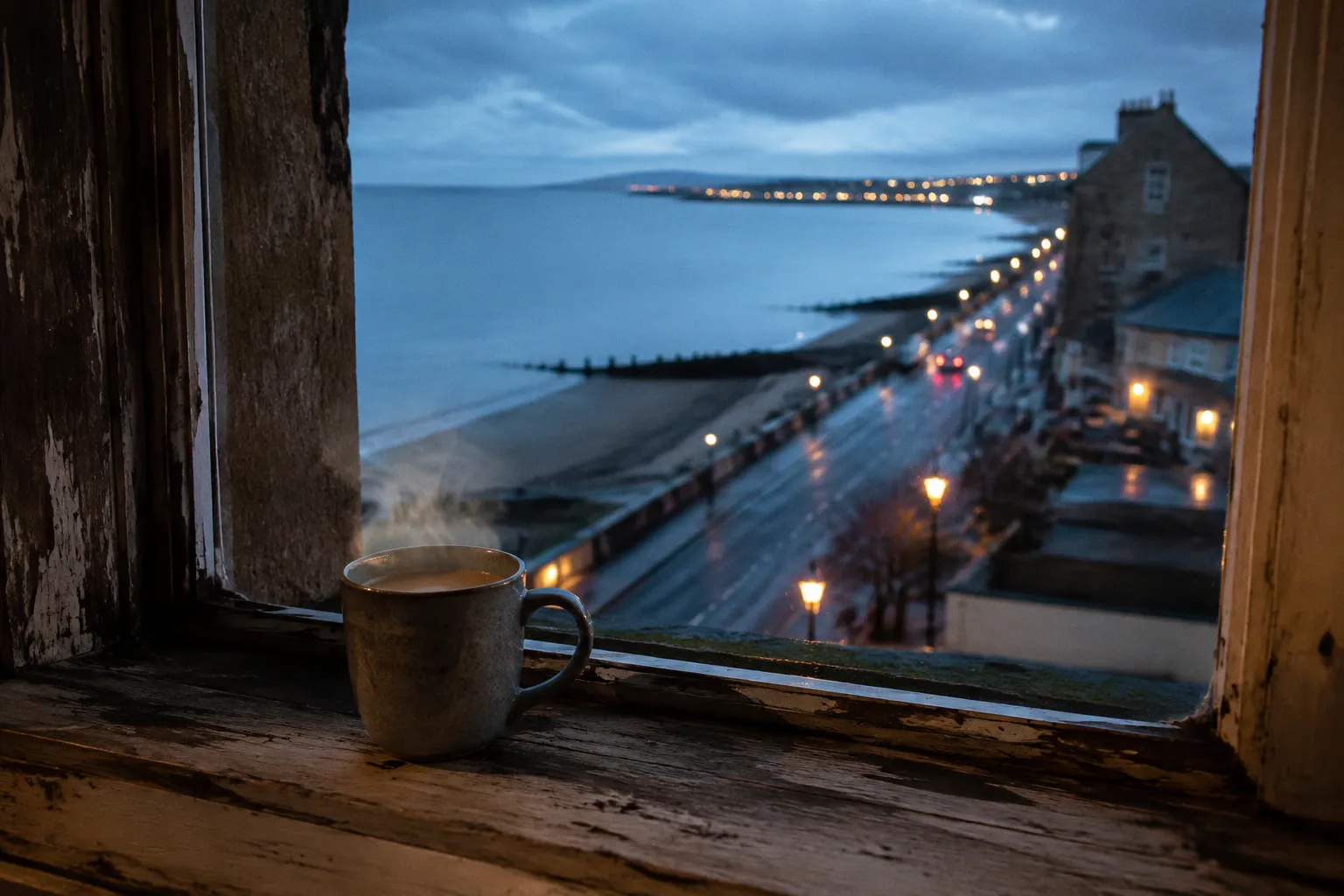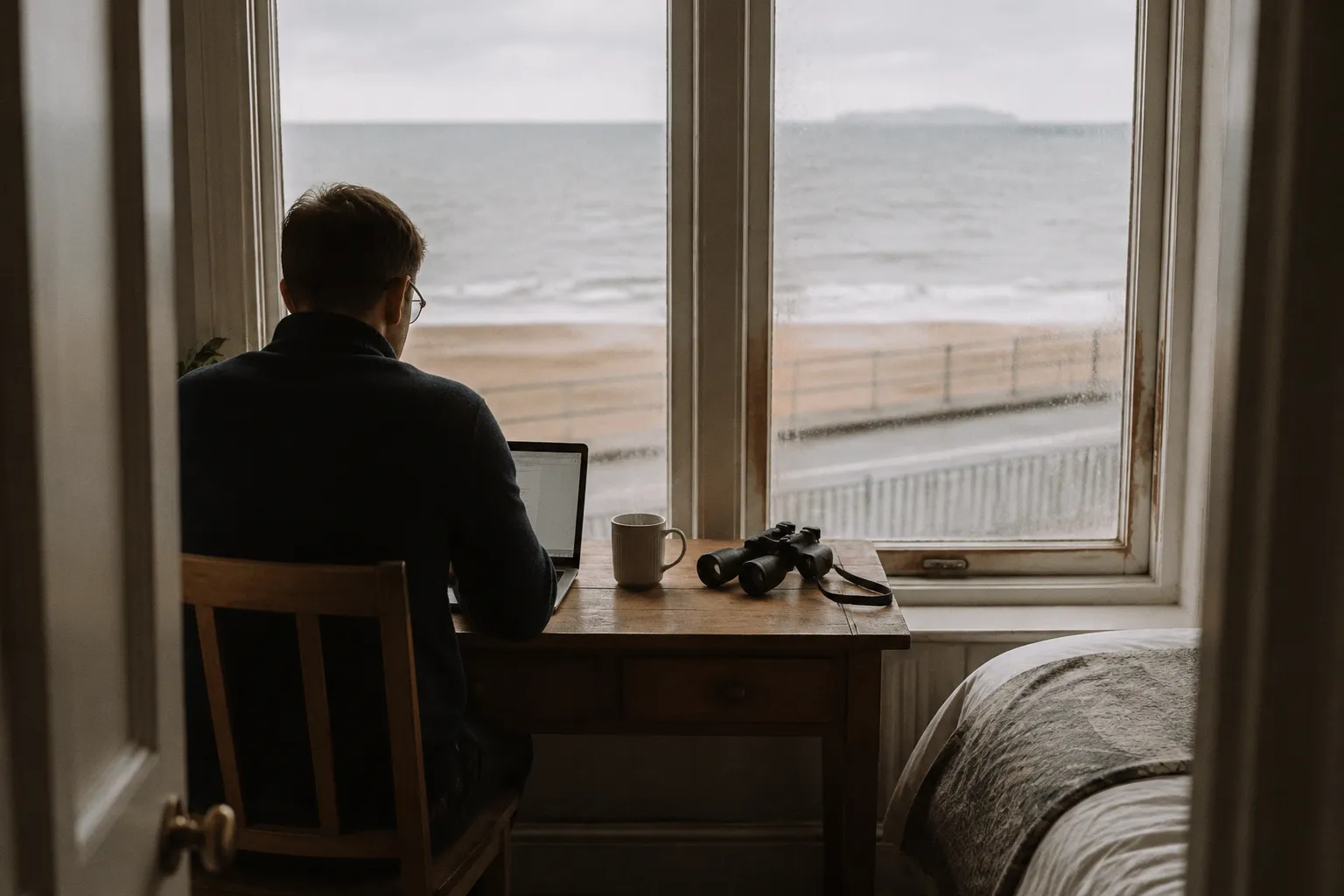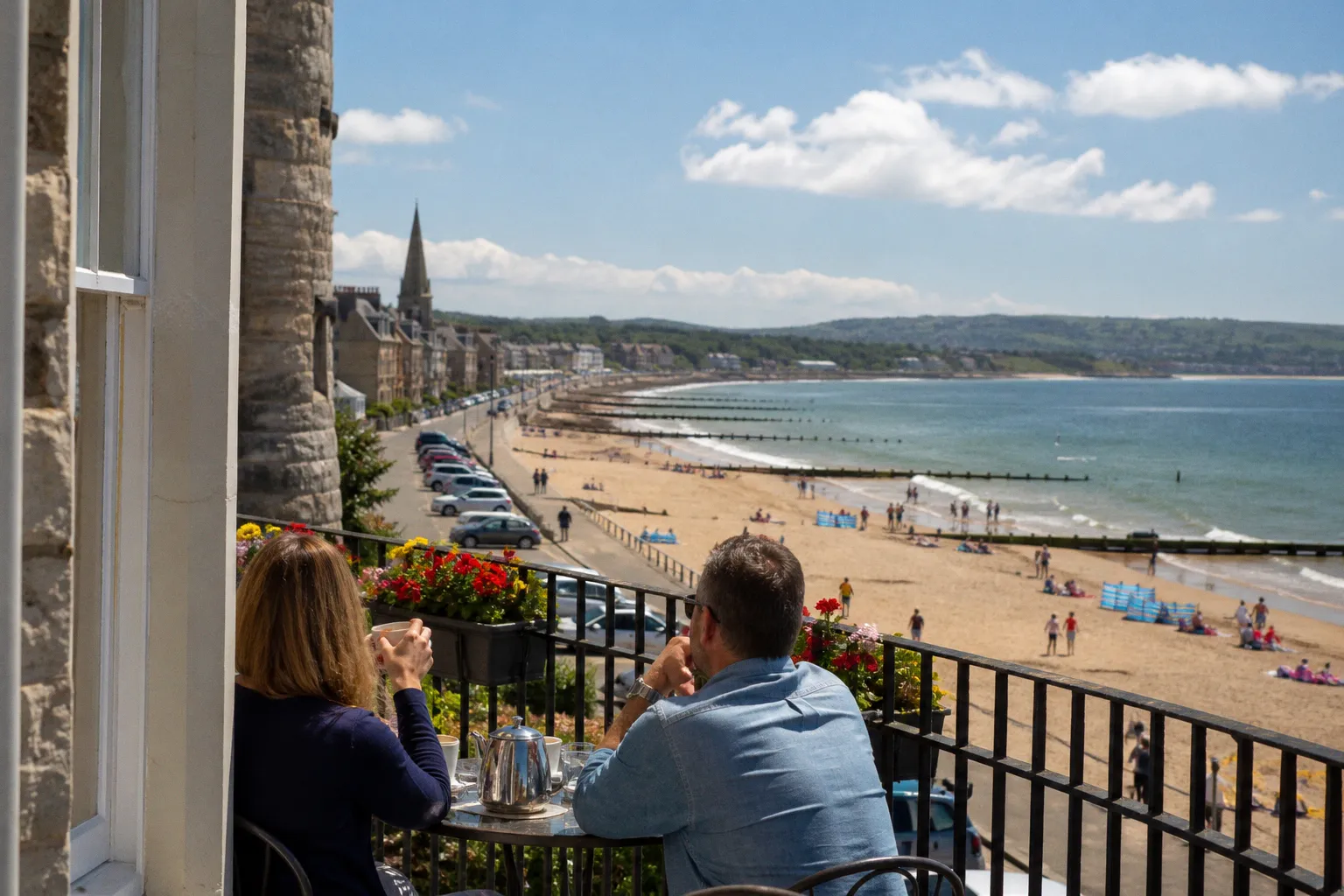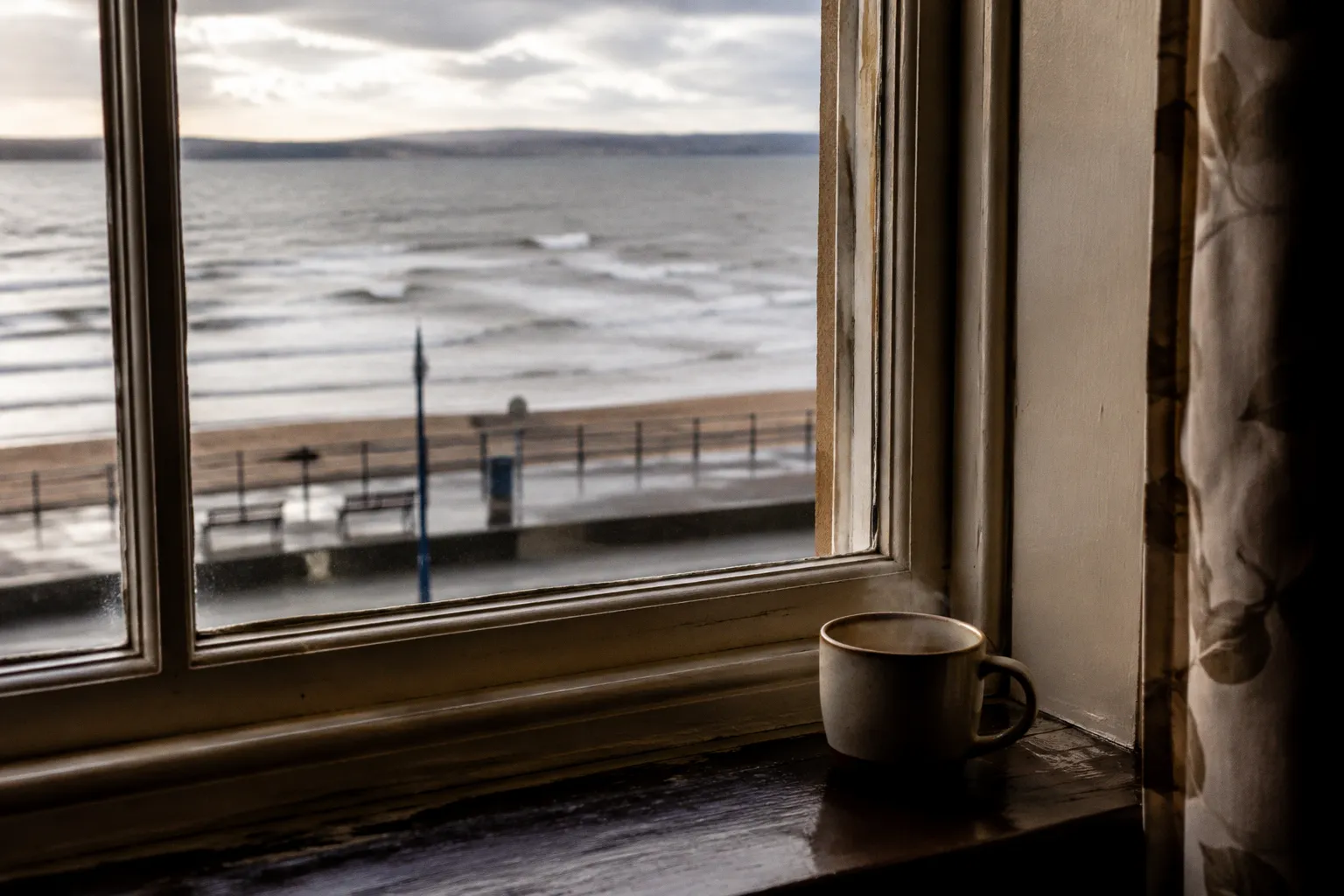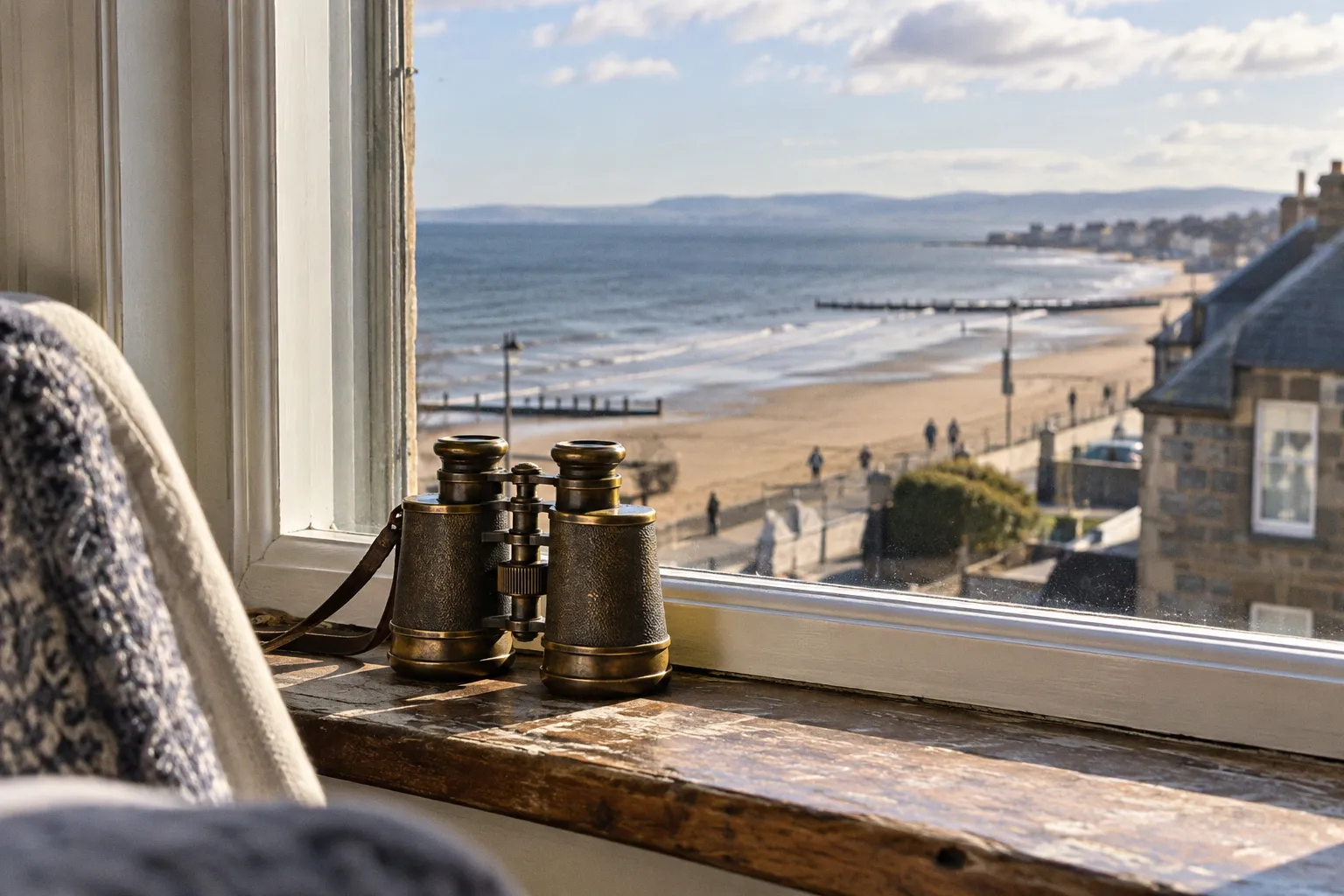
A guest house may stand only 90 metres from Portobello beach and still offer no full sea view at all.
That is not necessarily a failure of the property. It is a consequence of Edinburgh’s coastal geometry: Victorian terraces, narrow streets, adjoining elevations, bay windows, side-facing rooms and changing sightlines across the promenade. The phrase “near the beach” describes access. It does not, by itself, describe what happens when you draw the curtains.
For anyone comparing Edinburgh coastal guest house room views, the distinction is decisive. A room overlooking the sea can transform a modest seaside stay into something properly memorable. A room described as coastal but facing a neighbouring wall may still be perfectly comfortable, but it is a different proposition and should be priced, selected and understood as such.
The geography of sightlines: why proximity does not guarantee a view
Portobello and Joppa are unusually appealing because they combine genuine coastal access with a relatively quick connection to central Edinburgh. By bus, the journey into the city centre is approximately 20 to 25 minutes, depending on the route and traffic. That gives the area a useful dual identity: a seaside address with urban reach, rather than an isolated resort that requires a separate holiday logic.
The trouble begins when marketing language compresses several different experiences into one phrase.
A property can be:
- close enough to the beach for an easy walk;
- positioned on a street that runs towards the water;
- located within a coastal postcode;
- equipped with a room from which the Firth of Forth is visible;
- or genuinely front-facing, with a broad and uninterrupted panorama.
These are not interchangeable descriptions. In a Victorian coastal neighbourhood, a difference of a few metres, a floor, or a window bay can radically alter the view. A first-floor room may look directly towards the promenade while a ground-floor room sees only the rhythm of railings, parked cars and passing pedestrians. A side-facing window may catch a wedge of water without delivering the expansive vista implied by “sea view”.
The most reliable question is therefore not “How close is the guest house to the beach?” but “What does this particular room face, and through which window?”
That is a more exacting question, but coastal accommodation rewards exactness. If the room is being chosen for the view, the view is part of the room’s architecture.
The beach is a location. The sea view is a spatial condition.
Distance remains useful, of course. A guest house 50 yards from Portobello’s sandy beach and promenade has a material advantage over one several streets inland, particularly for early walks, swimming, paddleboarding or simply stepping out to hear the water before breakfast. Straven Guest House in Joppa is one example of this kind of proximity. But even there, the individual room still deserves scrutiny. Being near the promenade does not tell you whether the room faces it.
The same principle applies to Edinburgh waterfront guest houses more broadly. A property can have an excellent address and a weak visual relationship with the water. Conversely, a room set slightly back may have a cleaner, higher or more generous sightline than one technically closer to the shore.
Victorian architecture and the challenge of coastal sightlines
The architectural character of Portobello and Joppa is part of the appeal, but it also creates the very inconsistencies that make room selection necessary.
Many coastal guest houses occupy older buildings whose proportions were not designed around contemporary hospitality categories. Their rooms may have been arranged as private drawing rooms, family bedrooms or servants’ quarters long before anyone began selling “Firth of Forth sea view rooms” as a booking filter. The result is a collection of individual spaces rather than a uniform inventory.
That individuality can be beautiful. It can also be inconvenient.
A large bay window may pull the room towards the water and create a wide, layered view across the Firth. A narrow sash window may offer only a partial glimpse between buildings. A room at the rear may be quieter and more private but visually disconnected from the shoreline. An upper-floor room may achieve the height needed to clear surrounding roofs, while a lower room benefits from a stronger relationship with the promenade and street life.
The visual language of older buildings is often more nuanced than a binary “sea view” label allows. Consider the following distinctions when reading a room description:
| Room condition | What it may offer | What it may not offer |
|---|---|---|
| Full front-facing view | A direct, broad prospect towards the Firth of Forth | Privacy may be lower, particularly on busy promenade-facing elevations |
| Partial or side view | A framed glimpse of water and changing light | No uninterrupted panorama; the angle may vary considerably |
| Bay-window room | Greater width of outlook and a more generous visual field | More exposure to daylight, street noise or temperature fluctuation |
| Upper-floor room | Better clearance over neighbouring buildings and rooftops | More stairs if there is no lift; the view may still be angled rather than frontal |
| Rear-facing room | Often quieter, with more privacy and less promenade activity | Little or no relationship with the sea |
| Balcony or overhang terrace | A stronger sense of outdoor connection and horizon | Its value depends on orientation, wind exposure and whether the room itself shares the same outlook |
This is where architectural literacy becomes practical rather than decorative. A bay window is not merely a period feature. It changes the room’s depth, daylight distribution and viewing angle. An original fireplace is not only a heritage detail. It can establish the visual centre of the room and make the space feel composed even when the sea is not visible from every position.
The strongest rooms balance these elements rather than displaying them as a collection of props. Heritage tones, original joinery and tactile textiles matter because they shape how the room is inhabited. A beautiful view through an uncomfortable window is still a poor room. If the glazing is draughty, the curtains do not close properly, or the bed is placed so that the only way to see the water is to stand beside a radiator, the design has failed at the level that matters.
What makes a coastal view genuinely premium?
Not all sea views have the same value. A premium vista is not necessarily the largest one, nor does it always belong to the most expensive room. What matters is the relationship between outlook, light, privacy, comfort and the way the room lets the guest use the view.
One of the clearest examples is the King Size room at Seabreeze Guest House, at 1 Seaview Terrace. Its large bay window and original fireplace establish two strong focal points: one outward-facing, one architectural. The view across the Firth of Forth is not simply an image placed behind the bed. It becomes part of the room’s composition, with the bay window providing breadth and the fireplace giving the interior a sense of permanence.
That combination is more valuable than a generic “sea-facing” label because it tells you how the view is experienced. A room can face the water but have a small window positioned too high or too far to one side. Another can offer a partial outlook but create a more satisfying visual rhythm through a deep bay, layered curtains and a comfortable chair placed at the correct angle.
The most desirable details tend to be tactile as well as visual:
- A properly proportioned window seat or armchair, allowing the guest to use the view without standing at the glass.
- Curtains with enough weight and fullness to control glare, privacy and evening draughts.
- A bed orientation that acknowledges the outlook, rather than turning the sea into an incidental view from the doorway.
- Layered lighting, so the room remains calm after sunset instead of becoming a dark pane reflecting the interior.
- Quiet hardware and good seals, particularly in exposed coastal buildings where wind can undermine the sense of refinement.
- A clear relationship between window and furniture, with no oversized wardrobe or television blocking the room’s principal axis.
- Textiles that absorb rather than amplify sound, especially in rooms facing the promenade.
The phrase “coastal room orientation benefits” can sound like booking-platform jargon, but the underlying idea is sound. Orientation affects more than the view. It influences when daylight enters, how much heat the room gathers, whether the water is visible from the bed, and how directly street noise reaches the space.
A front-facing room may be exhilarating during the day and more exposed at night. A room with a side outlook may receive beautiful lateral light and greater privacy. A rear-facing room may offer better sleep, particularly for guests who are more interested in the beach at breakfast than in watching the promenade after dark.
Premium hospitality is not about maximising one feature at the expense of all others. It is about curating the balance.
The difference between a framed view and a panorama
A framed view can be more elegant than a wide one. A narrow window that isolates the water, a distant headland or the movement of boats may produce a more composed visual experience than a broad outlook cluttered by signs, roofs and parked vehicles. This is particularly true in older seaside streets, where the built environment is inseparable from the view.
A panorama, however, delivers a different kind of pleasure. The Ark at Anchor apartment in Joppa has a 12-metre overhang balcony with 180-degree views across the Firth of Forth to Fife. That scale changes the category of the stay. The water is not simply visible from a room; it becomes an outdoor spatial extension of the accommodation.
The practical distinction is important. A balcony of this depth and width offers room to sit, move and spend time outside. A shallow Juliet balcony or narrow external ledge may provide visual drama but little usable space. Similarly, a room with a large window may feel more connected to the water than one with a balcony that is too exposed to wind to use comfortably.
When comparing rooms, ask what the view permits you to do. Can you read beside it? Have coffee there? Watch the tide? Open the window without sacrificing privacy? See the water from the bed, or only from one corner of the room? These questions take the view out of the brochure and put it back into lived experience.
Portobello or Joppa: access, atmosphere and the price of the outlook
Portobello and Joppa are close enough to be considered together, but they do not offer exactly the same guest experience. Portobello’s sandy beach and promenade bring a more legible seaside atmosphere: an easy relationship with walking, open water and public activity. Joppa can feel more residential and architecturally varied, with the coast integrated into a quieter urban edge.
Neither setting should be reduced to a simple hierarchy. The best choice depends on what the guest values.
Portobello beach front accommodation is compelling for visitors who want the shoreline to function as part of the daily itinerary. The distance from the building to the sand matters here. It supports unplanned walks and early-morning access without turning every trip to the water into a logistical decision.
Joppa seaside stay room selection can be more about the quality of the individual building and its outlook. A carefully positioned room, particularly one with a generous balcony or elevated sightline, may offer a stronger sense of the Firth than a room in a more prominent Portobello address. The relevant comparison is not neighbourhood prestige but spatial performance.
There is also a price-to-value question. A premium room with a view commands more only when the view is usable and clearly defined. Paying extra for a vague promise of “coastal atmosphere” is not the same as paying for a named room with a confirmed front-facing window, a bay, a balcony or a documented outlook.
A discerning booking decision weighs the whole proposition:
- Is the view direct, partial or merely implied by the address?
- Does the room have enough space to sit comfortably near the window?
- Does the premium rate include a meaningful improvement in bed size, bathroom quality or natural light?
- Is the room exposed to promenade noise, and is there evidence of adequate window treatment?
- Is the sea visible throughout the day, or only from a particular angle?
- Does the property offer a quieter alternative at a lower rate without compromising the essentials?
- How much of the stay will actually be spent in the room?
That last question is often neglected. A guest planning full days in central Edinburgh may not extract much value from a dramatic sea-facing room. Someone arriving for a slower coastal break, a writing retreat or a restorative weekend may regard the outlook as the principal reason to book.
Aesthetic judgement must remain tethered to use. The most photographable room is not automatically the most comfortable one.
Windows, light and the mechanics of comfort
The visual appeal of a sea view is immediate, but the long-term quality of a room is often determined by less glamorous elements. Coastal accommodation needs to handle brightness, wind, moisture, temperature changes and sound with some competence.
Large glazing can make a room feel expansive, particularly in a building with high ceilings and restrained furniture. It can also create heat build-up during bright weather, glare across a laptop or breakfast table, and a sense of exposure after dark. The solution is not to disguise the window with heavy furnishings but to layer the room intelligently.
A well-resolved coastal room usually needs three lighting conditions:
1. Natural daylight, allowed to define the room rather than being blocked by thick, permanently closed curtains.
2. Task lighting, positioned for reading, dressing and practical movement after sunset.
3. Low-level ambient lighting, giving the interior enough depth that guests are not left with either harsh ceiling light or a black window reflecting every lamp.
Textiles have a similarly practical role. Linen, wool, cotton velvet and heavier woven fabrics can introduce heritage tones without making the room feel staged. More importantly, they can soften acoustics and provide control over privacy. The tactile quality of a curtain or bedcover should support the guest rather than function as a visual flourish.
Sound is the other half of the coastal equation. A front-facing Edinburgh waterfront guest house may benefit from an excellent view but remain connected to the public life of the promenade. That connection can be charming during the day and less welcome at midnight. Older buildings do not offer identical modern soundproofing or standardised layouts, so room placement becomes part of the comfort decision.
This is why a room described as “bright sea view” should not be assessed in isolation. A better description would also tell the guest whether the window is front-facing, whether it opens, whether there are secondary windows, and how the bed is positioned. The more precise the room description, the less likely the guest is to confuse visual appeal with full performance.
How to secure the right room before confirming the stay
Booking platforms favour compressed language. A few words must stand in for orientation, floor level, window size, daylight, noise and privacy. That compression creates the familiar mismatch between expectation and arrival: the guest books a coastal room and discovers that the sea appears only as a narrow blue line beyond a side elevation.
The remedy is a short, specific conversation with the property. Not a demand for guarantees that no older building can honestly provide, but a request for spatial information.
Ask:
- Which named rooms have a direct view towards the Firth of Forth?
- Is the view full, partial or side-facing?
- Is the sea visible from the bed or only from the window?
- What floor is the room on?
- Does it have a bay window, balcony or multiple windows?
- Is the outlook shown in current room photographs rather than general property images?
- Does the room face the promenade, a side street or the rear of the building?
- Are there curtains or blinds for privacy and glare control?
- Is the room likely to hear passing traffic or promenade activity?
- If the sea view is the priority, which room would the property itself recommend?
The final question is often the most revealing. A thoughtful host understands that a room’s value depends on the guest’s purpose. Someone looking for the best outlook may not want the same room as someone who values quiet sleep, easy access or a lower rate.
Do not rely on the expression “sea view” without asking how it is defined. Across different booking platforms, partial water views may be presented under the same broad category as uninterrupted outlooks. The distinction is not a technicality when the room rate has been set around the view.
It is also sensible to request the exact room rather than a general category where possible. “King Room with Sea View” may refer to one particularly strong room and another with a less generous angle. In a building with irregular Victorian layouts, room-by-room variation is not an anomaly; it is the governing condition.
A considered booking hierarchy
If the view is central to the stay, select in this order:
1. Named room with a documented outlook.
The description should identify the window, bay, balcony or direction rather than relying only on the word “coastal”.
2. Photographs taken from inside the room.
Exterior images of the building and beach establish location, not the actual guest experience.
3. A clear understanding of the view’s scale.
Distinguish between a framed glimpse, a partial angle and a broad panorama.
4. A comfort check alongside the visual one.
Ask about bed placement, curtains, ventilation, sound and the ability to sit near the window.
5. A price comparison with quieter rooms.
If the premium is substantial, decide whether the view will be used often enough to justify it.
This is not an argument for interrogating a small guest house as if it were a hotel chain. Quite the opposite. The charm of Portobello and Joppa lies partly in their individual buildings, their irregular plans and their lack of standardisation. The point is to understand that individuality before booking, not to penalise it afterwards.
The view should belong to the room, not merely the listing
Edinburgh’s coastal guest houses offer a particularly fine version of the seaside stay: the Firth of Forth within reach, the city still accessible, and a stock of heritage buildings with far more visual character than a standardised waterfront block. But the quality of that experience depends on reading the room rather than merely admiring the address.
The best coastal accommodation creates spatial harmony between the outside and the inside. A bay window should bring in light without turning the room into a display case. A balcony should be usable, not merely impressive in a floor plan. Original features should deepen the atmosphere while the bed, lighting, textiles and acoustics protect the guest’s comfort. The view should be specific enough to trust and generous enough to live with.
A room 90 metres from the beach may offer no sea view. Another, positioned carefully above the street, may open towards Fife with remarkable clarity. A room at Seabreeze may make the bay window and fireplace feel like a complete composition. The Ark at Anchor may turn the horizon into an outdoor room across its 12-metre balcony. These are different forms of coastal value, and they should not be flattened into one marketing phrase.
The right choice is therefore not simply the closest property or the most dramatic photograph. It is the room whose outlook, architecture and comfort agree with the way you intend to stay. In Portobello and Joppa, that usually means looking past the postcode, past the promise of proximity and towards the exact geometry of the window.