The appeal lies in the overlap: a working waterfront with a long industrial memory, a contained harbour outlook, and reliable access to central Edinburgh.
That combination changes the meaning of a short stay. A guest can spend the morning writing, working, or watching the harbour traffic, then reach the city’s cultural and commercial centre without turning the journey into an expedition. The accommodation is coastal in atmosphere but urban in its practical reach. For a week-long stay, that distinction matters more than a generic promise of sea air.
The Maritime Legacy of Our Lady's Port of Grace
Newhaven’s history begins with function rather than ornament. Established as Our Lady’s Port of Grace by James III in 1488, the harbour developed as a place of national, commercial, and military importance. In 1505, James IV commissioned a Royal Dockyard here, associated with the construction of the Great Michael, one of the most ambitious warships of its period.
This was not a picturesque fishing village that happened to acquire a few historic buildings. It was a place organised around ships, materials, labour, defence, and trade. The Society of Free Fishermen, founded in 1572, reflects that collective structure. Fishing was a precarious occupation, and the society offered a form of mutual support to people whose working lives were governed by tides, weather, and the condition of the harbour.
That background still shapes the experience of staying here. Newhaven’s character does not depend on a single picturesque street or a carefully staged heritage façade. It comes from the accumulated logic of the place: the harbour walls, the working edges, the stone buildings, and the relationship between land, water, and infrastructure.
For anyone choosing an Edinburgh waterfront guest house stay, this is an important distinction. The setting has history, but the history is not decorative. It explains why the accommodation can feel more substantial and less interchangeable than a standard city apartment. A thick-walled building, a former maritime structure, or a flat overlooking the basin carries a different sense of place from a newly built room with an ornamental nautical theme.
The accommodation stock around Newhaven is varied. Some stays are modern apartments designed around broad windows and open-plan living. Others occupy older buildings whose layouts were shaped by work rather than hospitality. Rooms may be compact, entrances may be less formal than those of a hotel, and the best views may be tightly tied to the building’s position rather than advertised as a universal feature.
That is part of the appeal, but it also requires accurate expectations. A historic Newhaven seaside stay is not automatically polished in the manner of a purpose-built resort. Its strengths are usually proportion, material, outlook, and atmosphere. The harbour gives the visit a strong geographical identity; the building may give it the irregularities that come with age.
Navigating the Historic Breakwaters and Lighthouses
The harbour’s visual character is inseparable from its breakwater and navigational structures. The breakwater, initially built by Robert Stevenson in the nineteenth century and extended later in that century, creates the sheltered basin that defines the waterfront. It is both a practical piece of harbour engineering and the frame through which many visitors understand Newhaven.
The two principal historic navigational aids are the 1830 stone beacon and the 1869 octagonal cast-iron lighthouse. Both were decommissioned in 1942. Their original navigational role ended, but the structures remained part of the harbour’s physical and historical identity.
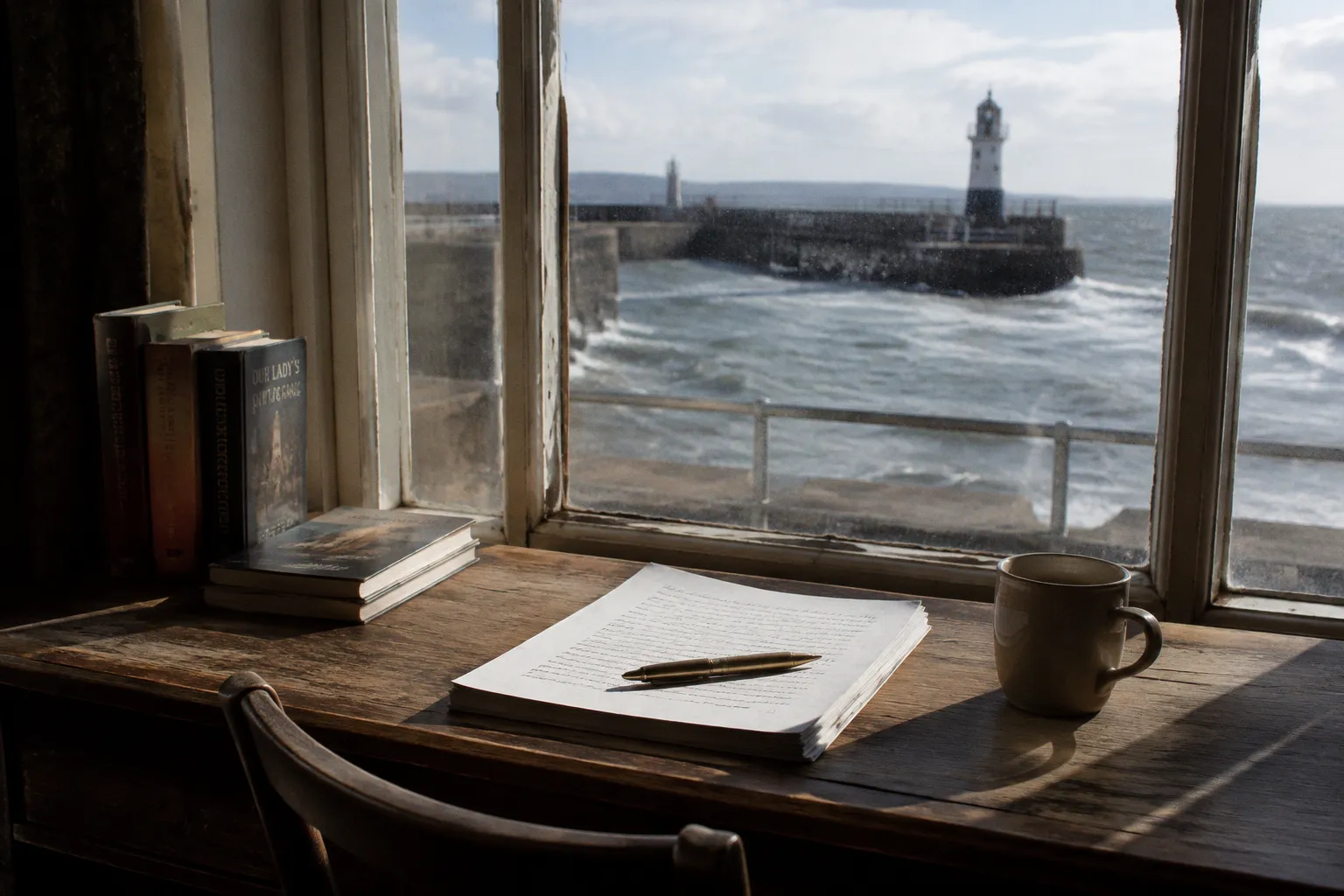
The lighthouse is particularly distinctive. Built as a 50-foot octagonal cast-iron tower by James Dove & Company, it is not a generic coastal marker that could be exchanged for another. Its form is specific to the harbour: industrial, vertical, and immediately legible against the lower buildings and water.
Both the beacon and the lighthouse are Category B listed landmarks. That designation places them within the protected historic character of the harbour and limits the kind of alterations that can be made to them or to their immediate setting. For nearby accommodation, the consequences are less dramatic than the word “restriction” might suggest, but they are real. Views, signage, extensions, external finishes, and changes to the surrounding streetscape may all be considered in relation to the character of the historic environment.
The lighthouse was relit in 2019 by Forth Ports. The relighting did not return it to its former role as a navigational aid. Instead, it gave the structure renewed presence as a visual feature and a reminder of the harbour’s maritime past. For guests, that distinction is useful: the light is part of the atmosphere and heritage of the place, not a promise that the building is operating as a modern lighthouse.
Newhaven’s waterfront is compelling because its landmarks are not stage scenery. They are working infrastructure that has acquired a second life as heritage.
A walk around the harbour rewards attention to scale. The breakwater is not just a line on a map; it establishes the limit of the sheltered water and changes how the wind, sound, and movement of the area are perceived. Near the basin, the landscape feels contained. Further out, the Firth opens into a larger horizon. That shift is one reason a Newhaven sea view B&B can feel calmer than its distance from central Edinburgh would suggest.
The outlook also changes with weather. On a clear day, the harbour reads as a composed arrangement of stone, metal, water, and sky. In poor weather, the same structures become more emphatic: the beacon and lighthouse stand out against the grey, and the breakwater gives the water a visible edge. This is not the soft, uniformly photogenic version of the seaside. It is a North Sea waterfront, and its character comes partly from that lack of predictability.
Life in a Newhaven Waterfront Guest House
The practical question for a guest is not whether the harbour looks attractive in a photograph. It is whether the accommodation supports the way the guest intends to live for several days.
For a writer, researcher, or anyone working away from home, the most useful quality is separation without isolation. Newhaven offers a clear break from the intensity of the Old Town and the central hotel districts, but it does not require a full retreat from the city. The harbour creates a psychological boundary. Once inside a well-positioned guest house or apartment, the pace of the day can feel slower, even when the city remains within easy reach.
That makes the area suitable for a working week rather than only a one-night stop. The room needs to function as more than a place to sleep. Natural light, a proper table or desk, dependable heating, and a layout that allows one person to work without occupying the bed are more consequential than a long list of decorative amenities. A view across the water is valuable, but it cannot compensate for a room that is awkward to use after the first morning.
The same applies to couples and leisure travellers. A waterfront address gives the stay a recognisable centre. Guests can walk by the harbour, follow the edge of the water, and return to a quieter base without having to plan every hour around major attractions. The experience is not beach-resort entertainment. It is a slower pattern built from short walks, changing light, the movement of vessels, and the option of going into town when the mood requires it.
Before booking, the useful questions are concrete:
- Does the room face the harbour, the street, or an internal side of the building?
- Is the sea view direct, partial, or dependent on standing at a particular window?
- Is there a suitable work surface for a laptop, notebook, or reading?
- Does the property provide the quiet expected from a waterfront stay, or is it close to a road, venue, or active pedestrian route?
- Are stairs, narrow entrances, or older-building quirks likely to affect the stay?
- Is the accommodation self-contained, lightly serviced, or operated more like a traditional bed and breakfast?
- How straightforward is the route to public transport and the city centre?
These are not bureaucratic checks. They determine whether the property’s central promise is real for the individual guest. A room can be near the water without feeling connected to it. Another may have no dramatic panorama but offer better light, a more comfortable chair, and a calmer working rhythm.
The best Newhaven accommodation tends to make its position useful rather than merely visible. A harbour-facing window is an asset, but so is the ability to close the door on the day’s movement and work for an hour without the atmosphere becoming intrusive. The area’s appeal is strongest when the exterior energy remains available without entering every part of the interior.
The Rhythm of the Firth: From Royal Dockyards to Modern Retreats
Newhaven’s modern accommodation economy depends on the contrast between old infrastructure and contemporary mobility. The harbour carries the memory of a dockyard and fishing community, while today’s guest may be visiting for writing time, a festival, university work, business, or a few days near the coast.
That mixed demand is more stable than a purely seasonal seaside model. A remote coastal property may rely heavily on warm weather and holiday periods. Newhaven can draw from Edinburgh’s year-round activity as well as from the appeal of the waterfront itself. Guests may choose it because they want a quieter base during a busy city visit, not because they intend to spend every day on the shore.
The result is a useful two-part rhythm.
The coastal stay
In the warmer months, the harbour works as an alternative to the crowded centre. Guests can start the day near the water, take a walk along the waterfront, and use the accommodation as a base for exploring Edinburgh. Families and couples may value the extra breathing space, while independent travellers often appreciate a setting with more visual character than a conventional business district.
The coastal identity also gives the accommodation a clear editorial quality. There is something to notice from day to day: the colour of the water, the visibility across the Firth, the condition of the sky, the changing relationship between the historic structures and the modern city beyond them. That is especially useful for a writer’s week. The setting supplies variation without demanding constant movement.
The urban retreat
Outside the strongest leisure periods, the same property can appeal to visitors who need access to the city but do not want to sleep in its busiest districts. Festival audiences, conference attendees, academics, and professionals may accept a short journey in exchange for a more distinctive evening base.
This is where Newhaven differs from a remote seaside stay. The point is not escape at any cost. It is controlled distance. Guests can spend the day in central Edinburgh and return to a place where the visual and acoustic cues are different. The change is enough to create a boundary around the day, but not so great that transport becomes a project.
For operators, that dual identity is more useful than a narrow “summer by the sea” position. It allows the accommodation to speak to different kinds of visitors without pretending to be all things to all people. A guest house can foreground the harbour in one season and its access to Edinburgh in another, while the underlying offer remains consistent: a characterful place to stay outside the centre but within practical reach of it.
Logistics of a Coastal Residency: Accessing the City Centre
The central logistical advantage of a newhaven harbour guest house edinburgh stay is that the waterfront is connected to the city rather than cut off from it. Public transport makes the coastal setting workable for guests who do not want to rely on a car. The tram and bus network provide routes towards central Edinburgh, while walking and local connections give the stay a more neighbourhood-based rhythm.
A journey of around twenty minutes by bus, depending on the route and traffic, is short enough to support regular city access without making the harbour feel like another district of the centre. The tram offers a more predictable connection along its route. The exact convenience will depend on the property’s position, the time of day, and the destination, but the broad proposition is sound: guests can combine a waterfront base with an urban itinerary.
This matters particularly during a week-long residency. A one-night visitor may tolerate an awkward connection because the accommodation itself is the destination. Someone staying for several days needs repeatable logistics. The route to the centre should be easy to understand, the return journey should not require elaborate planning, and the walk between the property and the stop should feel manageable in ordinary weather.
A practical day might therefore have a simple shape:
1. Morning at the harbour. Use the room or a nearby café as a working base, with the waterfront providing a defined break from the city.
2. Midday access to central Edinburgh. Travel in for meetings, libraries, galleries, university appointments, or festival events.
3. A flexible return. Come back to Newhaven without treating the journey as the final task of the day.
4. An evening shaped by the setting. Walk by the basin, eat locally, or remain in the accommodation with the harbour as the background rather than another item on an itinerary.
That sequence is less glamorous than the language often used to sell seaside accommodation, but it is more honest and more valuable. A good coastal residency is not one in which every minute is picturesque. It is one in which the practical friction stays low enough for the setting to remain enjoyable.
There are also limits. A harbour address does not guarantee silence. Wind, road traffic, nearby activity, and the normal sounds of a working waterfront can all be part of the environment. The shoreline is not the same as a private beach, and the best water views may come with exposure to weather. Guests who need complete seclusion or a full resort infrastructure should look elsewhere.
For most visitors, however, the trade-off is favourable. Newhaven gives up some of the polished uniformity of a central hotel district in exchange for stronger identity and a more legible sense of place. The stay works when the guest values both: time near the Firth and the ability to re-enter Edinburgh quickly.
The point of a Newhaven stay is not to leave Edinburgh behind. It is to put enough water, stone, and distance between the day’s obligations and the room where the day ends.
A Harbour-Side Address with Practical Weight
The value of Newhaven is cumulative. The maritime history gives the area depth. The breakwater and listed structures give it a recognisable physical frame. The accommodation provides a quieter base, while public transport prevents that quiet from becoming inconvenience.
For a guest choosing between a central hotel and a Newhaven waterfront guest house, the decision comes down to the kind of separation they want. Central accommodation maximises immediate access and reduces travel to the last few minutes. Newhaven adds a journey, but in return it gives the stay a stronger transition between work, sightseeing, and rest.
That exchange is particularly persuasive for a writer’s week. The harbour does not promise inspiration on demand, and it should not be sold as a cure for distraction. What it offers is a useful environment: a place with enough visual movement to prevent the day from becoming static, enough distance to feel separate from the centre, and enough transport access to keep professional and cultural commitments practical.
The historic structures reinforce that proposition. The 1830 stone beacon and the 1869 octagonal cast-iron lighthouse were decommissioned in 1942, but their presence still helps define the waterfront. Their Category B listing preserves their significance within the harbour’s historic setting, and the lighthouse’s 2019 relighting by Forth Ports returned a measure of visual life to a landmark whose original function had ended.
Nothing about this is accidental resort romance. Newhaven is compelling because its atmosphere comes from infrastructure that has endured, adapted, and acquired new meaning. The harbour was built for ships and labour; now it also accommodates people looking for a practical retreat beside the Firth of Forth.
A newhaven harbour guest house edinburgh stay is therefore best understood as a calibrated contrast: coastal without being remote, historic without being frozen, and quieter than the city centre without being disconnected from it. For a few days of writing, work, or deliberate wandering, that may be the most useful kind of seaside accommodation Edinburgh can offer.