The kilns are reminders of the area’s industrial past; they are not, by themselves, proof that the glass and pottery found on the foreshore came from those structures.
Walk the shoreline between Joppa and Figgate Burn and you are not exploring an untouched landscape. You are reading the residue of more than two centuries of coastal industry, domestic use, demolition, tidal movement, and repeated redistribution by the Firth of Forth. Some pieces may be historic. Some may have arrived through more recent movement of sediment or litter. The exact balance is difficult to establish from a single walk, and the beach does not provide an inventory sheet.
The practical economics of beachcombing here are still unforgiving. Most finds will be white, green, and brown: the common baseline against which everything else should be judged. Rarer tones do exist on this coast, but they do not surface reliably. Any guide that presents unusual colours as a normal daily yield is selling something other than information.
Portobello rewards attention more than optimism. The useful question is not whether the beach contains sea glass. It does. The useful question is where the material has collected, how to distinguish weathered glass from recent breakage, and what can reasonably be inferred from the industrial landscape without turning a plausible story into a false one.
The Industrial Legacy of the Firth of Forth Shoreline
Sea glass is not a natural beach feature. It is manufactured glass altered by time, water, abrasion, salt, and repeated movement through sediment. Portobello’s strand carries that history in plain sight, although the presence of industrial buildings does not allow every fragment to be assigned to a particular kiln, factory, or period.
The eighteenth and nineteenth centuries left a dense industrial footprint along this part of the Firth of Forth. Glassworks and potteries operated on or near the wider shoreline, while domestic and commercial activity supplied the coast with bottles, vessels, tiles, and other manufactured material. Broken objects, discarded fragments, demolition debris, and material moved through the harbour and urban environment could all become part of the foreshore’s sediment history.
That distinction matters. The two surviving brick kilns behind Portobello Beach are documented reminders of the area’s industrial past. They help explain why the shoreline deserves to be read as an industrial landscape rather than as a purely recreational strip of sand. They do not establish that the kilns produced the sea glass found today, and brick kilns should not be treated as evidence of glass production. Their value is historical and contextual: they show that manufacturing once shaped the area around the beach.
The possible sources of individual finds are broader. A piece of glass may relate to a bottle or household object used nearby, to older industrial activity elsewhere along the Firth, or to material that has been moved by tides and storms. A pottery fragment may come from local production, domestic disposal, construction waste, or another part of the shoreline system. Unless a piece carries unusually clear markings and can be compared with reliable ceramic or bottle references, its exact origin should remain an informed possibility rather than a declaration.
That uncertainty does not make the finds less interesting. It makes the reading more disciplined.
Portobello’s shoreline can produce ceramic sherds and sea-pottery fragments alongside tumbled bottle glass. Some pieces retain lettering, embossed marks, glaze patterns, or manufacturing details. These are not simply decorative extras. They are clues to use, age, and movement, even when they cannot provide a complete provenance.
For the practical hunter, the industrial inheritance matters in three ways:
- It creates source diversity. The material on the foreshore may represent different periods of production and different kinds of objects. Modern-looking bottle glass and heavier, more weathered fragments can appear within the same session.
- It makes pottery worth searching for. Ceramic finds are not an accidental bonus category. Portobello beachcombing includes pottery shards, tile fragments, and glazed pieces as part of the shoreline record.
- It gives markings unusual value. Lettering, maker’s marks, embossed details, and distinctive glaze patterns can tell you more than colour alone. They may not identify a precise source, but they turn an anonymous fragment into evidence.
The kilns explain the industrial character of the shoreline. They do not provide a production label for every piece of glass or pottery found on the sand.
The foreshore between Portobello and Joppa has been repeatedly disturbed and reworked. Potteries and other manufacturing activity operated in the wider area, and the coastline has also been affected by urban growth, construction, disposal, and ordinary household use. Material can be buried, exposed, moved laterally, and buried again. A fragment found close to an old industrial landmark may be connected to that history, but proximity is not proof.
That is the first rule of reading the beach: use the landscape to form a question, not to manufacture an answer.
Mapping the Best Beachcombing Spots from Joppa to Figgate Burn
The two-mile promenade is not a uniform yield surface. Sand depth, rock exposure, groynes, drainage, wave direction, and recent weather all change the way fragments are exposed. Treating the whole beach as one continuous search area is the most common operational mistake a casual hunter makes.
Joppa end
The rockier section towards the eastern end offers a different search surface from the broad open strand. Exposed rock edges and patches of shingle can interrupt the sand and create small areas where waves sort heavier material. Glass found in these places may appear more mature, with stronger frosting, pitting, or softened edges.
The important point is not that every piece at Joppa is older. It is that the substrate makes weathering and exposure easier to observe. Look at the interfaces: sand against rock, shingle against sand, and small depressions where water has recently moved through the surface. These boundaries often tell you more than the middle of a smooth beach.
Rarer colours may appear here, but “more often” remains relative. The common colours are still the dependable yield. A rocky section can improve the chance of an unusual find without turning that find into a predictable outcome.
Wooden groynes
The timber groynes running perpendicular to the beach act as local interruptions in the movement of sand and small debris. After unsettled weather, material may collect along one face or at the point where the structure meets the beach.
Start with the side facing the prevailing movement of water and sediment, then inspect the ends and the shallow pockets around the timber. Do not assume that every groyne is working in exactly the same way. Sand levels change, wind direction changes, and a structure that was productive after one storm may be buried or exposed after the next.
The best search is not a straight line along the promenade. It is a series of short checks around the structures, followed by a comparison of what the beach has exposed that day.
Figgate Burn mouth
The meeting point between the burn and the foreshore offers a mixed sediment environment. Water moving through the burn can disturb and redeposit material, while the meeting of fresh and tidal flows creates a shoreline that changes more quickly than a stable stretch of open sand.
This is not necessarily the easiest place to search. Fresh deposits can cover older fragments, and the surface may contain a great deal of ordinary debris. The reward is variation. Glass, ceramic fragments, brick, tile, and other material may occur together, making the area useful for anyone interested in the wider industrial record rather than only in polished sea glass.
| Zone | Search surface | What to look for | Useful conditions |
|---|---|---|---|
| Joppa end | Rock, shingle, and sand interfaces | Frosted glass, pitted fragments, ceramic edges, colour variation | Low tide after unsettled onshore weather |
| Wooden groynes | Sand interrupted by timber structures | Concentrated fragments around the up-current face and ends | After storms or noticeable sand movement |
| Figgate Burn mouth | Mixed and recently reworked sediment | Glass, pottery, tile, and other shoreline material | When the burn and tide have exposed fresh margins |
Timing matters as much as location. A low tide following onshore winds may expose more substrate and push previously buried fragments into view. Storms can strip the upper beach, rearrange groyne fields, and reveal material that was not visible on the previous visit.
That does not mean the first calm day after bad weather will always produce a spectacular haul. Storms can also cover one area while exposing another. The useful habit is to compare surfaces rather than chase a fixed promise. Note where the sand line has moved, where shingle has gathered, and where the water has cut small channels across the beach.
A long calm spell may leave the upper strand looking clean while material sits below a settled layer of sand. If the beach appears unproductive, the problem may be exposure rather than absence. Read the weather before you read the beach.
The promenade gives Portobello a practical advantage. It provides a raised viewpoint from which you can scan groyne fields, rock exposures, and the burn mouth before descending. Use it as an observation deck, not merely as a footpath. A few minutes of looking from above can prevent a long search across a visibly uniform stretch of sand.
Identifying Your Finds: From Common Tones to Rare Ceramic Shards
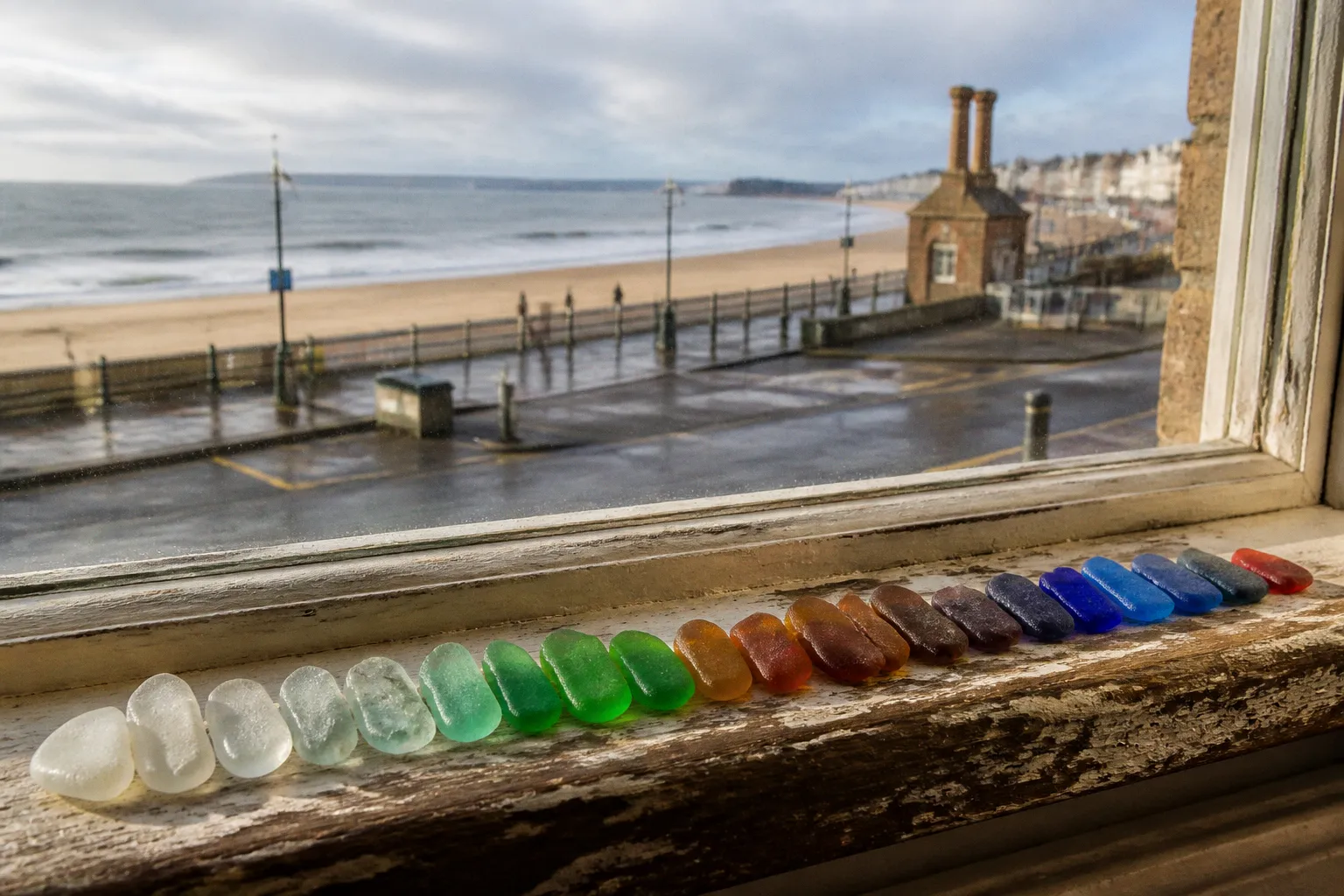
The honest distribution of sea-glass colour at Portobello is dominated by three tones. White, green, and brown are the workhorses: the pieces most likely to appear and the colours that quickly establish whether a session has produced ordinary material or something less common.
Cobalt blue, black, lavender, aqua, amber, turquoise, and red are possible finds reported from sea-glass beaches, including this part of the Scottish coast. They should be treated as possibilities, not as a dependable range. Red is especially uncommon in sea glass generally, so finding a red fragment at Portobello would be an outlier rather than a realistic yield target.
Colour is only one part of identification. Three other features separate a weathered fragment from a piece of recent litter.
1. Surface weathering. Mature sea glass usually has a softened, frosted, or slightly textured surface rather than the clear gloss of a fresh break. The surface may look waxy or cloudy, and the edges should be rounded rather than dangerously sharp. Weathering is not an exact clock: a piece’s appearance depends on glass composition, exposure, movement, and burial conditions. It is evidence of treatment by the environment, not a guaranteed date.
2. Lettering and marks. Embossed or impressed lettering can reveal the original use of a fragment. A partial word, raised line, maker’s mark, or bottle detail may be more informative than an unusual colour. Handle marked pieces carefully and avoid assuming that a surviving letter identifies a local manufacturer without further comparison.
3. Ceramic character. Pottery fragments often have a matt or worn surface, a visible body beneath the glaze, and patterns that remain legible after abrasion. Glaze, fabric, thickness, and firing texture can help distinguish a domestic vessel from a tile or construction fragment. A decorative shard is not automatically old, but it can carry a surprising amount of information.
Ceramic finds deserve their own method. Search the same boundaries used for glass, but do not reject pieces simply because they are not translucent. Portobello beach pottery shards may be white-bodied, buff, brown, or heavily glazed. Some will be too degraded to interpret. Others may retain a painted band, transfer design, raised decoration, or the edge of a vessel.
Reading age without overclaiming
Weight is a useful diagnostic, but it is not a date stamp. Thick bottle bases and older-looking fragments can feel heavier than thin modern glass, while different manufacturing methods and object types can produce the same effect. Use weight alongside thickness, colour, embossing, and surface condition.
The same caution applies to ceramic texture. Salt-glazed stoneware may show a distinctive pebbled or orange-peel surface, while smoother glazes may reflect later manufacture or simply a different object. These clues can suggest a production family or period, but a field identification should remain provisional unless supported by a specialist reference.
The strongest finds combine several clues. A heavy fragment with a rounded edge, deep frosting, and partial embossed lettering is more informative than a bright blue chip whose only unusual feature is its colour. A pottery shard with a recognisable glaze pattern and vessel curve is more useful than a generic white ceramic fragment, even if the generic piece is older.
A simple sorting system helps during a session:
- Recent or uncertain: sharp, glossy, cleanly broken glass; fragments that may be modern litter; ceramics with fresh edges and no weathering.
- Weathered common material: rounded white, green, or brown glass with visible frosting; ordinary pottery and tile fragments with softened edges.
- Marked or distinctive material: lettering, maker’s marks, unusual thickness, strong glaze patterns, embossed decoration, or unusual colour.
- Potentially significant material: pieces that may relate to a known industrial process, historic structure, or archaeological context and should be photographed rather than removed.
Keep the categories flexible. Sea-glass hunting is not a laboratory exercise, and the beach will not arrange its evidence in neat chronological groups. The aim is to improve observation, not to force every fragment into a confident label.
At Portobello, the unusual piece is not necessarily the most useful piece. A common fragment with lettering or a recognisable glaze can tell you more than a rare colour with no context.
Do not wash every find aggressively if you are trying to identify it. Salt, sand, and surface deposits can obscure details, but scrubbing can also remove fragile residue or alter the appearance that helped establish weathering. Photograph unusual pieces with a scale for reference, record the general area where they were found, and keep marked fragments separate from ordinary material.
Navigating Scottish Coastal Access and Responsible Beachcombing
Scotland’s access framework is generous, but it is not a declaration that every activity is unrestricted. The Land Reform (Scotland) Act 2003 establishes statutory access rights, interpreted through the Scottish Outdoor Access Code. Those rights support responsible recreation, including walking and enjoying the coast, while placing clear duties on visitors to avoid damage, disturbance, and unreasonable interference with other people’s use.
The foreshore is therefore open in a practical recreational sense, but access and removal are not identical concepts. Picking up a small number of loose, tumbled fragments is widely practised on public beaches, yet the access legislation should not be read as an unlimited right to extract material. Ownership and management can vary between stretches of foreshore, and local restrictions, heritage protections, environmental designations, or bylaws may apply.
For a casual beachcomber, the sensible approach is conservative: take only small loose pieces, do not dig, do not remove material built into structures, and stop if signage or a site designation indicates that collection is restricted. If a fragment appears archaeologically significant, leave it in place and report or photograph it instead of treating it as a souvenir.
Three practical rules matter most.
- Exercise access responsibly. Keep clear of wildlife, avoid vegetated shingle and dune faces, and do not disturb resting or nesting birds. The fact that a beach is accessible does not make every part of it suitable for searching.
- Read the signs. Dog controls, seasonal restrictions, construction areas, nature protections, and local notices can change how a section of coast should be used. Do not rely on memory from a previous visit.
- Do not turn beachcombing into extraction. Removing sand, shingle, large quantities of debris, or material from industrial structures is a different activity from picking up a few loose fragments. It may require permission or may be prohibited.
The same distinction matters for guest houses and commercial operators near the beach. A property can recommend Portobello sea-glass hunting to visitors without implying that the foreshore is part of its premises. A paid walk, organised activity, or commercial collection session should be considered separately from an individual guest taking a quiet shoreline walk. Operators need to check the relevant permissions, insurance, local conditions, and any heritage or environmental restrictions before presenting the beach as an organised experience.
Portobello is a public shoreline with an active local community. Treating it as a private resource because accommodation is nearby is not a harmless branding decision. It creates the wrong expectations for guests and shifts avoidable risk onto the property.
Responsible beachcombing also means leaving the beach better than you found it. Carry out litter when it is safe to do so. Do not dig into dune faces, undermine banks, or move stones from protective structures. Avoid disturbing areas where birds are feeding or resting. If you find sharp modern glass, handle it with care and dispose of it safely rather than confusing it with a collectable.
Open access is not the same as unrestricted collection. The best Portobello beachcomber reads the signs, respects the wildlife, and knows when a fragment should stay on the shore.
The ethical question is not only how much material can be taken. It is what the removal does to the character of the place. A single loose fragment may seem insignificant, but thousands of visitors make small decisions on the same beach. Historic lettering, unusual pottery, and pieces connected to the shoreline’s industrial memory are better understood before they are pocketed.
Reading the Landscape: Why Portobello’s Kilns Still Shape the Sand
The two brick kilns behind Portobello Beach matter because they make the area’s industrial history visible. They are surviving structures in a landscape that has otherwise been altered, rebuilt, buried, or dispersed. They help a visitor understand that Portobello’s coast was shaped by manufacturing and urban activity, not only by tides and tourism.
They should not, however, be described as the infrastructure behind every sea-glass find. The kilns are not proof of glass production, and their presence does not establish a direct chain from those buildings to the fragments in a hunter’s hand. The possible sources of the beach material include historic glassworks and potteries, domestic and commercial disposal, construction and demolition debris, and material moved along the Firth over time.
What the kilns provide is a historical frame. They tell you to look at the shoreline as a worked environment. They encourage better questions: What was manufactured here? Where did waste go? How has the beach been reshaped? Which fragments may have travelled, and which may have entered the local sediment system through later activity?
The physical beach then decides what becomes visible. Sand does not settle evenly. Rock edges, groynes, shallow channels, shingle lines, and the changing mouth of the Figgate Burn create local sorting zones. Storms can expose old material without creating new material. A fragment that appears after a gale may have been under the sand for years, or it may have moved in from another part of the shore.
For hunters reading the beach operationally, three signals matter.
- Substrate changes. Where sand meets rock or shingle, inspect the boundary. These interfaces often concentrate heavier and more weathered fragments.
- Obstacle orientation. Groynes, stones, and debris lines interrupt the movement of sediment. Check the face that receives the strongest movement of water and sand, then inspect the ends where flow can curl around the structure.
- Recent weather. Onshore winds and storm-driven waves can strip or rearrange the upper beach. The productive area may shift from one visit to the next, so yesterday’s best spot is not a permanent guarantee.
The question of replenishment needs equal care. Much of the material found on Portobello may be historic, especially where pieces show substantial weathering or where they occur in sediment that has clearly been reworked over time. The old industrial sources no longer operate in the way they once did, so it is reasonable to think of historic material as a limited inheritance rather than an endlessly renewed supply.
But the current supply cannot be described confidently as a closed system. New fragments may still enter the shoreline through modern breakage, urban activity, movement from other parts of the Firth, and the continuing redistribution of existing sediment. The rate and balance of that replenishment are not established simply by walking the beach. It is more accurate to say that much of the interesting material may be historic while the present-day rate of replacement remains unknown.
That uncertainty changes the responsible conclusion. Do not assume that every piece pocketed is permanently removed from a sealed, non-replenishing inventory. Equally, do not treat the beach as an unlimited resource. Historic marked fragments and distinctive pottery are finite at the level that matters to a visitor: once removed, they are no longer available for the next person to read in place.
The sensible practice is selective collection. Leave common material when you have enough examples. Photograph unusual pieces before taking them. Do not remove anything built into a structure or likely to have archaeological significance. If a fragment seems more important as evidence than as decoration, the shoreline has already answered the question of what to do with it.
Portobello is best understood as a working shoreline with shifting yield zones, a complicated industrial inheritance, and a regulatory framework that rewards restraint. Walk it with the eye of a beachcomber, but also with the discipline of a reader. The two kilns will continue to anchor the visible history of the place. The sand will continue to move. The fragments will continue to appear and disappear according to weather, tide, sediment, and chance.
That is what makes the search worthwhile. Not the promise of a guaranteed rare colour, and not a tidy story in which every find comes from the nearest old building. The value lies in seeing how a city, its industries, its waste, and its shoreline remain connected long after the original production has stopped.