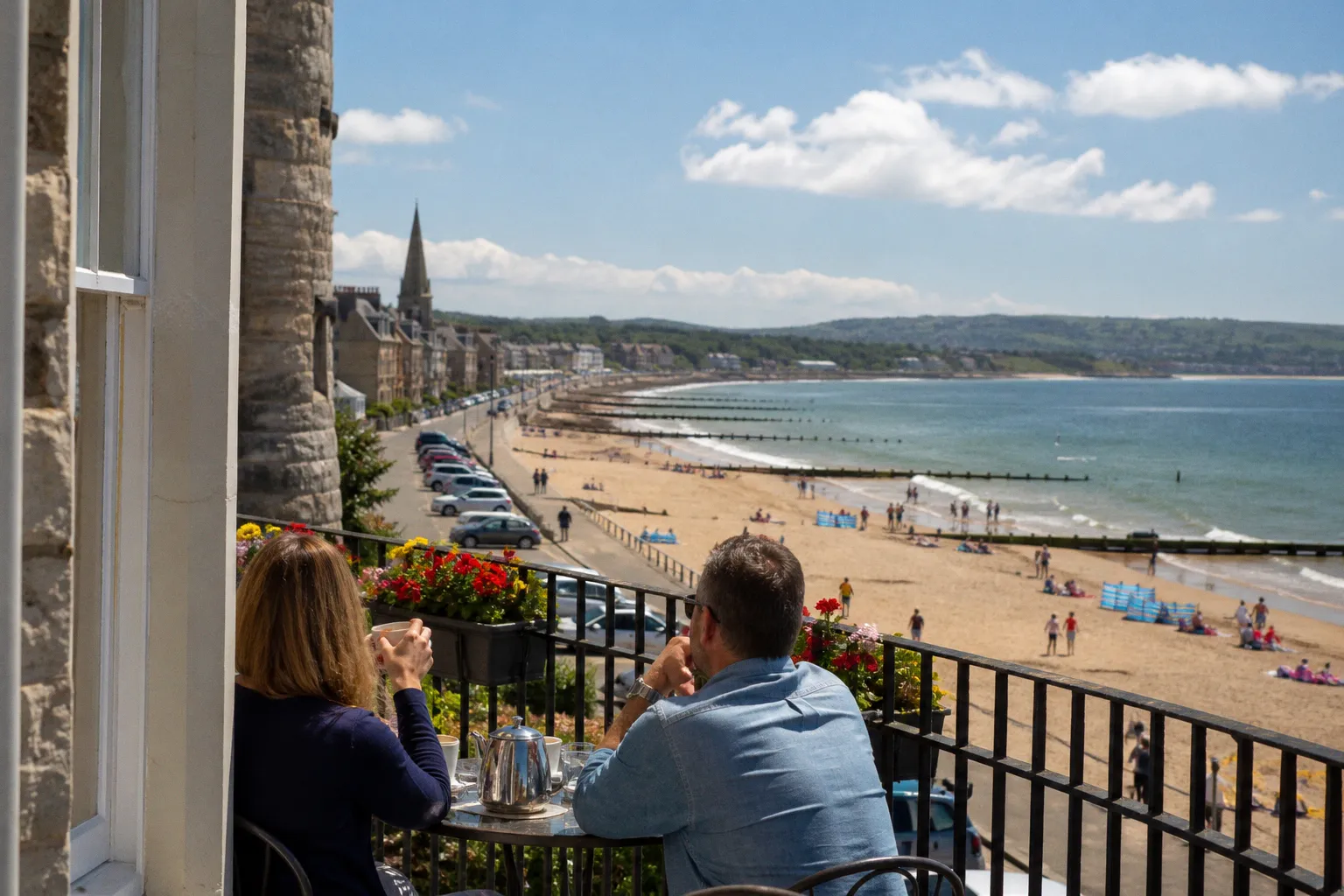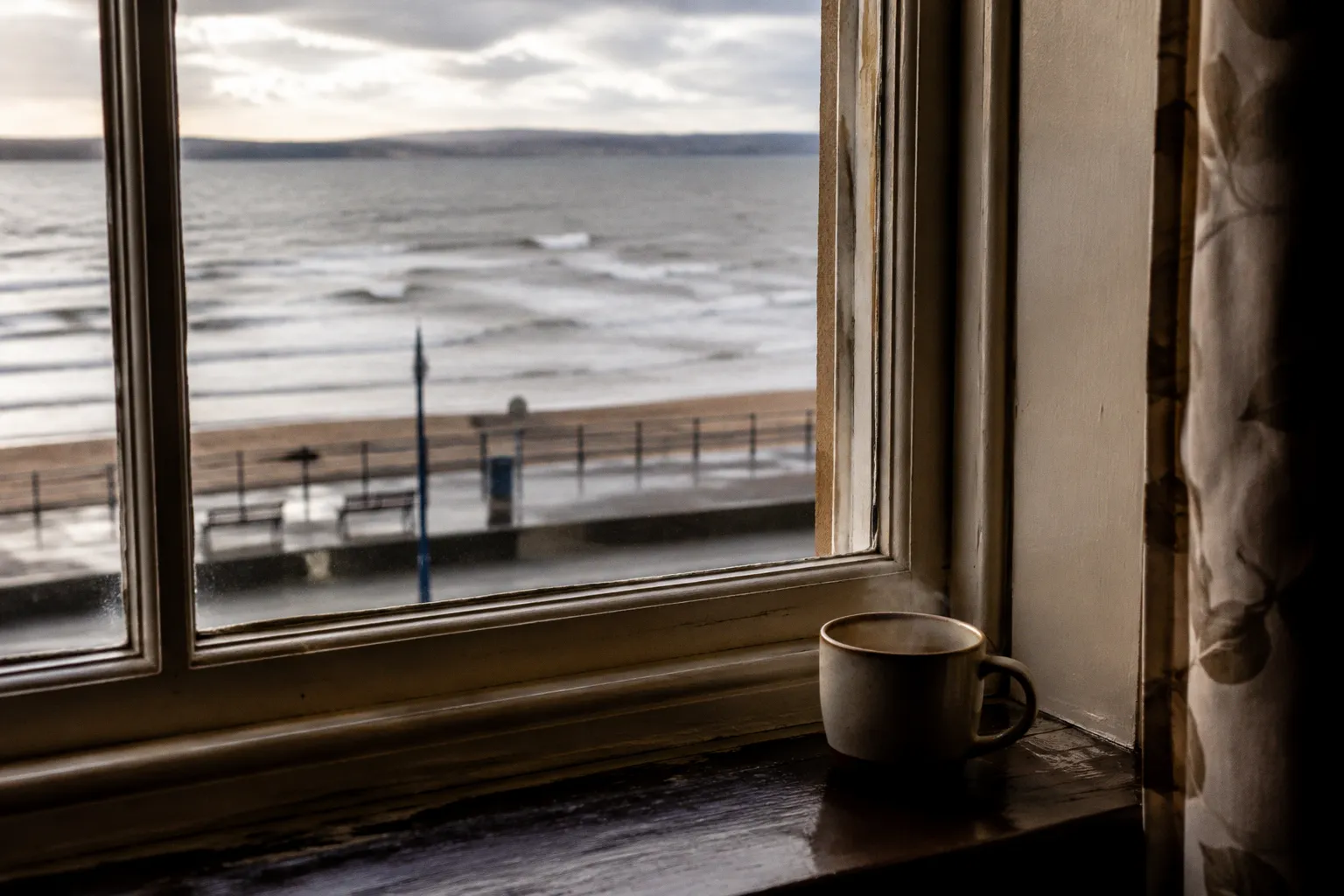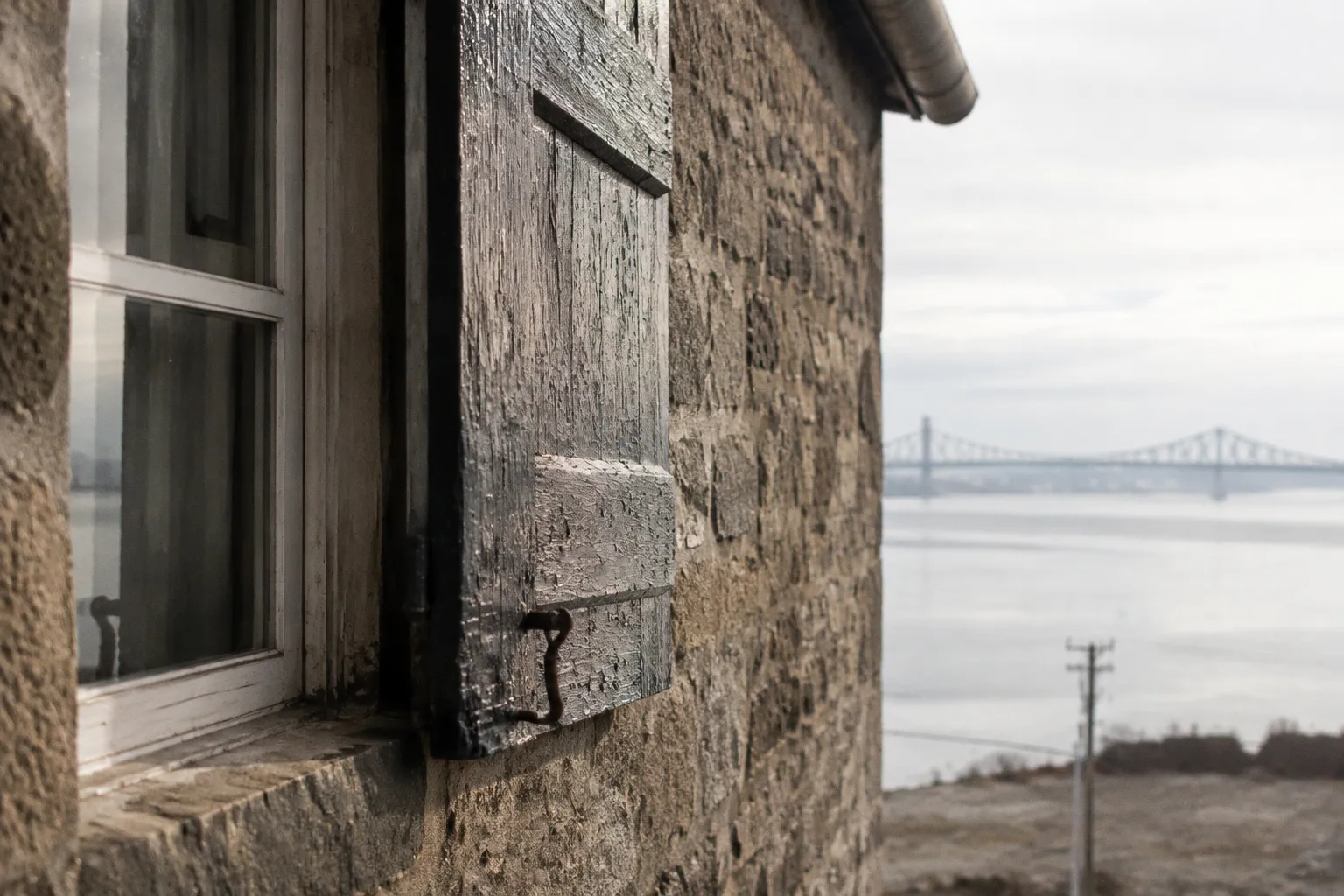
The explanation is physical rather than romantic: coastal water stays cool, sea breezes move inland, haar can suppress daytime heating, and traditional Scottish masonry slows the transfer of heat through the building envelope.
The effect is particularly relevant to owners and guests comparing Portobello beach guest houses, Joppa coastal accommodation, and other Edinburgh waterfront properties. A room near the shore may feel materially different from one only a few miles inland. But the difference is not a guarantee of a fixed indoor temperature. It depends on the building’s orientation, ventilation, glazing, occupancy, insulation, and how well historic construction has been adapted for present-day use.
The useful term here is the Edinburgh coastal guest house microclimate. It describes a combination of marine moderation and building performance, not a single cooling mechanism.
The thermal advantage of traditional Scottish masonry
Many older guest houses around Edinburgh’s coastline are built with substantial stone walls. These walls do more than provide a recognisable architectural character. They act as thermal mass.
Stone absorbs heat slowly. During a warm day, thick masonry takes time to respond to rising outdoor temperatures, reducing the speed at which heat reaches interior rooms. When the external temperature falls in the evening, the same walls release stored heat gradually rather than changing temperature immediately.
This creates a delay between outdoor conditions and indoor conditions. In a lightweight modern building, a sunny room with large glazing can become hot quickly. In a traditional stone property, the walls may hold the interior closer to its earlier temperature for longer.
That does not mean every historic building is automatically cool. Thermal mass works best when the building is operated correctly. If windows are left open during the hottest part of the day, or if a room receives direct solar gain through unshaded south-facing glass, the accumulated heat can eventually overwhelm the wall’s buffering capacity.
For an owner, the relevant operational question is not whether a property has stone walls. It is whether the building can use that mass effectively.
A well-run coastal guest house typically benefits from:
- Overnight ventilation, when outdoor air is cooler and the building can discharge stored heat.
- Controlled daytime shading on rooms exposed to direct sun.
- Windows that can be opened safely and effectively, rather than decorative sashes that provide little airflow.
- Internal doors and circulation routes that allow heat to move away from occupied bedrooms.
- Roof, loft, and window upgrades that reduce unwanted heat gain without trapping moisture inside the structure.
- Heating controls that prevent the building from carrying unnecessary residual heat into warmer weather.
The distinction matters because stone masonry is not a substitute for building management. It is a passive asset that must be integrated into the operating pattern of the property.
Stone walls do not create cool rooms on their own. They create time: time before outdoor heat reaches the interior, and time for the building to recover after sunset.
Thermal mass versus insulation
Thermal mass and insulation are often treated as interchangeable. They are not.
Insulation reduces the rate of heat transfer. Thermal mass absorbs and delays that transfer. A building can have heavy masonry but poor insulation at the roof, windows, or floor. It may remain stable during a short warm spell but lose heat quickly in colder weather. Conversely, a highly insulated lightweight structure may perform well overall but respond rapidly to solar gain unless shading and ventilation are properly designed.
Historic Scottish buildings require a careful balance. Aggressive retrofit work can create condensation risks if moisture movement through old walls is ignored. Sealing every gap may improve airtightness in one part of the building while making dampness harder to manage elsewhere.
For guest house owners, this is an operational and regulatory issue as much as an energy issue. Any alteration to a listed or traditionally constructed property needs to be considered alongside planning requirements, ventilation standards, fire safety, and the building’s existing fabric. A cooling improvement that introduces moisture damage or compromises escape routes is not a successful upgrade.
How the Firth of Forth moderates coastal temperatures
The Firth of Forth is an estuarine channel connected to the North Sea. Its marine environment provides a large, relatively stable heat reservoir next to Edinburgh’s eastern and northern coastal districts.
Reported summer sea surface temperatures in the Firth average around 13.4°C. The water can become warmer or colder depending on location and conditions, but it rarely rises above 20°C. Across the wider Forth and Tay Scottish Marine Region, reported sea surface temperatures range from approximately 6.9°C to 14.4°C, depending on the season and the area measured.
The wider marine region covers about 4,487 square kilometres, with an average sea depth of around 39 metres. These are not decorative statistics. They explain why the coast does not respond to short-term solar heating in the same way as inland ground surfaces.
Land heats rapidly under direct sunlight. Water changes temperature more slowly because heat is distributed through movement and a large volume of liquid. A coastal district beside cool water therefore tends to experience a smaller and slower temperature rise than an inland area exposed to the same weather system.
This is the central reason that Firth of Forth seaside accommodation temperatures can feel moderated during warm weather. The coastline is not generating cold air continuously. It is exchanging heat with a marine environment that warms more slowly than the land.
The coast is a buffer, not a guarantee
The marine effect is strongest when the weather pattern allows air to move from the water towards the shore. Wind direction, cloud cover, humidity, building density, and the timing of the warm period all influence the result.
A guest room with an open view towards the water may still become uncomfortable if:
- Its windows face the afternoon sun.
- The glass area is large and unshaded.
- Air movement is blocked by neighbouring buildings.
- The room is on the top floor beneath an inadequately protected roof.
- Heat from bathrooms, kitchens, laundry facilities, lighting, and electronic equipment accumulates indoors.
- Windows are kept closed during a warm period because of traffic noise, security concerns, or guest preference.
The same property may therefore contain rooms with noticeably different performance. Ground-floor rear rooms, upper-floor sea-facing rooms, and attic bedrooms do not share the same solar exposure or ventilation pattern.
A credible description of a coastal guest house should distinguish between the location’s microclimate and the performance of the individual room. “Near the sea” is a useful starting point. It is not a building specification.
The mechanics of a sea breeze
The Portobello beach guest house sea breeze is produced by a familiar coastal process. During the day, the land surface warms more quickly than the adjacent water. Air above the land rises as it heats. This creates a pressure difference that draws cooler, denser air inland from the sea.
The resulting airflow can moderate the immediate coastal environment. It can also improve indoor comfort when a property has openings positioned to capture it.
The practical value of a sea breeze depends on air movement through the building. A breeze outside does not automatically ventilate a bedroom. The property needs a route for air to enter, pass through, and exit. One open window on a sheltered façade may provide less useful ventilation than two smaller openings on different sides of the building.
This is where the building’s layout becomes more important than its marketing description. Owners assessing an Edinburgh seaside guest house should examine:
- Whether bedrooms have openings on the windward side.
- Whether stairwells, corridors, or service areas interrupt cross-ventilation.
- Whether sash windows open sufficiently for meaningful airflow.
- Whether window restrictors, security hardware, or fire precautions limit normal ventilation.
- Whether bathrooms have independent extraction rather than relying on guests to open bedroom windows.
- Whether kitchen and laundry heat is isolated from sleeping areas.
- Whether external noise makes natural ventilation impractical at night.
The strongest coastal properties use several modest advantages together. Marine cooling lowers the temperature of incoming air. Sea breezes move that air through the site. Masonry slows heat transfer. Shading prevents avoidable solar gain. Ventilation removes accumulated heat after sunset.
No single feature does the entire job.
What this means for Joppa coastal accommodation
Joppa sits close enough to the Firth of Forth for marine influence to matter, but local conditions still vary from street to street. The shoreline, building orientation, surrounding walls, road layout, and height above sea level can all affect exposure to wind and sun.
For Joppa coastal accommodation in summer, the most commercially useful features are not necessarily the broadest sea views. A property with a clear cross-breeze, shaded windows, manageable noise levels, and rooms that can be ventilated safely may outperform a more exposed building with extensive unshaded glazing.
Owners should also consider guest behaviour. Many visitors will close windows if the room is noisy, windy, or difficult to secure. Some will use portable fans continuously rather than adjust blinds or ventilation. Others will expect a completely still room and may regard natural airflow as a fault. Comfort is therefore partly a physical question and partly a service-design question.
Clear room information can reduce friction. Guests should know whether a room faces the sea, whether windows open, whether mechanical ventilation is present, and whether the property has fixed cooling equipment. Overstating the natural cooling effect creates avoidable complaints when an unusually warm period coincides with poor room orientation.
Haar: the Firth’s most visible cooling mechanism
Haar is the local term commonly used for sea fog that moves inland from the North Sea and the Firth of Forth. It forms when moist maritime air encounters cooler conditions and condenses into fog. Along the coast, it can arrive quickly, reduce visibility, and suppress daytime heating.
For a guest house, haar has two immediate effects. It limits direct solar radiation and brings cool, damp air across the shoreline. This can lower the apparent heat of a coastal day, particularly when inland districts remain sunnier and warmer.
However, fog is not the same as dry, comfortable ventilation. Haar increases humidity. Open windows may introduce cool air but also moisture, and damp textiles or poorly ventilated bathrooms can take longer to dry. In an older property, persistent humidity can expose weaknesses in roof coverings, window reveals, external pointing, or internal ventilation.
The operational response should be measured rather than automatic:
1. Use the cooler conditions to prevent indoor heat from building up, but avoid leaving every opening wide open during periods of high humidity.
2. Maintain effective extraction in bathrooms and utility spaces.
3. Monitor condensation around windows and on colder wall surfaces.
4. Keep guest linen and upholstery away from areas with restricted airflow.
5. Check that natural ventilation is not being used to compensate for inadequate mechanical extraction.
6. Close or reduce openings when the exterior air is damp, wind-driven, or contaminated by traffic and marine aerosol.
Haar is an advantage in terms of temperature control, but it places greater demands on moisture management. A property that feels cool but smells damp is not performing well.
Coastal cooling is a balance between removing heat and importing moisture. Treating the two as the same problem is how historic buildings develop new ones.
Historic buildings and modern summer comfort
The commercial challenge for an Edinburgh waterfront guest house is to retain the performance benefits of traditional construction without treating historic fabric as untouchable.
Guests now expect reliable showers, quiet rooms, stable Wi-Fi, good sleep, and predictable comfort. They do not judge a property by its wall thickness. If a room overheats, the presence of original masonry will not compensate for poor sleep.
At the same time, installing full mechanical cooling throughout an older property can be expensive, visually disruptive, and inefficient if the underlying causes of overheating are not addressed. Cooling equipment also produces waste heat, requires maintenance, consumes electricity, and may add noise in bedrooms.
A sensible hierarchy is usually:
First, reduce unwanted heat gain
Solar gain is often easier to prevent than to remove. External shading is more effective than internal blinds because it stops radiation before it passes through the glass. Where external alterations are restricted, internal blinds, curtains, solar-control glazing, or carefully managed room allocation may still help.
The roof deserves particular attention. Top-floor rooms can experience the highest heat load even in a building with thick walls. Loft insulation, roof ventilation, and appropriate refurbishment of dormer windows can have more practical impact than adding cooling equipment to every bedroom.
Lighting and equipment also contribute. High-load lamps, televisions, refrigeration units, laundry equipment, and kitchen extraction can produce heat that is insignificant in an open building but material in a compact guest room.
Second, improve controlled ventilation
Natural ventilation is valuable when it is usable. Windows should be safe, functional, and easy for guests to understand. If the property depends on a narrow window opening that produces little airflow, its theoretical ventilation capacity is irrelevant.
Mechanical extraction should be assessed separately from cooling. Fans remove air, but they do not necessarily lower room temperature unless cooler replacement air can enter. Poorly balanced systems may draw air from kitchens, bathrooms, or dusty service areas.
For larger properties, demand-controlled ventilation or heat-recovery systems may be appropriate, but installation must be considered against the building’s fabric, noise targets, maintenance capacity, and capital budget.
Third, add targeted mechanical cooling where the risk justifies it
Not every room requires the same intervention. A top-floor south-facing bedroom, a dining room with large glazing, or a room allocated to guests with mobility or health considerations may justify local cooling sooner than a shaded ground-floor room.
Portable equipment can be a short-term response, but it introduces storage, servicing, electrical-load, noise, and condensate-management issues. Fixed systems require more capital and can affect façades, planning permissions, listed-building consents, and external noise levels.
The decision should be based on measured overheating risk and the property’s booking pattern, not on a general assumption that every coastal building is either naturally comfortable or in need of air conditioning.
What owners should measure before making upgrades
The absence of room-specific HVAC data for individual guest houses in Joppa or Portobello means broad marine figures cannot be converted into a promised indoor temperature. Owners need their own evidence.
A basic monitoring programme can identify where intervention is justified. Sensors placed in representative rooms can record temperature and relative humidity across warm periods, including ground-floor, upper-floor, sea-facing, rear-facing, and attic rooms. The useful output is not a single maximum reading but a pattern:
- How quickly each room heats up.
- When the peak temperature occurs.
- How long the room remains uncomfortable after sunset.
- Whether opening windows produces a measurable improvement.
- Whether humidity rises when the room is ventilated.
- Whether guests are likely to accept the noise or security implications of open windows.
- Which rooms create the greatest operational and reputational risk.
The comparison should include external conditions, but it should not assume that an outdoor weather station represents the property precisely. A room behind a stone wall, under a slate roof, or exposed to afternoon sun may diverge significantly from the general coastal reading.
A compact assessment table can help prioritise expenditure:
| Property feature | Likely benefit | Main limitation |
|---|---|---|
| Thick stone masonry | Delays heat transfer and smooths short-term temperature peaks | Does not prevent overheating during prolonged warm weather |
| Sea-facing exposure | Better access to marine airflow and cooling influence | Can increase wind, salt exposure, and noise |
| Cross-ventilation | Removes stored heat quickly when conditions are suitable | Depends on layout, window operation, and guest acceptance |
| External shading | Prevents solar gain before it enters the room | May require planning or listed-building approval |
| Loft and roof upgrades | Reduces heat transfer into top-floor rooms | Must be designed to manage moisture and ventilation |
| Portable cooling units | Flexible response for selected rooms | Noise, condensate, storage, and electrical-load issues |
| Fixed air conditioning | Predictable cooling during extreme conditions | Capital cost, maintenance, energy use, and visual impact |
This type of assessment is more useful than assigning a property a simplistic label such as “naturally cool”. The phrase has value only when linked to a building that can actually deliver comfort.
How the microclimate affects the guest experience
For visitors, the Edinburgh seaside guest house weather effects are most noticeable at the edges of the day. Coastal rooms may cool more quickly in the evening, remain less exposed to intense afternoon heat, and benefit from air movement that is absent in dense inland streets.
The trade-off is variability. The same maritime influence can produce wind, fog, dampness, and abrupt changes in visibility. A room that is comfortable in a clear, breezy afternoon may feel humid during a still haar event. A window that provides useful ventilation may also admit traffic noise or gull activity. These are not defects unique to coastal accommodation; they are part of the operating environment and should be managed honestly.
Room allocation can reduce complaints. During warm weather, upper-floor rooms with poor shading may need different pricing, different guest guidance, or temporary allocation rules. During damp conditions, rooms with limited extraction should not be allowed to accumulate wet towels and closed-window humidity. Housekeeping schedules may need to account for slower drying times after foggy periods.
The property’s information should remain precise. A guest can understand that the coast is generally moderated but not expect an absolute guarantee. Claims about natural cooling should describe the factors involved: marine air, masonry, ventilation, and shading. They should not imply that a building is immune to heatwaves or that mechanical cooling is never required.
Selecting between coastal accommodation types
The same principles apply across the main types of Edinburgh seaside accommodation, but the risk profile changes with the building.
A traditional bed and breakfast may have thick walls and operable windows but limited service ducts and inconsistent room layouts. A refurbished boutique property may offer better controls but introduce large glazed extensions with significant solar gain. A self-catering coastal flat may give guests more control over windows and appliances, while also creating greater uncertainty about how heating and ventilation are used.
| Accommodation type | Typical cooling strength | Typical operational concern |
|---|---|---|
| Traditional seaside B&B | Masonry thermal mass and potentially good window ventilation | Uneven room performance and retrofit constraints |
| Refurbished guest house | Better controls, insulation, and guest information | Large glazing areas or mechanical systems needing maintenance |
| Coastal holiday flat | Guest control over ventilation and appliances | Inconsistent operation and higher exposure to cooking heat |
| Waterfront boutique hotel | Potential for engineered comfort systems | Higher energy demand and complex plant management |
| Older upper-floor accommodation | Delayed heat transfer through masonry | Roof and dormer overheating during prolonged warm spells |
For investors, this is where the property’s cooling profile becomes part of yield analysis. A low capital-cost acquisition may require substantial work to provide acceptable summer comfort. Conversely, a property with strong passive performance may reduce energy demand and maintenance exposure, provided its rooms can be marketed accurately and operated consistently.
Seasonal fluctuation also affects the calculation. Edinburgh’s coastal demand is not confined to the hottest weeks of summer. A building that performs well in cool, damp shoulder seasons but struggles during occasional warm spells may still be commercially viable. The question is whether the uncomfortable periods coincide with high occupancy, whether guests can be moved between rooms, and whether a targeted intervention is cheaper than a whole-building system.
The practical position for owners
The Firth of Forth gives Edinburgh’s shoreline a meaningful thermal advantage. Cool water, sea-breeze circulation, haar, and traditional stone construction can reduce the speed and intensity of indoor heat gain. The marine region’s scale and depth help explain why the coastal environment remains relatively stable compared with rapidly heated inland surfaces.
But the advantage is conditional. It depends on orientation, fabric, shading, ventilation, humidity control, and operating discipline. A stone guest house with sealed windows, unshaded roof rooms, poor extraction, and high internal heat loads will not perform like a well-managed coastal building.
For owners and serious investors, the most defensible approach is straightforward:
- Treat the marine microclimate as a passive asset, not a performance guarantee.
- Measure representative rooms before committing to major cooling works.
- Prioritise solar control, roof performance, and usable ventilation.
- Separate heat removal from moisture management.
- Assess planning, listed-building, fire-safety, and ventilation requirements before altering historic fabric.
- Use targeted mechanical cooling where the building and occupancy pattern justify it.
- Describe the guest experience accurately, without promising conditions the property cannot control.
A Firth of Forth guest house stays naturally cool through a chain of modest physical advantages. The commercial result depends on whether the operator preserves that chain—or breaks it with poor retrofit decisions, uncontrolled solar gain, and inadequate ventilation.