What governs the seafront here is not usually posted on a noticeboard; it is conducted through shared gestures between the people who use the place — wild swimmers crossing from the water, cyclists threading past at a considerate pace, dog walkers with leads in hand, and the queues that form outside the cafes on a Saturday morning. To move comfortably along this stretch is to learn an unwritten choreography, and that choreography begins long before anyone reaches for a menu.
The phrase “portobello promenade cafe etiquette for visitors” may sound more formal than the place itself. In practice, it is less about rules than awareness: knowing when you are standing in someone else’s route, when a queue has already acquired its own order, and when a table or stretch of paving serves a purpose beyond your immediate coffee stop. The seafront works because these small distinctions are noticed.
Navigating the promenade’s shared rhythm: pedestrians, cyclists, and coffee queues
Portobello’s seafront has always been a place of overlapping uses. The original promenade was laid down in 1866, and the ribbon of paving it left behind has, in the years since, become the spine of a working shoreline — a route that carries pedestrians, prams, runners, scooters, and bicycles in both directions at once. The cafe culture that runs along it has grown into that space rather than displaced it. A pavement table outside a coastal favourite sits in the same corridor as a commuter cutting through to the bus stop and a family walking a spaniel along the waterline.
That mixture is the first thing a visitor needs to understand. Portobello is not a pedestrianised dining quarter with a beach attached. It is a promenade first, and a cafe setting second. The view may encourage people to slow down, but the route still has to carry those who are heading somewhere else.
The cafes have oriented themselves to that movement. Doors face seaward, seating spills towards the paving, and counter service is designed for people who may be stopping mid-walk rather than settling in for an entire afternoon. Lothian Bus routes 26, 15, 19, and 49 bring visitors within a few minutes of the front, which means the footfall is rarely theoretical. Anyone arriving by bus should expect to step straight into the promenade’s rhythm and to move with it rather than against it.
A useful starting habit is to treat the promenade as a country footpath that happens to run past a farmhouse kitchen. Keep to the left when walking against the prevailing tide of cyclists, hold a straight line past outdoor seating rather than cutting between tables, and pause at the kerb — not in the middle of the path — if you need to check a phone or a map. If you are travelling with a pushchair, allow yourself room to stop without narrowing the route for people coming behind you. If you are carrying takeaway drinks, keep them close rather than swinging them at shoulder height through a crowded passage.
These are small courtesies, but on a two-mile stretch shared by everyone from school groups to long-distance walkers, they are the courtesies that keep the place functioning at the pace it was built for. A cyclist ringing a bell is not necessarily being impatient; a pedestrian stepping aside is not surrendering the promenade. Both are acknowledging that the route belongs to several kinds of user at once.
Coffee queues create a second layer of movement. They often gather near entrances, railings, or counter-service windows, where the line can easily become a second obstruction if it spreads across the pavement. The considerate position is close enough to show that you are waiting, but not so far into the walking line that every passing person has to detour around you. Where staff indicate a particular place to queue, follow it. The arrangement may look informal, but it usually reflects the cafe’s experience of how to keep customers and passers-by moving at the same time.
The walk-in queue is not an obstacle to be defeated but the local pace of things, set by those who arrived before you.
The art of the walk-in: managing peak brunch hours at coastal favourites
The most important thing to understand about Portobello’s seafront cafes is that many operate on a walk-in basis. Establishments such as The Beach House Cafe take customers as they arrive, with seating offered on a first-come, first-served model rather than through a booking system. This is not an oversight or a lack of modernity; it is the local contract. It keeps the cafe accessible to people who live in the surrounding streets, to families who have walked down on impulse, and to visitors who have come off the bus without a reservation in their pocket.
The practical consequence is that peak hours — typically the late-morning and early-afternoon window on weekends, particularly during a spell of decent weather — produce queues. The supplied facts are clear on the important point: waits can occur at weekend brunch peaks. They are not a fixed appointment, and they should not be treated as one. Weather, group size, the pace of existing tables, and the cafe’s own capacity can all change the experience from one visit to the next.
The queue is part of the experience, but that does not mean every visitor has to enjoy standing in it. The sensible approach is to build flexibility into the morning. If you have a train to catch, a child who needs feeding, or a dog that is already tiring of the pavement, a walk-in cafe may not be the right first stop. If your schedule is open, the same uncertainty becomes less of a problem: you can wait, take a short walk, or choose a quieter counter-service option while the busiest tables turn over.
A few habits help:
1. Arrive before the rush if you want the best chance of an immediate table. A little after opening on a weekend, or earlier in the week, will generally offer a calmer start than the height of brunch.
2. Join an established queue without negotiation. Front-of-house staff cannot create a table that is not available, and asking to be moved ahead usually slows the process for everyone behind you. If you are unsure where the line begins, ask once and then take your place.
3. Read the service model before sitting down. Where a cafe is counter-led, order at the counter rather than waiting for full table service. The room’s rhythm assumes that customers will take some responsibility for their own order.
4. Be realistic about larger groups. If you are travelling with more than four people, call ahead where a cafe offers a phone line. Some places may be able to advise you; others may not. Either answer is useful, because it tells you whether to wait together or choose a different stop.
5. Keep the queue compact. A group that fans out across the pavement can turn a manageable wait into a blockage, especially when prams, bikes, or beach equipment are also passing through.
The difference between a walk-in cafe and a reserved table is not simply whether you have a booking. It changes how you use the promenade.
| Approach | Walk-in queue at most seafront cafes | Reserved table, where offered |
|---|---|---|
| Booking required | No | Yes |
| Weekend peak | Queues and waiting can occur during busy brunch periods | A planned arrival time |
| Suitable for groups over four | Sometimes, with a phone call or staff guidance | Usually easier to organise |
| Pace of service | Often counter-order and self-led | May involve table service |
| What it asks of you | Patience and a flexible window | Punctuality and a fixed slot |
The table is a working summary, not a rulebook. The honest version is simpler: walk in, wait if you must, and let the cafe set the tempo. The reward is a coffee taken within sight of the firth, at a table that anyone in the queue could have claimed.
There is also a difference between waiting politely and treating the wait as a performance of dissatisfaction. Staff already know that the cafe is busy. Repeatedly asking how long remains, hovering over occupied tables, or positioning yourself so that a seated customer feels pressed to leave does not produce a faster service. It merely changes the atmosphere of the room. In a small coastal cafe, the mood is part of the experience, and visitors contribute to it whether they intend to or not.
Four-legged guests: best practices for pet-friendly patio seating
Dogs are a presence along Portobello Promenade in a way that shapes how its cafes operate. Many of the seafront establishments provide dedicated pet-friendly outdoor seating areas — patio tables and pavement benches where a dog can settle beside its owner without intruding on the dining space of other customers. This is not a concession; it is a recognition that a large share of the morning and evening trade arrives on four legs, and that the promenade’s daily rhythm includes a dog walk before coffee rather than after.
Pet-friendly does not mean unrestricted. The outdoor area is shared with other dogs, children, food, hot drinks, and passing feet. A dog that is relaxed at home may become alert or unsettled when the promenade fills with bicycles, runners, and people carrying beach gear. The owner’s job is not to prove that the dog is friendly. It is to notice whether the dog is comfortable and whether its presence is making the neighbouring table uncomfortable.
The etiquette that follows is straightforward:
- Keep your dog on a lead while moving through the seating area. Even if the cafe has a relaxed outdoor policy, a lead gives other customers space and prevents sudden movement into the walking route.
- Keep the lead short enough to avoid creating a trip hazard. A long line stretched between chair legs can be almost invisible to someone approaching with a tray or a pram.
- Do not lift your dog onto a chair or bench. Outdoor seating is shared furniture. However affectionate the dog, the next customer has a right to a clean surface.
- Bring water if your dog is likely to need it. Few cafes provide a bowl at every table, and the firth breeze can be drying even when the temperature feels mild.
- Avoid feeding the dog beside a busy queue. Treats and dropped food can attract attention from other animals and create unnecessary excitement in a confined space.
- Move away if the dog becomes overwhelmed. The promenade offers enough variation that a quieter stretch is usually a better option than trying to force a dog to settle beside a crowded entrance.
If your dog is reactive, young, or simply overwhelmed by the volume of footfall on a busy Saturday, the kindest thing you can do is choose a quieter stretch of the promenade for your visit. The walk-in model rewards flexibility, and dogs benefit from it as much as their owners do. A short coffee taken somewhere calmer is more successful than a longer visit spent managing tension at a packed patio.
The same consideration applies in the other direction. Visitors who are nervous around dogs should not have to apologise for asking for an indoor table or for choosing a seat with more distance. A pet-friendly policy is an invitation to share the space, not an instruction that every customer must enjoy the same arrangement.
From artisan vans to beachfront tables: supporting local coastal vendors
Portobello’s seafront has become a small but resilient showcase for independent coastal trade, and the cafes along it are the visible half of a wider local economy. The Little Green Van — a converted Citroen H that has served coffee from local Edinburgh roaster Artisan Roast on the promenade since 2013 — is the most recognisable example of that economy in motion: a single vehicle, a short menu, and a supply chain drawn from regional producers.
It is also a useful case study in how promenade etiquette works in miniature. The queue forms along the railings, the order is taken at the side hatch, the coffee is drunk standing or sitting on the sea wall, and the whole transaction takes place inside the flow of foot traffic rather than outside it. A van may look casual, but it still needs the same courtesy as a full-sized cafe: customers should know where the line begins, keep the hatch clear, collect their order without lingering in the service area, and take rubbish with them if no bin is immediately available.
Independent trade along the front depends on a particular kind of visitor behaviour. It depends on people who understand that a walk-up order at a converted van is not a lesser experience than a sit-down brunch — it is a different one, with its own setting and its own pace. It depends on people who pay attention to which roastery, bakery, or seafood supplier a cafe is buying from, and who treat that information as part of the choice. And it depends on people who understand that a generous tip at a one-person espresso bar in October is one of the small acts that keeps that bar open through January.
Behind every converted van and family-run table is a regional supply chain that the pavement economy keeps quietly in business.
The point is not to romanticise the local economy but to read it accurately. The seafront’s cafe culture is small enough that every customer registers, and the trade it sustains — coffee roasting in Edinburgh, baking across the Lothians, seafood landed along the firth — is visible to anyone who looks. Choosing a vendor because of that visibility is one of the more quietly consequential decisions a visitor can make along the promenade.
There is a practical side to supporting independent vendors as well. Menus may be shorter, opening patterns may be less predictable, and a small operator may not have the staff to answer repeated questions while serving a queue. That is not a reason to lower expectations; it is a reason to understand the kind of business you are entering. Ask a clear question, listen to the answer, and accept that a seasonal or small-scale menu will not behave like a chain restaurant’s.
Equally, do not confuse buying local with claiming the place. The seafront is not a themed experience arranged for visitors. It is a working part of Portobello, and the businesses that make it attractive also serve people who live nearby. A visitor who makes room for regulars, clears a table promptly, and leaves the pavement accessible is doing more for the local atmosphere than one who photographs every detail while blocking the counter.
Safety and flow: respecting emergency access zones along the two-mile stretch
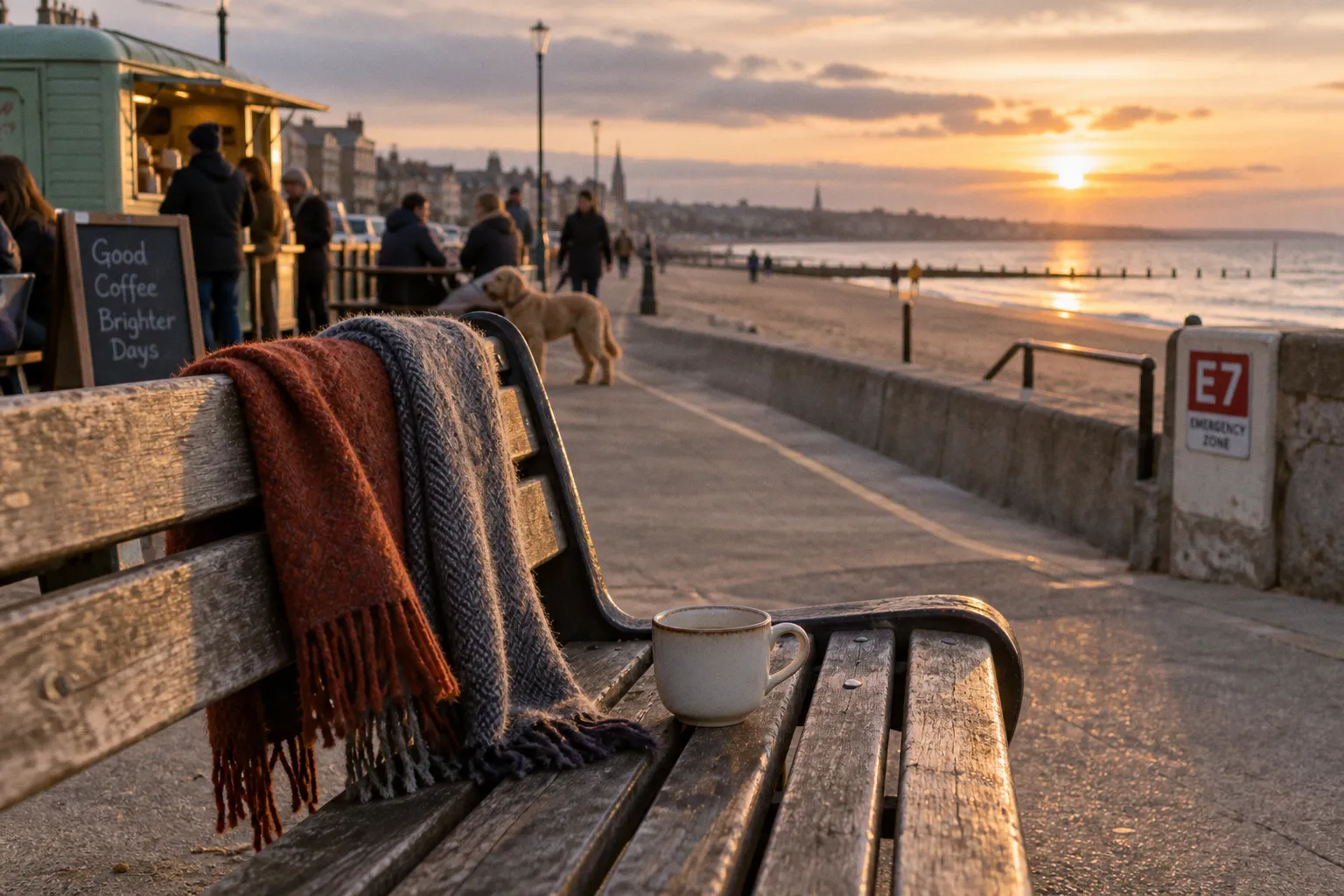
There is a detail along Portobello Beach that visitors often overlook and locals rarely think about: the emergency zone markers set into the seafront. They are not signage in the usual sense; they are reference points installed along the beach area to allow emergency services to pinpoint incidents quickly, dividing the shoreline into recognisable sections. They look like a small piece of municipal infrastructure and behave like one, but their presence shapes how the promenade works.
For visitors, the practical implication is straightforward. When you choose a table, choose with awareness of where the nearest marker sits. Do not place pushchairs, bicycles, or dogs in the line of sight between a marker and the beach access. Do not block the slipways that connect the promenade to the sand, even briefly. Do not assume that open paving in front of a cafe is an extension of the seating area if it falls within a marked zone.
It is tempting to think that a bicycle left on the side for a moment, or a pushchair parked while someone orders coffee, cannot make much difference. Emergency access is not designed around the most convenient ordinary moment. It is designed for the situation in which a clear route matters immediately. A few seconds saved by leaving access open may matter more than the extra convenience of keeping your belongings beside your table.
The same logic applies to beach equipment. Fold chairs, scooters, bags, and boards should not be arranged across the natural approach to the sand. If you need to pause and organise your group, move to the side of the main route first. This is especially important when the promenade is busy and people behind you cannot easily see what has been left at ground level.
The markers are there for the worst-case moments of someone else’s day, and the courtesy of leaving them unobstructed is one of the least visible but most consistent forms of local etiquette.
The promenade’s other shared uses require the same kind of attention. Cyclists are expected to give walkers space and to announce themselves before passing; the route is not a closed road, and the volume of pedestrians on a weekend makes considerate cycling a condition of the space. A bell or a verbal warning should be followed by enough room for the person ahead to respond. Passing at speed through a cluster of families is not made safer simply because the cyclist has signalled.
Wild swimmers crossing from the water to a cafe towel should be allowed a clear path. They are often cold, sometimes unsteady, and always moving more slowly than the footfall around them. Someone carrying wet gear may also need a little extra time to step aside without dropping it. The coastal setting makes these encounters ordinary, but ordinary does not mean they require no attention.
None of these courtesies requires a sign, and none of them is enforced beyond the steady pressure of community expectation. That pressure is part of how a public shoreline remains usable. If visitors wait for every good behaviour to be printed on a notice, they will always be several seconds behind the place they are visiting.
Etiquette as participation
What the promenade asks of a visitor is not deference but attention. The two-mile stretch has rules, but they are rules written in habit rather than in print, and the visitor who reads them correctly will have a better morning than the visitor who treats the place as a backdrop. The walk-in queue is the local contract; the pet-friendly patio is a working policy rather than an indulgence; the converted van and the family-run table are the front line of a regional trade; the emergency markers are a reminder that the beach is a working shoreline, not a stage set.
This is the useful distinction between coastal cafe etiquette and simple good manners. Good manners might tell you not to interrupt someone’s meal. Coastal etiquette also asks you not to leave a bicycle across the route, to notice how a queue is positioned, and to understand that the table closest to the beach may be beside an access point rather than available seating. It is situational rather than ceremonial.
The shorthand is this:
- Walk to one side and hold a predictable line.
- Let cyclists and pedestrians pass without turning the route into a contest.
- Join queues where they begin and keep your group compact.
- Read whether a cafe expects counter ordering or table service.
- Keep dogs close, especially around outdoor tables and entrances.
- Leave emergency markers, slipways, and beach access routes clear.
- Support independent vendors without treating their businesses as performances staged for visitors.
- Accept that a busy weekend may require patience or a change of plan.
None of it is difficult, and none of it requires local knowledge in advance — only the willingness to learn the choreography once you arrive. Portobello’s seafront cafes reward that willingness with coffee, conversation, and a view of the firth that has been shared, in roughly the same form, since the promenade was first laid down in 1866. The best visitor is not the one who knows every unwritten rule before arriving. It is the one who notices how the place works, adjusts quickly, and leaves the shoreline no harder to use than they found it.