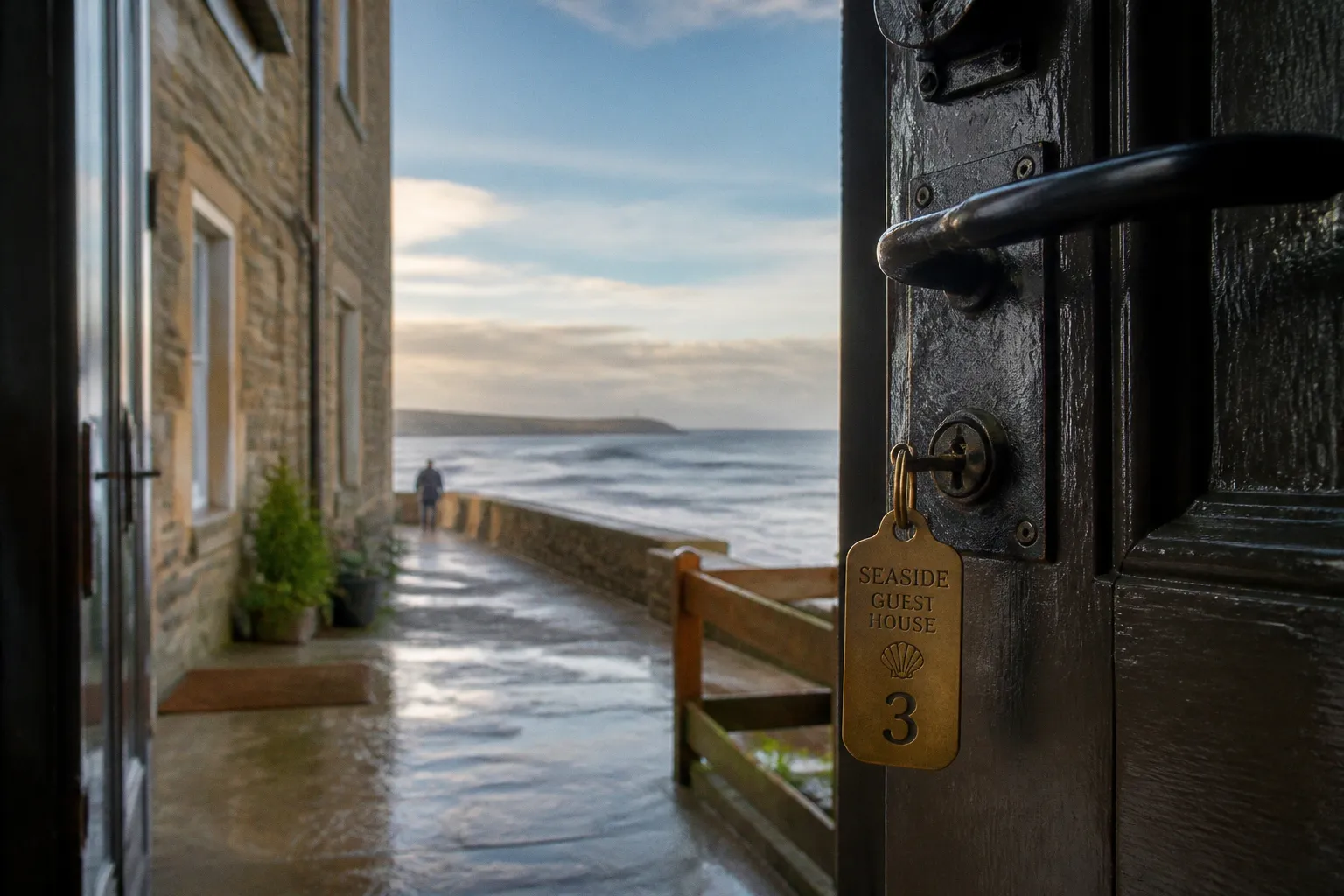
On paper, it is a small operational upgrade with a disproportionately pleasant effect.
The trouble begins when the lock is treated as an indoor consumer gadget placed on an outdoor door. Coastal air is not simply damp air. Chlorides carried by sea spray can settle on metal surfaces, enter imperfect seams and work their way into contacts, fasteners and moving parts. Around Edinburgh, that matters not only to properties directly on the shoreline. Exposed streets in Portobello, open approaches around the Firth of Forth and sea-facing buildings towards East Lothian can all create demanding conditions for entry hardware.
For hosts considering smart locks for coastal guest houses, the central question is therefore not whether keyless entry is useful. It plainly is. The question is whether the hardware has been specified for the exposure, and whether the property’s maintenance routine is realistic enough to keep it working.
A standard lock may perform perfectly in a showroom and still prove unsuitable at a wind-exposed entrance. The failure window is not identical from property to property: some installations deteriorate within months, while others remain usable for longer. Exposure, installation quality, material choice, condensation, cleaning and the design of the lock all change the outcome. What can be said with confidence is less dramatic than a precise countdown, but more useful: salt air turns small weaknesses into recurring maintenance problems, and consumer-grade hardware gives a host fewer margins for error.
The 18-month failure cycle: why standard hardware corrodes
There is a familiar pattern in coastal access systems, even if it should not be mistaken for a fixed timetable. The first symptom is often intermittent rather than catastrophic. A keypad takes longer to register a touch. A motor sounds strained. A fingerprint reader becomes unreliable in weather that would previously have caused no trouble. The app may continue to unlock the door, which encourages the host to postpone investigation.
That is how an access problem becomes an arrival problem. Guests do not experience a corroded contact or a weakened seal; they experience a code that works on the third attempt, a door that does not release cleanly, or a host who has to talk them through a manual override at the end of a journey.
Over a broad six-to-eighteen-month window, exposed standard hardware may begin to show meaningful deterioration, but that range is not a product warranty, a prediction for every property or a substitute for inspection. A sheltered entrance under a deep canopy is not equivalent to a gate facing the prevailing wind. A lock protected by a well-designed escutcheon is not equivalent to one with an exposed keypad and a poorly sealed battery compartment. The point of the range is to show how quickly coastal exposure can become operationally relevant, not to suggest that every lock fails on a particular month.
The chemistry is straightforward. Marine air carries chloride particles that encourage corrosion in susceptible metals. Once a deposit remains wet, it can support an electrochemical reaction on the surface and around joints. Repeated cycles of dampness and drying are particularly unhelpful: the visible salt residue may remain after the surface appears dry, ready to attract moisture again.
Several components are vulnerable at once:
- The exterior body and escutcheon can pit, blister or discolour, particularly where a coating has been scratched.
- Battery contacts can develop deposits or lose reliable contact, creating symptoms that resemble a failing battery.
- Fasteners and springs may corrode even when the main body still looks acceptable.
- The latch and motor assembly can become harder to operate as grit and corrosion increase resistance.
- The circuit board and connectors are at risk when condensation reaches areas that were never designed for persistent marine exposure.
The power problem is often misunderstood. A lock does not necessarily start consuming more energy because a radio module is somehow fighting corrosion. More commonly, resistance in the mechanical path, a struggling actuator, poor contact at the battery terminals or repeated unsuccessful attempts can increase the demand on the system. The practical result is the same: batteries appear to drain faster, but replacing them does not address the cause.
Coastal corrosion rarely announces itself as a dramatic failure. It usually arrives as a series of small inconveniences that guests notice before the host does.
This is why the retail buying habit is so risky. Hosts compare finishes, app features and prices, then assume that an outdoor-rated product is automatically suitable for a marine setting. It is not. Outdoor use may mean protection from rain and dust. Coastal use adds a corrosive environment, wind-driven deposits and a higher likelihood that water will find its way into seams, connectors and recessed fittings.
The right question is not whether a lock can survive a shower. It is whether the complete installation can tolerate repeated exposure while remaining serviceable for guests who will not treat the door gently or report early symptoms with technical precision.
Decoding marine-grade specifications: IP ratings and ASTM B117
The specifications page is where many purchasing decisions go wrong because different tests answer different questions.
An IP rating, defined through the Ingress Protection system, describes resistance to the entry of solids and water under specified test conditions. The first digit concerns solids and dust; the second concerns water. A higher water number can indicate protection against more demanding forms of water exposure, but it does not certify resistance to salt-induced corrosion.
That distinction deserves to be printed on every coastal lock quotation. An IP rating can tell a host something about whether rain or spray may enter the enclosure. It cannot tell them what the enclosure is made from, whether the fasteners are corrosion-resistant, how the battery contacts are protected or whether the finish will withstand chloride deposits.
Nor does IP67 or IP68 automatically make a device a better front-door choice. Those ratings relate to temporary or continuous immersion under defined conditions, while a seaside entrance may be exposed to wind-driven spray, condensation, ultraviolet light, grit and frequent handling without ever being immersed. A lock should be selected for the actual exposure, not simply for the largest number on the datasheet.
For most sheltered coastal entrances, a credible water-ingress rating is a sensible starting point. For exposed gates, lower-level doors and locations that receive direct spray, the host should ask for more detail:
- Was the rating tested on the complete assembled product or only on a component?
- Is the keypad, reader and battery compartment protected to the same level?
- Are cable entries and mounting points sealed after installation?
- Does the manufacturer describe the product as suitable for marine or coastal exposure?
- Which parts are replaceable if the exterior begins to corrode?
- Are the warranty exclusions clear about salt, spray and environmental damage?
ASTM B117 is useful, but it is frequently oversold. The standard describes a controlled salt-spray, or salt-fog, test in which specimens are exposed to a saline mist under specified laboratory conditions. This gives manufacturers and purchasers a comparative way to assess coatings and materials. It can reveal differences between finishes and help identify products that perform poorly in an accelerated corrosive environment.
It does not create a conversion table from test hours to years beside the sea.
A product that performs for a particular number of hours in ASTM B117 has not thereby demonstrated an equivalent number of calendar years in Portobello, Gullane or any other location. Real installations experience changing temperature, rainfall, drying periods, pollutants, abrasion, cleaning chemicals, orientation and different concentrations of deposited salts. The laboratory test is a comparison tool, not a field-life guarantee.
The same caution applies to claims based on ANSI/BHMA grades. A lock grade may tell a host about performance, strength, cycle testing or other aspects of the hardware, depending on the relevant standard and product documentation. It should not be treated as a universal salt-spray score. If corrosion resistance is central to the purchase, the supplier should provide the specific environmental test report and explain which component was tested, how it was prepared and what failure criterion was used.
A specification is useful only when it describes the thing the host is actually buying. A marketing page that combines an IP rating, a commercial grade and a salt-spray figure without explaining the relationship may look technical while leaving the central question unanswered.
Material science for seaside hosts: 316 stainless steel versus zinc alloys
The material beneath the finish matters more than the finish itself.
316 and 316L stainless steel are commonly chosen for marine and coastal applications because their composition gives them improved resistance to chloride-related pitting compared with more general-purpose stainless grades. The molybdenum content is important here. It does not make the material invulnerable, but it gives the host a better starting point in an environment where salt deposits are part of normal operation.
The L designation refers to a lower-carbon version, useful in manufacturing processes such as welding. For a host, the more important point is not to treat “316L” as a magic word. The whole assembly still matters: the grade of the screws, springs, pins, hinges, concealed brackets and internal components can determine how the lock behaves after installation.
Zinc alloys and aluminium are not automatically unusable. They are common because they are economical, easy to cast and capable of producing attractive shapes. The problem is that a standard residential alloy body, decorative plating and minimal sealing may not offer enough protection for a highly exposed door. Once a coating is damaged or a joint begins to admit moisture, the host is relying on a material and construction that may not have been designed for sustained chloride exposure.
Chrome plating is another area where appearance can mislead. A polished surface may look more premium at installation, but the visible finish is only one layer in a larger system. If the coating is thin, scratched or poorly supported at edges and screw points, corrosion can develop beneath it. Powder coating can provide useful protection, but it too depends on preparation, coverage, edge treatment and the condition of the surface over time.
For a coastal guest house, the purchase should be assessed as an assembly rather than a front plate. Ask about:
- The base material of the exterior body, not merely the advertised finish.
- The material used for screws, springs, pins and exposed fixings.
- Whether the keypad or reader is replaceable without replacing the entire lock.
- The way the battery compartment is sealed and drained.
- The location of the emergency power contacts or mechanical override.
- Compatibility between the lock, door, strike plate and surrounding hardware.
- Cleaning instructions that will not damage the coating or remove protective lubricant.
A brushed stainless appearance can be attractive, but aesthetics are not the argument for marine-grade hardware. The argument is that a sound substrate gives the installation more tolerance when a guest leaves the door exposed, when a cleaner uses the wrong cloth or when a week of damp weather delays inspection.
The economic comparison also needs more honesty than a simple cheap-versus-expensive calculation. There is no universal price or service-life ratio that applies across smart locks. A lower-cost lock may be perfectly sensible on an inland, sheltered door. The same model may become poor value at a sea-facing entrance if it brings call-outs, emergency access, replacement batteries, guest compensation or a complete reinstallation. A more expensive lock may reduce those risks, but only if its specifications genuinely match the environment and its maintenance requirements are followed.
| Consideration | Standard residential smart lock | Coastal-suitable electronic lock |
|---|---|---|
| Exterior material | Often zinc alloy, aluminium or coated mixed materials | Corrosion-resistant material specified for the exposed assembly |
| Water protection | May address rain or splash only | Clear rating and installation guidance for the intended exposure |
| Salt resistance | May be unstated or supported by a generic test claim | Specific test information, limitations and warranty terms |
| Battery compartment | Frequently a weak point in exposed installations | Better protected, serviceable and designed to limit moisture entry |
| Access during failure | App, keypad or emergency power may be available | Redundant access method planned and tested by the host |
| Maintenance | Often treated as fit-and-forget | Inspection, cleaning and component replacement built into operations |
| Best location | Sheltered entrance with limited exposure | Main or secondary entrance where remote access justifies the specification |
The table is not a verdict on a product category. It is a reminder that “smart lock” describes a function, not a level of durability.
Operational continuity: maintenance cycles for coastal entry systems
Even well-specified hardware needs a maintenance rhythm. The objective is not to polish the lock until it looks new. It is to catch the small changes that precede a guest-facing failure.
A three-to-six-month inspection interval is a reasonable starting point for many coastal installations, with more frequent checks for doors facing the prevailing wind or receiving direct spray. The interval should be shortened when the property has already shown signs of deposits, discolouration or unreliable operation. A lock on a sheltered entrance may need less attention than one on a garden gate, but it should not be ignored simply because it is still opening.
The inspection can be practical rather than elaborate:
1. Check the exterior for deposits and staining. White residue, green deposits, bubbling finish or rust marks around fixings are reasons to investigate rather than wipe away and forget.
2. Operate the lock repeatedly. The latch should move smoothly, without a new scraping sensation, hesitation or change in motor sound.
3. Inspect the door alignment. A door that has swollen, dropped or shifted can make the motor work harder and create symptoms that look like electronic failure.
4. Examine accessible contacts and compartments. Look for moisture, discolouration or powdery deposits around batteries and emergency terminals.
5. Test every access route. The app, keypad, physical override, emergency power method and staff credential should all work before a guest depends on them.
6. Record the result. A simple maintenance log makes it easier to distinguish a one-off battery issue from a pattern of declining performance.
Cleaning should follow the manufacturer’s instructions. Salt residue should not be allowed to accumulate, but aggressive household chemicals, abrasive pads and improvised solvents can damage coatings and seals. In many cases, a gentle clean with an appropriate damp cloth followed by careful drying is safer than trying to make the surface shine. Lubrication should be applied only where the manufacturer permits it and with a product suitable for the lock’s materials. Grease on the wrong part can attract grit or interfere with a sensor.
The battery strategy deserves its own line in the operating procedure. Hosts should use the battery type specified by the manufacturer, keep replacements on site and avoid treating low-battery warnings as an administrative nuisance. A coastal lock may fail because of corrosion, but it may also fail because the battery compartment has lost reliable contact or because the motor is compensating for a badly aligned door. Replacing cells without checking the mechanical load is not maintenance; it is delay.
Remote check-in hardware for Edinburgh B&Bs also needs a failure plan that works when the internet does not. A host should know:
- How a guest enters if the Wi-Fi connection is unavailable.
- Whether a temporary code remains valid offline.
- Where the physical override is kept and who can access it.
- How to provide emergency power without exposing the property to casual entry.
- Which local contractor can attend outside normal hours.
- Whether a failed exterior unit can be bypassed without replacing the entire door set.
This is where the security benefits of smart locks for small inns need to be discussed without marketing language. Unique codes, access logs and the ability to remove a former guest’s access can be valuable. They may reduce the circulation of copied keys and make staff access easier to manage. But those benefits exist alongside new failure modes: depleted batteries, network dependence, software accounts, damaged keypads and corrosion at the door itself.
A lock is not secure merely because it has an app. Security comes from the complete access plan, including who receives credentials, how long they remain active, what happens when a booking changes and how the property is entered when the preferred system is unavailable.
The strongest coastal access system is not the one with the most features. It is the one that still gives the host a controlled, documented way in when one feature fails.
Protective covers and silicone sleeves have a limited role. They may reduce direct exposure in some installations, but they can also trap moisture, interfere with buttons or conceal deterioration. A cover is not a substitute for a corrosion-resistant body, a properly sealed installation and a maintenance schedule. If the door’s position is exceptionally exposed, changing the hardware or relocating the access point may be more effective than adding another layer around an unsuitable lock.
Evaluating digital mechanical alternatives for high-exposure zones
The most exposed door is not always the best place to install the most connected device.
Sea-facing gates, lower-level courtyard entrances, bin stores, staff doors and secondary access points may receive more spray and grit than the principal guest entrance. They may also have a simpler access pattern. If the host does not need remote unlocking, live access logs or changing guest codes at that specific door, a digital mechanical lock can be the more rational choice.
These systems use a keypad or push-button mechanism without the same dependence on batteries, wireless communication or a circuit board. Their failure modes are different rather than nonexistent. Buttons can wear, mechanisms can seize, codes can be shared and the metal still needs care. Yet removing the electronic module and battery compartment can eliminate several points of vulnerability in a high-exposure location.
The trade-off is operational. A mechanical digital lock will not provide the same remote-control experience as a connected system. It may not integrate with a booking platform, issue a time-limited code from a phone or provide an access history. For a main guest entrance, those functions may justify the additional maintenance burden. For a rarely used garden gate, they may be unnecessary complexity.
A sensible coastal strategy is often layered:
- Use a properly specified electronic lock where remote access materially improves guest operations.
- Use a simpler digital mechanical system where exposure is high and connectivity adds little.
- Keep a controlled physical override for critical doors.
- Avoid placing the only route into the property behind one battery-powered, network-dependent device.
- Match the maintenance interval to the door’s exposure, not to the manufacturer’s most optimistic general guidance.
- Treat the strike plate, hinges, frame and door alignment as part of the access system.
The result may be less visually uniform than fitting one model everywhere. That is not necessarily a defect. A guest house is a working building, and different doors have different jobs. A front entrance used by every arriving guest deserves convenience and redundancy. A storm-facing side gate may deserve simplicity.
Smart locks are not the wrong technology for seaside accommodation in Edinburgh. The mistake is assuming that the same specification can be carried from an inland flat to a door exposed to salt-laden wind. IP ratings, salt-spray results, material grades and commercial classifications can all help, but none of them removes the need to understand the actual installation.
For hosts, the durable choice is rarely the lock with the most persuasive brochure or the lowest purchase price. It is the one whose materials fit the air, whose access method fits the operation and whose maintenance can be carried out before a guest discovers the warning signs. In coastal hospitality, the front door is not décor. It is a small piece of critical infrastructure, and it should be specified accordingly.