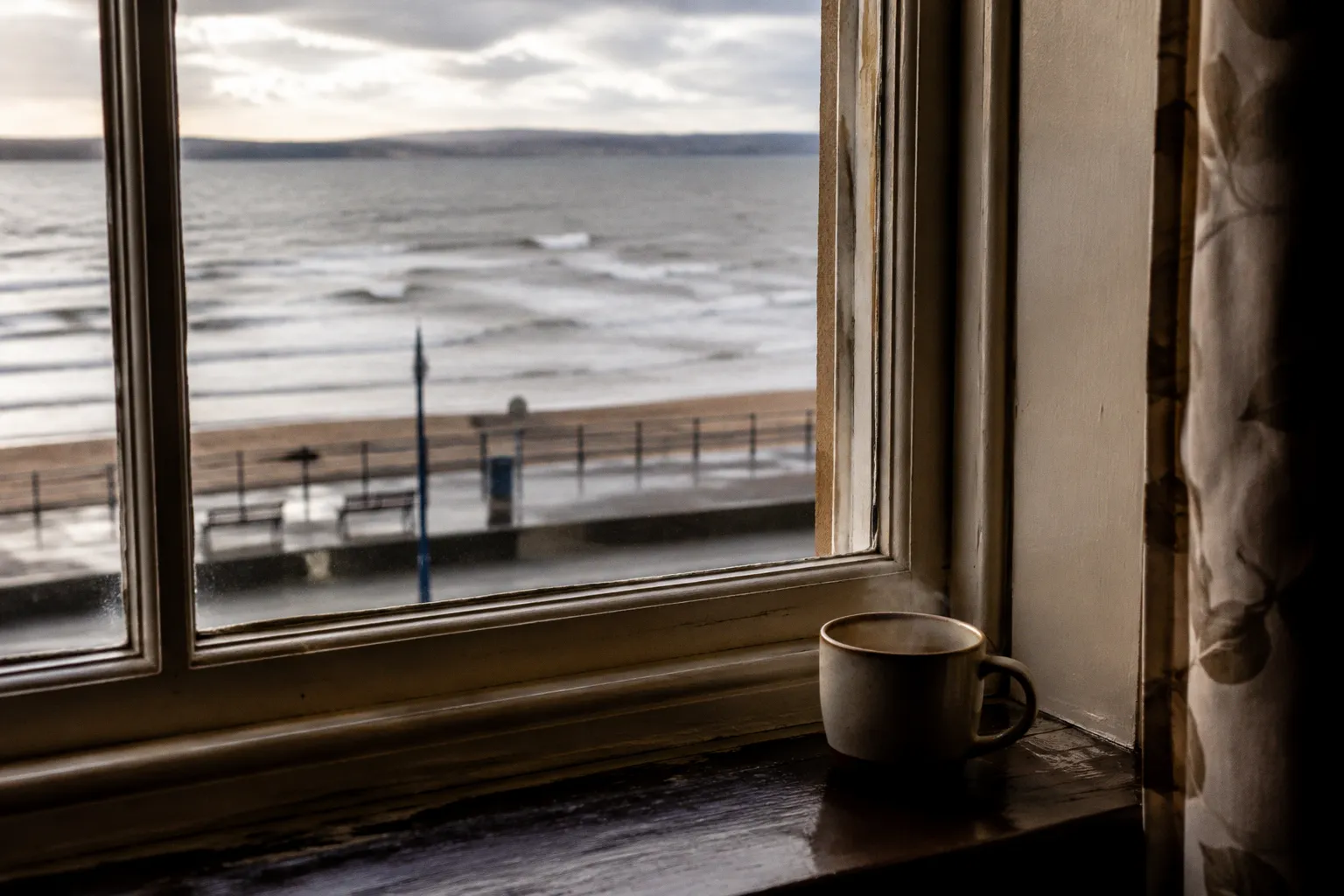
A cottage or guest house can sit roughly 50 yards from Portobello Beach and still offer a markedly quieter night than a city-centre hotel. That apparent contradiction comes down to the building itself: the thickness of the walls, the position of the bedroom, the quality of the window frames, and whether coastal wind reaches the room directly or is softened by neighbouring houses.
For light sleepers, Joppa coastal cottage soundproofing is therefore less about expecting a perfectly silent retreat and more about understanding how the property handles sound. Traditional Scottish masonry can do much of the work. Windows, doors and room orientation decide whether the result feels genuinely restful or merely picturesque in daylight.
The acoustic advantage of traditional Scottish stone masonry
Joppa sits at the eastern end of Portobello Beach, with a quieter residential character than central Edinburgh. The setting matters, but the construction matters more. Many older properties in the area rely on traditional Scottish stone walls, and those walls bring two useful qualities to a seaside stay: mass and thermal stability.
A thick masonry wall does not behave like a lightweight internal partition. It takes more energy for sound to pass through it, particularly when the noise is coming from outside the building. It also slows the transfer of heat, which helps rooms avoid the sharp temperature changes that can make coastal bedrooms uncomfortable overnight. Neither quality makes a building acoustically sealed, but both contribute to a calmer sleeping environment.
When I assess a room for a light sleeper, I do not treat the phrase “traditional property” as an automatic recommendation. Heritage construction can be an advantage, but only when the rest of the room supports it. A substantial wall may reduce traffic noise while an older sash window admits wind hiss, rattling glazing or voices from the street. A heavy floor may separate you from outdoor sound but carry footsteps from a room above. The acoustic performance belongs to the whole room, not to the masonry alone.
The most useful questions concern the relationship between the bedroom and the outside world:
- Does the room face the beach, a residential street, a rear garden or a side elevation?
- Is the bed positioned against an external wall or beside a window?
- Does the door close firmly, or is there a visible gap beneath it?
- Is the bedroom directly below a communal landing or another guest room?
- Are heating pipes, radiators or loose window fittings likely to create small recurring noises at night?
These are practical details, but they decide how a property feels after midnight. During the day, the visual appeal of a stone cottage can dominate the booking decision. At two in the morning, the condition of the latch, the movement of the window and the amount of sound travelling through the floor become much more important.
A thick stone wall can quieten the coast, but the window is still where the night gets in.
The benefit for a light sleeper is often a softer acoustic background rather than total silence. You may still hear the weather change or catch the distant movement of a bus, but the building can prevent those sounds from becoming sharp interruptions. That distinction is central to choosing a quiet coastal stay near Edinburgh. Silence is an unrealistic promise; controlled sound is a useful standard.
Coastal wind is not the same as traffic noise
Wind creates a particular problem in Edinburgh seaside accommodation. Traffic tends to arrive as separate events: a vehicle passes, a door closes, someone speaks outside. Coastal weather can be continuous. It presses against the façade, moves around corners, finds loose fittings and produces a low, irregular sound that is difficult to ignore when you are already awake.
In a Joppa bedroom, the experience of coastal wind noise will depend on exposure and maintenance as much as on distance from the shoreline. A room looking towards open water may have a more direct relationship with the weather than one sheltered by neighbouring terraces. A cottage close to Portobello Beach may be wonderfully convenient while still needing carefully maintained windows and seals to keep the wind from becoming intrusive.
This is where the language used to describe a property needs a little resistance. “Sea view” tells you what you may see. It does not tell you how the room sounds in a strong wind. “Close to the beach” describes the walk. It does not describe the condition of the bedroom window. For anyone searching for Edinburgh seaside accommodation noise levels, the missing information is often more important than the attractive wording.
A well-maintained window should close evenly, with no obvious movement in the frame. If the room has traditional glazing, secondary glazing or a properly fitted modern inner pane can make a significant practical difference. I would not assume that every historic Joppa cottage has been retrofitted in this way; acoustic performance varies from property to property, and there are no reliable decibel figures available for individual cottages here.
What you can assess is the likely route of the sound. Wind reaching a wall is less concerning than wind entering through a loose frame. A distant gust is usually easier to tolerate than a repeated rattle beside the bed. The difference is physical and specific, not a matter of whether the property is old or new.
What to look for around the room
A room-by-room acoustic assessment is more useful than a general promise of peace.
At the window, look for a frame that sits squarely, closes without force and does not flex when latched. Curtains can soften reflected sound and block draughts around the edges, but they cannot compensate for a badly fitting pane.
At the bedroom door, check whether it closes fully and whether the corridor is likely to carry conversation or footsteps. A thick internal door is helpful; a lightweight door with a large gap beneath it is less so. In a guest house, the landing can become the main source of nighttime disturbance even when the outside environment is quiet.
At the floor, consider what sits above and below. Traditional floors may feel solid, but construction varies. A room below another bedroom can be affected by footsteps, luggage wheels and early-morning movement. A room at the top of the building may avoid overhead noise while becoming more exposed to roof and wind sounds.
At the bed, notice its position rather than only its mattress. A bed directly beneath a window or against a party wall can make small sounds feel close. Even a calm room becomes harder to sleep in when every gust seems to arrive beside your pillow.
In the bathroom, listen for the water system. Water pressure, extractor fans and pipe noise are easy to ignore during a daytime viewing and surprisingly prominent at night. A bathroom sharing a wall with the bed may transmit flushing or shower noise from an adjoining room, particularly in a compact cottage.
This is not an argument against period accommodation. It is an argument for reading the building as a building. Historic properties often have a more substantial envelope than contemporary budget accommodation, but they also have idiosyncrasies. The quietest room may not be the one with the best view.
Window glazing and room orientation decide the outcome
For light sleepers, room orientation is often the most useful piece of information a host can provide. A bedroom facing a sheltered side street may be preferable to a front-facing room with a direct view of the sea. Another guest may make the opposite choice, valuing the outlook and accepting more exposure to wind. Neither preference is wrong, but the property should make the distinction clear.
In Joppa, the relationship between beach access and residential calm is one of the area’s strengths. Properties near Portobello Beach can put you close to the sand without placing you in the continuous urban activity of central Edinburgh. That does not remove all sound. It changes the type and rhythm of the sound you are likely to encounter.
A room facing a residential street may receive occasional pedestrian or vehicle noise. A room facing the coast may be more affected by weather. A rear-facing room may feel most protected, although its acoustic comfort will still depend on adjacent buildings, service areas and the structure of the property.
For a booking enquiry, I would ask a host a direct question rather than relying on the phrase “quiet room”:
- Which bedrooms are furthest from the road?
- Are any rooms directly above the entrance or beside a shared stair?
- Do the windows have secondary glazing or modern sealed units?
- Is the property exposed to prevailing coastal wind?
- Can a light sleeper request a rear-facing or upper-floor room?
The quality of the answer tells you something. A host who understands the building can usually describe the trade-off without resorting to vague reassurance. They may explain that one room is quieter from the street while another has the better view, or that a particular cottage is best suited to guests who want immediate beach access rather than complete acoustic separation.
That level of specificity is more valuable than a broad claim that the property is peaceful.
Comparing the main acoustic trade-offs
| Room or property position | Likely advantage | Possible drawback | Best suited to |
|---|---|---|---|
| Rear-facing bedroom | Less direct exposure to beach and passing activity | May have less light or a less memorable outlook | Light sleepers prioritising continuity of sleep |
| Sea-facing bedroom | Strong coastal atmosphere and open views | Greater exposure to wind and weather noise | Guests who value the outlook and tolerate a livelier soundscape |
| Upper-floor room | Reduced risk of entrance and street-level disturbance | Can be more exposed to roof and wind noise; stairs may be difficult with luggage | Mobile guests who prefer separation from shared areas |
| Ground-floor room | Easier access and less stair use | More vulnerable to entrance doors, footfall and street sound | Guests with mobility concerns, if the room is away from the main door |
| Room in a thick-walled stone property | Better potential for reducing external noise | Internal floors, doors and glazing still determine performance | Guests seeking a traditional building with a quieter envelope |
| Room beside a shared stair or bathroom | Convenient circulation | Greater risk of footsteps, doors and water-system noise | Short stays where location matters more than deep sleep |
The important word in this table is “potential”. A masonry building can provide a strong starting point, but the bed, window and internal circulation still have to work together. Soundproofing tips for seaside holiday lets are often presented as technical solutions, yet the simplest decision may be choosing the room that is furthest from the property’s busiest movement route.
Sleeping near Portobello Beach without losing the city
The appeal of Joppa is that you do not have to choose between a seaside setting and access to Edinburgh. Public buses connect Joppa and Portobello with central Edinburgh in approximately 20 to 25 minutes, making the area practical for a city break as well as a beach-focused stay.
That travel time also helps explain why the neighbourhood can feel different from a central hotel district. You return from the city to a residential coastal environment rather than to a street where late-night activity continues below the window. The trade-off is that your accommodation is not positioned at the centre of the evening network. You need to plan the final journey, especially if you are carrying luggage or arriving after a long day.
For a guest who sleeps lightly, this separation can be valuable. A central room may be protected from coastal wind but exposed to traffic, deliveries, nightlife or repeated door movement. A Joppa cottage may be nearer the weather while benefiting from thick walls and a lower level of urban background noise. The better choice depends on which sound your sleep tolerates least.
There is also a functional question of arrival. Beach-adjacent properties may be close to the sand but not necessarily effortless with wheeled luggage. Older buildings can have steps, narrow entrances or changes in floor level. If you have mobility limitations, ask about the route from the pavement to the bedroom, not simply whether the property has a ground-floor room. A ground-floor bedroom beside the entrance may solve the stairs while introducing a different kind of disturbance.
At Straven Guest House on Brunstane Road North, the combination is particularly clear: the four-star Victorian B&B is described as being 50 yards from Portobello Beach, with free unrestricted on-street parking. That makes it attractive for guests who want immediate access to the shore without giving up the option of arriving by car. The practical questions remain room-specific: which bedroom is quietest, how the windows are configured, and how close the room sits to the entrance or shared circulation.
The Rockville Hotel, at Joppa Pans, offers another version of the coastal setting, overlooking the Firth of Forth. An outlook over the water can be a major part of the experience, but again, a view should not be treated as an acoustic specification. Exposure, glazing and orientation decide how that outlook behaves after the lights are out.
What a genuinely quiet coastal stay should feel like
A quiet room is not necessarily a room where you hear nothing. In a coastal property, you may notice the weather, the occasional vehicle and the muted activity of other guests. The more useful question is whether those sounds remain in the background or repeatedly pull you out of sleep.
The best Joppa accommodation for a light sleeper should create a sense of distance between the bed and the disturbance. That distance may come from stone walls, a sheltered elevation, a well-fitted window, a corridor layout or simply a sensible room assignment. It is usually the combination that works.
I would be cautious about promises of absolute quiet. There are no published laboratory sound-reduction ratings for the specific cottage windows discussed here, and no historic property can guarantee the same acoustic result in every room or weather condition. Street orientation, glazing, window operation and the behaviour of neighbouring guests all affect the night.
But that caution should not obscure the real advantage of Joppa. Traditional stone construction can dampen external noise and provide a steadier indoor environment than a lightweight modern building. The area’s residential setting reduces the constant urban hum. Its proximity to Portobello Beach gives you the shoreline without requiring you to stay in the centre of Edinburgh. Those are meaningful advantages, particularly when the bedroom has been chosen with care.
If you are booking for a light sleeper, make the room the subject of the conversation. Ask about the windows, the elevation, the neighbouring rooms and the route from the entrance. A host who can answer those questions plainly is more useful than a listing filled with decorative adjectives.
Joppa works best when you understand its character: a coastal neighbourhood, not an acoustic bunker. The stone may soften the city and the sea, but the final quality of sleep comes from the details around it. Find the room with the right orientation, the soundest window and the least disruptive circulation, and the beach becomes what it ought to be—a nearby presence, not a nightly interruption.