Portobello Promenade: A Guide to Coastal Heritage and Walks
It lies only about three miles east of Edinburgh city centre, but the shoreline has a different measure of time: Victorian resort architecture, industrial traces, Turkish baths, beach cafés and the broad tidal margin of the firth all occupy the same walk.
This is not simply a pleasant route beside the water. The promenade is a record of how Edinburgh met the sea. Its present form was shaped in the Victorian era for day-trippers, while the settlement behind it began as an industrial village associated with brickworks, potteries and glassmaking. The beach became a resort later, and the customs of the coast have continued to change without quite erasing what came before.
For visitors staying near the shoreline, the best way to understand Portobello is on foot. The route is accessible, geographically clear and rich enough to support several readings: a self-guided coastal heritage tour, a family walk to Joppa Rocks, a longer connection towards the city’s eastern paths, or an unhurried circuit built around coffee, architecture and the tide.
From industrial village to Edinburgh seaside
Portobello’s coastal identity was not inevitable. Before it became a Victorian seaside resort, the settlement was associated with manufacture. Brickworks, potteries and glassmaking formed part of its eighteenth-century character, industries that depended on materials, transport and access to the wider firth rather than on leisure.
That earlier landscape is easy to overlook when the promenade is busy. The beach suggests recreation first: open sand, benches, arcades, cafés and the long horizontal line of the water. Yet the suburb’s name as a place of leisure belongs chiefly to the nineteenth century, when the coast began to attract visitors from Edinburgh for a day beside the water.
The promenade itself was laid out around 1866 and through the 1870s. Its purpose was practical as well as picturesque. It gave visitors a firm route along the shore, connecting the resort’s attractions and allowing the coastline to function as a destination rather than merely as an edge of the city. Beach cafés, amusements and bathing facilities grew within this new arrangement.
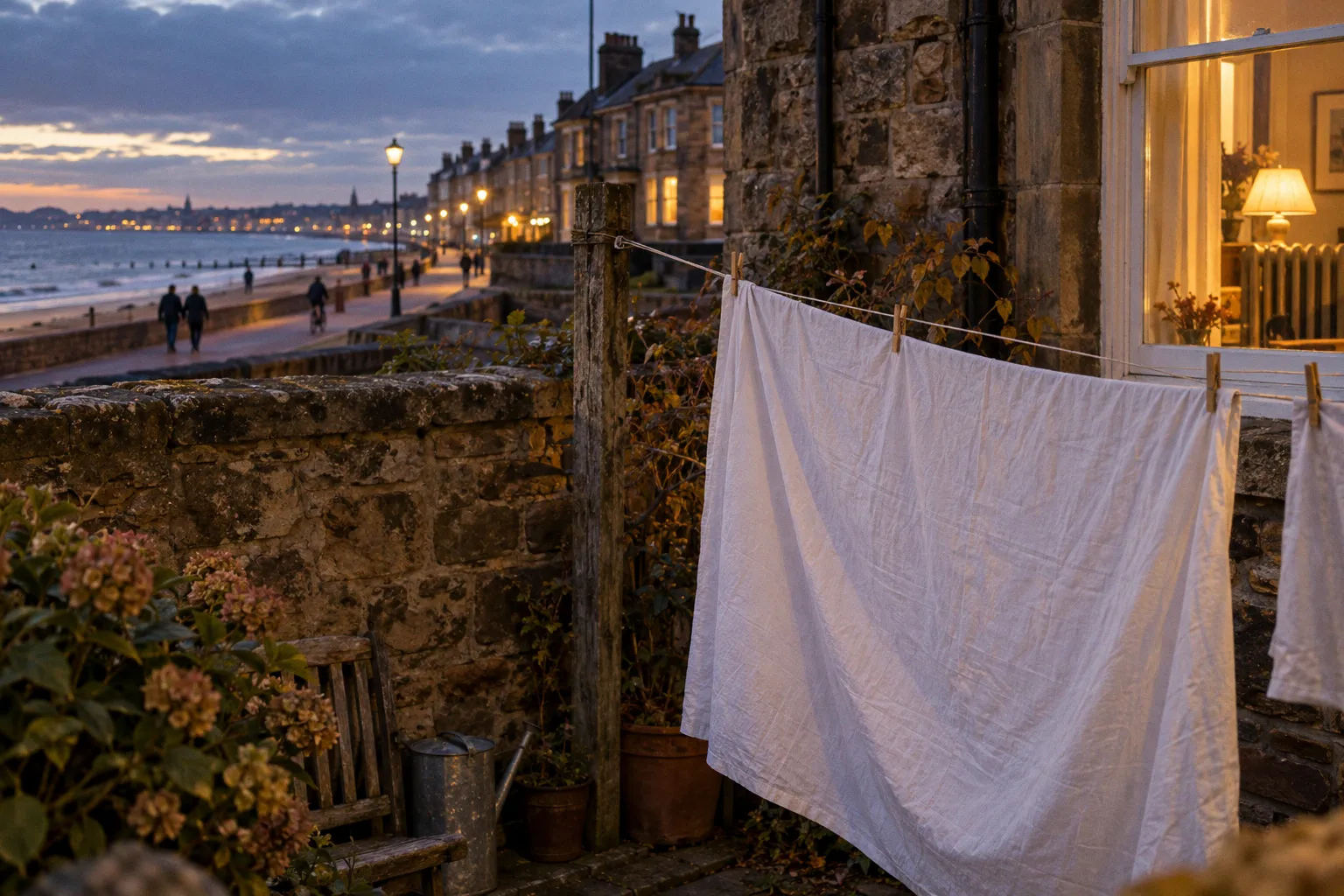
The result is a distinctive kind of urban coast. Portobello is neither a remote fishing village nor a purely landscaped waterfront. It is a city suburb with a beach, a promenade with residential streets behind it, and a Victorian resort whose public life remains tied to the water. The relationship is visible in the scale of the route: long enough for a proper walk, compact enough to be part of an ordinary afternoon.
Portobello’s promenade is best read as a working piece of urban history: a resort route that still carries the habits of the city behind it.
The distance from central Edinburgh matters here. At roughly three miles from the city centre, Portobello is close enough to be used by residents rather than encountered only as a day-trip excursion. That proximity helps explain the promenade’s contemporary character. It belongs to visitors, certainly, but it also belongs to swimmers, dog walkers, families, runners, café customers, local artists and people taking the shortest route to the water.
A stay near Joppa or Portobello places you within that everyday rhythm. The shoreline is not a staged heritage quarter. It is a living coastal suburb, and the most convincing experience comes from allowing the historic details to sit alongside ordinary local use.
Reading the Victorian promenade
The promenade’s architecture does not arrive as a single monumental statement. Instead, its history is distributed through small structures, changes in frontage and the surviving relationship between the paved route and the beach.
One useful approach is to walk slowly from the Portobello side towards Joppa, treating the route as a sequence of thresholds. The promenade is flat and traffic-free, so the physical effort is modest; the interest lies in noticing how the built edge changes as the walk progresses.
Several landmarks provide fixed points for a self-guided coastal heritage tour:
- The Coade Stone Pillars represent the ornamental language associated with the nineteenth-century resort. Their material and decorative presence belong to a period when seaside architecture was expected to be both functional and theatrical.
- Straiton Place Park offers a green interruption to the hard line of promenade and frontage. The Prince of Wales Fountain is one of the details that rewards a slower look rather than a passing glance.
- Noble’s Amusements Arcade carries forward the entertainment tradition that helped define Portobello as a destination for day visitors.
- Portobello Swim Centre anchors the bathing history of the promenade and remains one of its most important buildings.
- Joppa Rocks, at the eastern end, mark a change in the texture of the shoreline and provide a natural point at which to pause or continue along connected routes.
These landmarks should not be treated as isolated attractions. Their significance lies in the way they work together. A fountain, an arcade, a bathing building and the open beach form a visual argument about Victorian seaside life: public space, bodily recreation, social display and the commercial business of entertaining visitors.
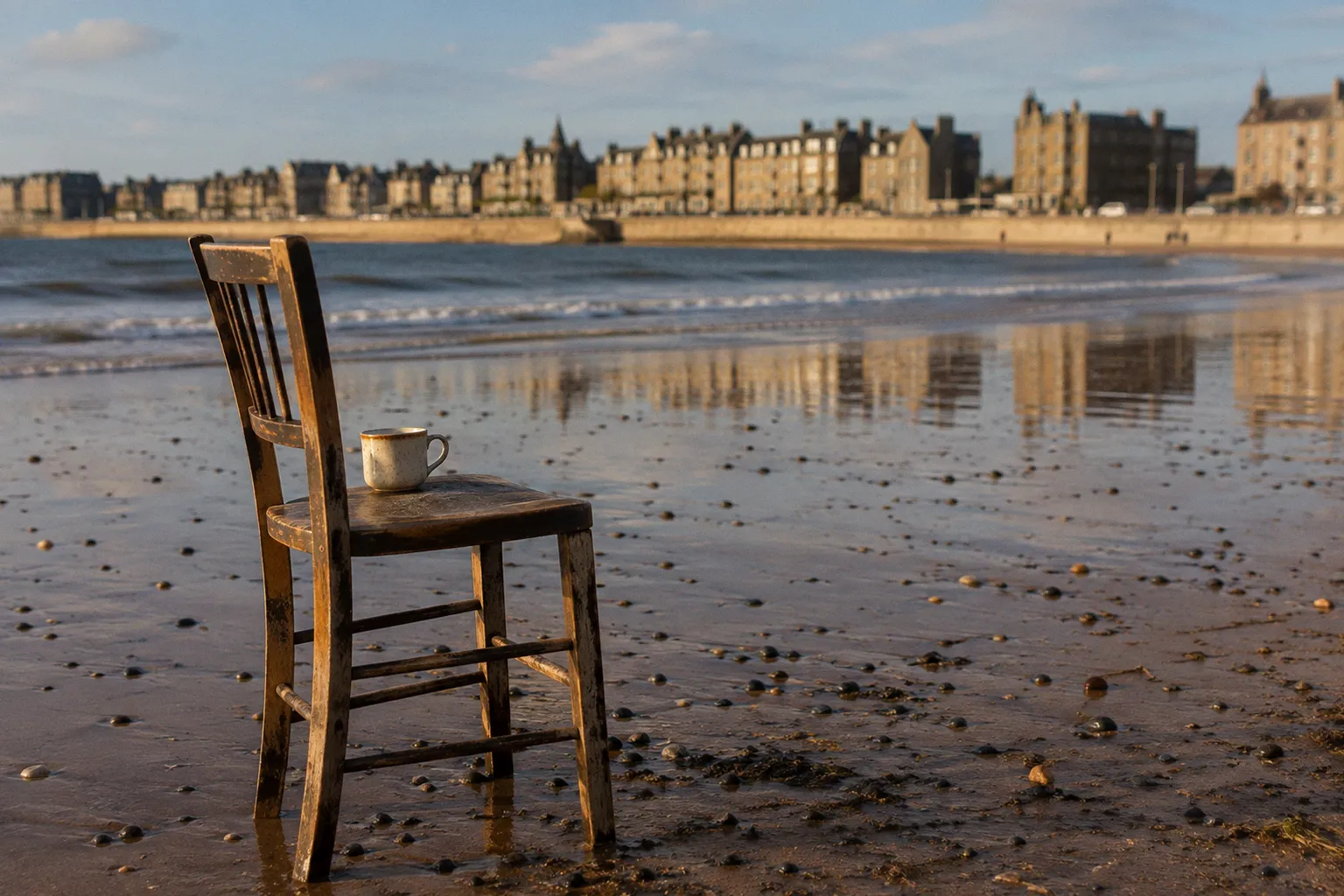
The architecture is also valuable for what it does not attempt. The promenade does not conceal the coast behind a heavy civic frontage. From the path, the firth remains present as weather, light, horizon and tide. Even when the water has withdrawn, the mudflats and exposed shoreline are part of the view. The route makes the geography difficult to ignore.
A practical way to walk the landmarks
Rather than moving through Portobello as though it were a museum with numbered rooms, divide the promenade into three loose sections:
| Section | What to look for | Best understood as |
|---|---|---|
| Portobello beach and central promenade | Resort frontage, cafés, amusements and the relationship between beach and urban suburb | The active Victorian leisure landscape |
| Swim Centre and Straiton Place area | Bathing history, civic details, the Prince of Wales Fountain and changing public uses | The infrastructure of seaside recreation |
| Eastern promenade towards Joppa Rocks | A quieter coastal edge, changing views across the firth and connections to longer paths | The transition from resort promenade to open shoreline |
This division is not an official itinerary, and the exact atmosphere changes with the hour and season. It is simply a useful way to prevent the walk from becoming a catalogue of names. Portobello’s heritage is spatial. Each place makes more sense when seen in relation to the beach, the road, the houses and the water.
The promenade also rewards revisiting. In bright weather, the firth can make the route feel expansive and almost rural. Under haar, the same buildings appear closer and more concentrated, their details becoming more important than the view. A neap tide changes the proportions of the beach, while a fuller tide brings the water nearer to the built edge. These are not inconveniences to be edited out of the experience; they are part of the coast’s character.
The Swim Centre and the Turkish Baths
The Portobello Swim Centre opened in 1898 and was designed by city architect Robert Morham. Its most remarkable surviving feature is the Victorian Turkish Baths, described as Scotland’s only publicly accessible operational Victorian Turkish Baths.
That fact gives the building a significance beyond its appearance. Victorian bathing was not merely a leisure activity. Public swimming, therapeutic bathing and the social rituals around cleanliness all belonged to a wider culture of municipal improvement. A building such as the Swim Centre connected the resort’s pleasure economy with the city’s public infrastructure.
Portobello’s bathing history has several layers. The promenade’s original resort culture encouraged visitors to come to the shore for recreation. The Swim Centre gave that culture a permanent civic building. The open-air pool that opened in 1936 belonged to a later phase of seaside life, although it is no longer operational and should not be confused with the current bathing facilities.
The Turkish Baths offer a more concentrated experience of the past than the promenade itself. Outside, the coast is expansive and exposed. Inside, the architectural language turns inward: heat, tiled surfaces, enclosed rooms and a sequence of bodily experiences. The contrast is telling. Portobello’s identity has always depended on both sides of the shoreline—open firth and carefully organised public recreation.
For a visitor, the building works best as part of a wider walk rather than as an isolated indoor stop. Begin along the beach, approach the Swim Centre from the promenade and then continue towards Joppa. The movement makes the building’s purpose legible. It was not placed beside an abstract waterfront; it was built within a seaside culture already shaped by bathing, promenading and the circulation of visitors.
If you are planning around a visit to the Turkish Baths, check current opening arrangements separately. Operational details can change, and the building’s historic importance does not guarantee unrestricted access at every hour. The promenade itself remains the dependable part of the itinerary.
The Turkish Baths preserve the moment when seaside pleasure became municipal architecture: recreation given walls, timetables and a public address.
From Joppa Rocks to longer coastal routes
The walk between Joppa and Portobello is the most direct way to experience the shoreline as a connected place. Joppa Rocks form a natural eastern marker for the promenade, and the route westwards offers a clear understanding of how the coast enters the city rather than ending at it.
For visitors searching for walking trails along the Firth of Forth coastline, this is an approachable starting point. The promenade is approximately 2.2 miles long, flat and paved, with no need to negotiate a complicated trailhead. It can be walked in one direction and treated as a short outing, or folded into a longer day using nearby connections.
The promenade forms part of a broader network that includes links towards:
- The Brunstane Burn Walkway, which carries the walk inland and creates a change from open shore to burn-side landscape.
- The Innocent Railway Path, one of the city’s established off-road routes and a useful connection between coastal walking and Edinburgh’s eastern neighbourhoods.
- The John Muir Way, which places the Portobello and Joppa shoreline within a much larger walking geography extending across Scotland’s east coast.
The character of these routes varies considerably. The promenade is urban and maritime at once: the path is smooth, the route is obvious and the beach remains close. Inland connections bring more vegetation, enclosed sections and changes in gradient. The John Muir Way, meanwhile, gives the shoreline a national-scale context, although a visitor should not assume that every connection makes a simple circular walk.
For a short stay, there are three sensible versions of the route:
1. The promenade out-and-back
Walk from the central Portobello frontage towards Joppa Rocks and return by the same path. This is the clearest option for seeing the main heritage landmarks without committing to a longer route.
2. The heritage-and-bathing walk
Combine the central promenade, the Coade Stone Pillars, Straiton Place Park, the Prince of Wales Fountain and the Swim Centre. This version keeps the focus on the Victorian resort and works well when weather or time is unsettled.
3. The connected coastal walk
Continue beyond the promenade using the Brunstane Burn Walkway or a link towards the Innocent Railway Path. This is better suited to walkers who want the shore to become part of a wider Edinburgh route rather than the entire destination.
The beach itself needs a little more care than the pavement. Surfaces change near the water, and exposed shoreline can be uneven. Tides alter the available space, especially around rocky sections and the eastern end. A promenade walk is forgiving; a route that leaves the pavement deserves ordinary coastal judgement about footwear, daylight and conditions.
The tide as part of the route
Portobello is a tidal coast, not a static seaside backdrop. The difference between high water and a receding tide is visible in the width of the beach, the colour of the exposed ground and the apparent distance to the firth. If you are planning to sit near the water, explore the rocks or watch swimmers, consult tide times and keep the return route in mind.
This matters particularly for visitors who arrive with an image of the shoreline based on a single photograph. At one hour the beach may feel broad and open; at another, the water can occupy much more of the foreground. Neither condition is more authentic. They are both part of the estuarine landscape.
The same is true of weather. Haar can flatten the horizon and soften the outlines of the opposite shore. Wind can make the promenade feel more exposed than its easy surface suggests. The practical response is simple: wear layers, keep a waterproof close and do not confuse a mild forecast in central Edinburgh with identical conditions beside the firth.
Cafés, seafood and the social life of the shore
Portobello’s beach cafés and waterfront venues are part of the promenade’s modern use, but they should not be treated as decorative additions to a heritage itinerary. The nineteenth-century resort depended on refreshment and amusement as much as on views. Contemporary cafés continue that basic coastal exchange: people come to the water, then pause for food, warmth or conversation.
The most rewarding way to approach dining along the promenade is to let it interrupt the walk. A café stop gives the route a human scale and makes it easier to notice who is using the coast. On a busy day, the promenade becomes a shared public room, with the beach acting as its open side.
Local seafood has an obvious place in this setting, although the presence of a coastal suburb does not mean that every menu is automatically rooted in the firth. Look for places whose food, sourcing and atmosphere feel connected to the shoreline rather than simply borrowing maritime decoration. In practical terms, this means allowing your choice to be guided by the current menu and the character of the venue, not by an assumption that seaside always means the same plate.
There is also a useful distinction between the historic resort and the contemporary hospitality economy. Victorian Portobello was designed to receive day-trippers. Today’s cafés serve a mixed public: local residents, Edinburgh visitors, walkers following the shoreline and guests staying in nearby accommodation. The promenade’s success depends on that mixture remaining possible.
For anyone staying in a beach guest house or seaside accommodation in Edinburgh, this is one of Portobello’s advantages. You do not need to compress the coast into a single afternoon. A morning walk can be quiet and tidal; a later visit can take in cafés, the arcade or the changing light over Joppa Rocks. Staying nearby makes the promenade available as a daily public space rather than a one-time attraction.
Art Walk Porty and the contemporary coastline
Portobello’s heritage is not sealed in its Victorian structures. Each September, the Portobello Art Walk brings a community art event to the coastline and promenade area. Its presence is important because it shows how the neighbourhood continues to interpret itself through shared public activity.
The event belongs to the same broad tradition as the promenade’s original resort culture, although its purpose is different. Victorian visitors arrived for bathing, amusements and the social theatre of the beach. Art Walk Porty uses the coastal setting to connect artists, residents and visitors through a contemporary programme. In both cases, the shoreline becomes a place where people gather rather than merely pass through.
For visitors, the event is a reminder not to separate heritage from present-day community life. The Coade Stone Pillars and Turkish Baths matter because they remain part of a neighbourhood still capable of generating new cultural rituals. The promenade is not valuable only when it resembles its nineteenth-century past. Its continuing use is part of the heritage.
That principle also affects how to behave as a visitor. Portobello is a residential suburb, not a theme park. Keep the route clear, be considerate around homes and cafés, and avoid treating local events as scenery arranged for outsiders. The coast works because it remains shared.
A responsible visit is not an abstract ethical extra here. It is the most practical way to preserve the atmosphere people come to experience. The promenade’s appeal lies in its ordinary public life: residents using the beach, children moving between the pavement and sand, swimmers choosing their own conditions, and businesses serving people who may return next week rather than once in a lifetime.
Planning a Portobello promenade walk
A little preparation makes the route more enjoyable without turning it into a military exercise. The promenade is straightforward, but its coastal setting introduces variables that do not appear on a city-centre pavement.
Plan around these details:
- Distance: The promenade is approximately 2.2 miles, or around 3.5 kilometres, along a flat paved route.
- Access: It is traffic-free and suitable for an uncomplicated coastal stroll, although beach surfaces and rocky areas are less even.
- Starting point: The central Portobello frontage gives the easiest access to cafés, landmarks and the main resort atmosphere.
- Eastern limit: Joppa Rocks provide a clear point at which to turn back or consider a longer connected route.
- Timing: Tide and daylight affect the appearance and usability of the beach, especially if you plan to spend time close to the water.
- Weather: The firth can feel cooler and more exposed than streets inland. Haar may reduce visibility and alter the character of the walk.
- Heritage stops: The Swim Centre, Coade Stone Pillars, Straiton Place Park, the Prince of Wales Fountain and Noble’s Amusements Arcade can be combined in one outing.
- Longer routes: Connections include the Brunstane Burn Walkway, the Innocent Railway Path and the John Muir Way, but each should be planned as a route in its own right.
The temptation with a place this accessible is to arrive without a plan and then leave having seen only the broadest outline. A better method is to choose one emphasis before you set out. Follow the architecture, follow the tide, follow the bathing history or follow the route east and inland. The promenade will support all four, but each reveals a different coast.
If you are travelling with children, the short out-and-back to Joppa Rocks is usually more manageable than promising a long connection across the wider network. If you are staying locally and have several days, divide the experience: one walk for the central landmarks, one for a slower café-and-beach morning, and another for the links towards Brunstane or the Innocent Railway Path.
Wild swimming also belongs to Portobello’s current coastal culture, but it should be approached as a serious activity rather than a picturesque accessory. Water temperature, tide, wind, visibility and personal experience all matter. The existence of a historic bathing tradition does not make present-day sea swimming risk-free. Watch local conditions, avoid treating other swimmers’ confidence as a safety assessment and leave the water with enough daylight and energy to return comfortably.
Why the promenade still matters
Portobello Promenade offers something increasingly rare in urban coastal development: a route where heritage, local routine and visitor experience remain visibly interdependent. It is not a reconstructed quarter designed to imitate a past that no longer exists. The Victorian resort survives in fragments—its promenade, bathing architecture, ornamental details and amusements—while the neighbourhood continues to make its own use of the shore.
That continuity is the central point of the walk. The promenade was established for visitors, but it did not become valuable only because visitors arrived. Its importance rests in the way it connects the city to the firth and gives public form to the coastline. The route is easy to follow, yet it opens into a much larger geography of tidal shore, inland paths and East Lothian walking country.
For a first visit, begin in Portobello, take the promenade east towards Joppa Rocks, pause at the Swim Centre and let the return journey move at a slower pace. Notice the architectural details on the way back. Stop for food if the timing is right. Look at the beach again after the tide has shifted. This is enough to understand the place without reducing it to a list of attractions.
The finest Portobello promenade walking routes and coastal heritage experiences are not the ones that rush towards the next landmark. They are the ones that allow the landmarks to remain attached to the coast that made them possible: the firth, the tidal beach, the paved Victorian route and the community that still uses it.