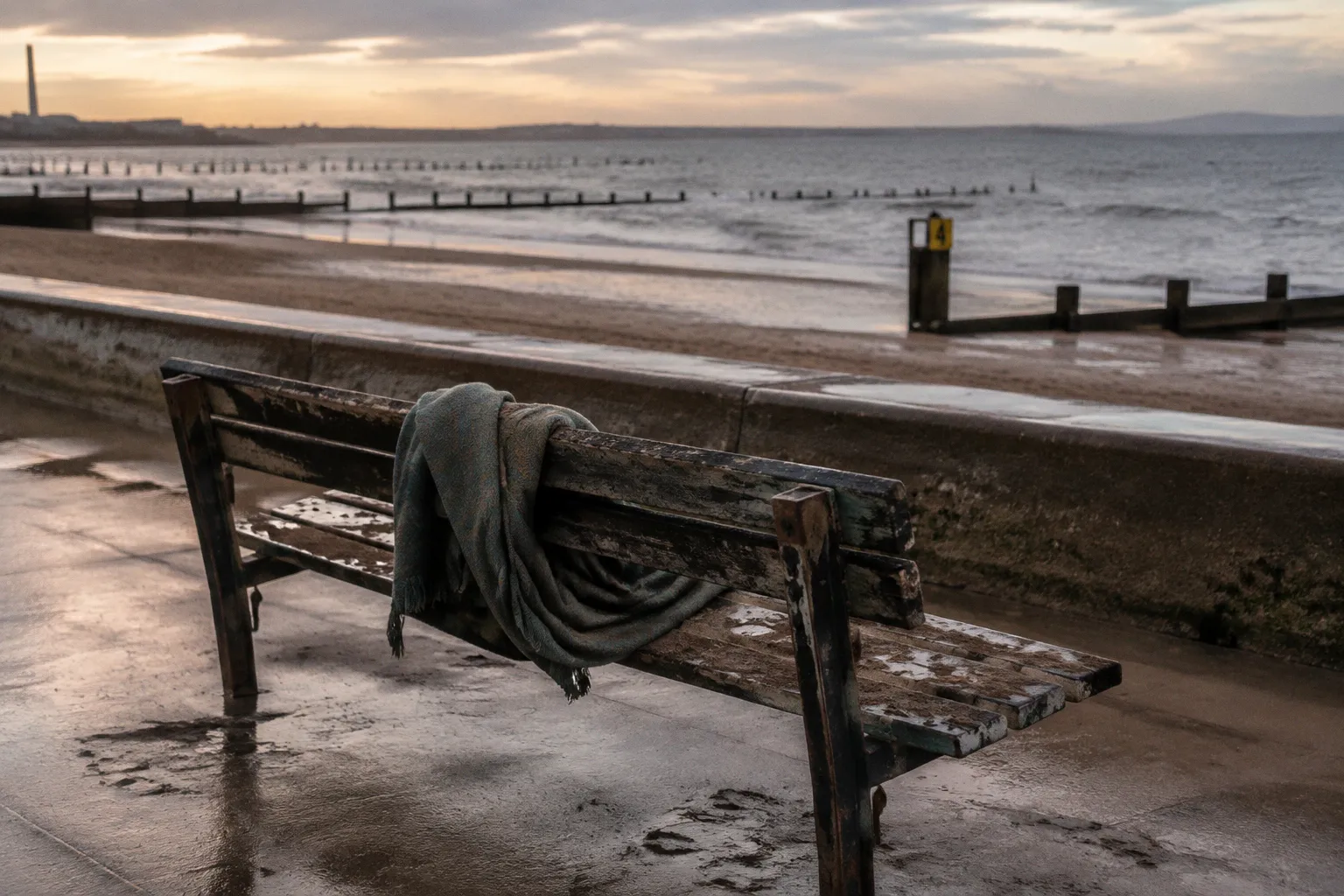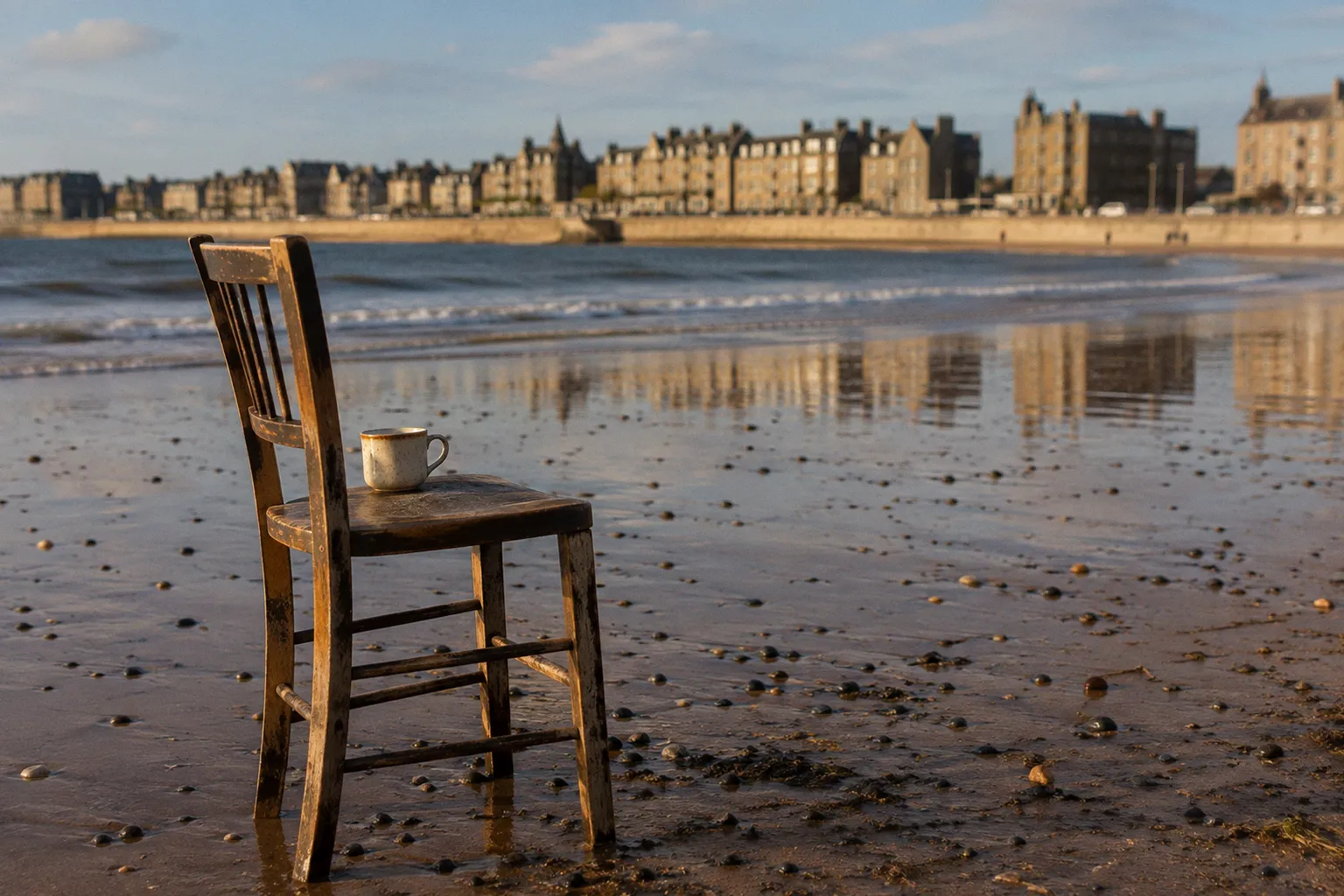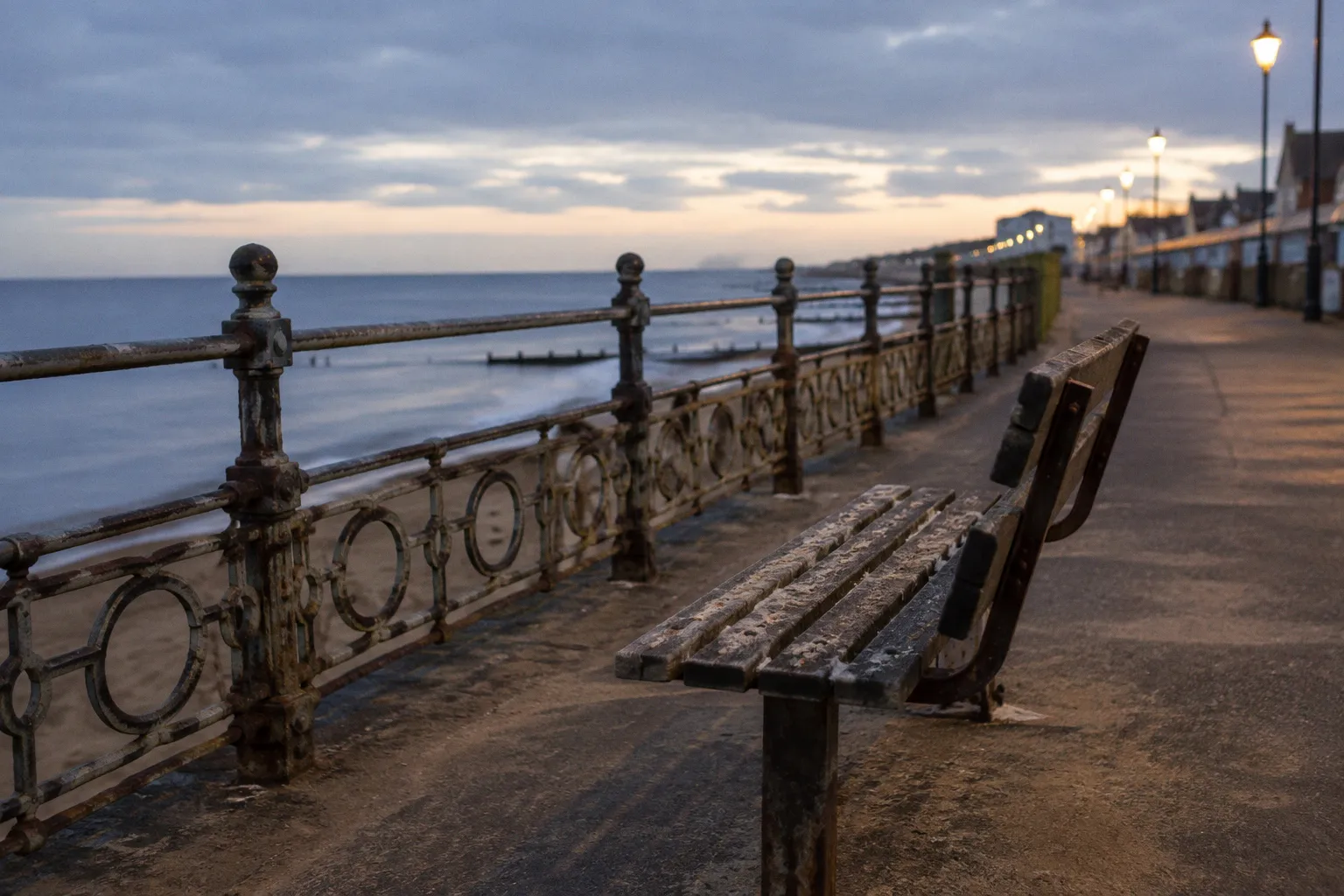
Yet the shoreline’s apparent simplicity conceals a remarkably layered past. This was not born as a leisure district. Before the cafés, sea swimmers and weekend walkers, Portobello was an industrial settlement shaped by clay, salt water, brick, pottery and the ambitions of Victorian civic improvement.
The promenade formalised that transformation. Laid out during the 1870s, with the esplanade created in 1876, it connected roughly two miles of sandy coast from Figgate Burn to Joppa. Its purpose was practical and theatrical at once: to make the shore easier to access, more visually ordered and more attractive to visitors. The result was Edinburgh’s great seaside frontage, a place where industrial history, public bathing and pleasure architecture were arranged in a distinctly urban composition.
This portobello promenade coastal heritage guide follows that evolution — from working shoreline to Victorian resort, from vanished pier to surviving architectural fragments, and from grand public entertainments to the quieter rituals of coastal walking today.
From Industrial Kilns to Seaside Resort: The Origins of Portobello
Portobello’s heritage is frequently softened by the romance of the beach. The sand is persuasive. So is the sea air, especially on a clear day when the Firth of Forth takes on a pale metallic sheen and the opposite shore appears almost architectural in its restraint. But the district’s earliest character was more rugged and industrious.
The settlement developed from an 18th-century industrial village associated with brickworks, potteries and bottle kilns. Local pottery production began around 1770 and continued until 1972, an extraordinary span that places the industry across several distinct versions of Portobello: village, independent burgh, Victorian resort and Edinburgh coastal district.
The name itself arrived before the resort. In 1742, sailor George Hamilton built a house known as Portobello Hut and named it after the 1739 Battle of Puerto Bello in Panama. A modest act of personal naming became the identity of an entire shoreline. There is a pleasing disproportion in that history: a small coastal dwelling lending its name to a district that would later attract pleasure-seekers, bathers and crowds from across Edinburgh.
Portobello became an independent burgh by Act of Parliament in 1833, more than six decades before it was merged into Edinburgh in 1896. That period of civic independence matters. It helps explain why the area developed its own architectural and social vocabulary rather than functioning simply as an outer neighbourhood of the capital. Its public buildings, industrial sites and promenade were expressions of a community with ambitions of its own.
Salt water as medicine, spectacle and business
The coast’s recreational future was already visible in the early 19th century. Salt-water baths were built in 1807 at a reported cost of £5,000, turning the sea into an organised experience rather than a mere natural boundary. Bathing was presented through the period’s familiar mixture of health, fashion and spectacle. It offered the promise of physical benefit, but it also required architecture: changing rooms, pools, access routes and places from which one might observe the activity.
This is one of the defining patterns in Portobello’s seaside history. Comfort does not arrive separately from design. It is designed into the landscape through thresholds, surfaces, shelter and movement. The coast becomes hospitable when the visitor no longer has to negotiate every part of it unaided.
The industrial shoreline and the bathing shoreline were not opposites. They overlapped. Potteries and kilns supplied work and identity; the beach supplied space, air and leisure. The eventual promenade would not erase the older economy so much as place a new public-facing layer over it.
Portobello’s seaside identity was not imported fully formed. It was built over an industrial coast, one public improvement at a time.
The 1870s Transformation: Building the Promenade and the Lost Pleasure Pier
The Victorian promenade gave Portobello its most recognisable spatial gesture: a long, formal edge between town and beach. Its creation in the 1870s brought order to a shoreline that had previously been experienced in more fragmented ways. The esplanade was laid out in 1876, linking the sandy stretch from Figgate Burn towards Joppa and establishing the route that remains central to the area’s coastal identity.
A promenade is never merely a road beside water. At its best, it choreographs the visitor. It offers a measured sequence of views, moments of exposure and refuge, changes in texture underfoot, and a civic frame for an otherwise shifting landscape. Portobello’s frontage did this through length and regularity. The beach provided the expansive foreground; the built edge supplied rhythm and scale.
The investment was also a statement about the future of the district. Portobello was being repositioned as a destination rather than simply a place of production. That repositioning brought an unmistakably Victorian appetite for spectacle.
The pleasure pier as a coastal theatre
In 1871, a 1,250-foot promenade pleasure pier opened along the shore. It was designed by Sir Thomas Bouch, the architect associated with the Tay Bridge, and included a pavilion, restaurant, bar and bandstand. The pier pushed the logic of the promenade into the water, creating a carefully staged approach to the sea.
Its length would have altered the experience of the coastline completely. From land, visitors could look back towards the buildings and promenade; from the pier, they could inhabit a new horizontal view, with the beach becoming a composed frontage and the water taking on a more immediate presence. The pavilion and bandstand added sound, food and sociability to the spatial experience. This was not a wilderness encounter. It was a designed seaside occasion.
The pier was demolished in 1917, and its absence is now part of Portobello’s heritage. It can be tempting to treat vanished structures as unfortunate gaps in the present landscape, but the missing pier also gives the promenade a useful historical depth. Today’s shoreline is not a preserved Victorian set piece. It is a palimpsest, with public life continuing after the original attractions have disappeared.
That distinction is important for anyone following a Portobello coastal heritage trail. The most valuable evidence is not always a surviving façade. It may be the alignment of the road, the width of the esplanade, the relationship between the built frontage and the sand, or the way a former resort was planned to receive visitors.
What Victorian design got right — and what it demanded
The Victorian seaside resort was built around a clear social proposition: public pleasure should have a proper setting. The setting needed to be legible, durable and visually memorable. It also needed to accommodate large numbers of people without losing its sense of occasion.
The promenade’s success lies in this balance between utility and theatre. Its surfaces allow movement; its open aspect preserves the sea view; its length creates a sense of destination. The architecture behind it provides heritage tones without requiring the visitor to enter a museum. The coast is read in passing, through façades, corners, rooflines and the changing density of the street.
That is a more sophisticated form of heritage than a single monument can provide. It is spatial heritage: the accumulated relationship between buildings, public routes and landscape.
Architectural Landmarks: The Tower and the Legacy of the Art-Deco Lido
Portobello’s most compelling landmarks do not all belong to the same architectural language. The district has an unusual ability to hold different eras in the same frame: late 18th-century defensive-looking masonry, Victorian resort planning, industrial remnants and 20th-century modernism.
The Tower on Beach Lane is one of the clearest examples. Built in the late 18th century, this Category B listed octagonal castellated structure stands behind the promenade. It was constructed using stone salvaged from the demolition of South Bridge projects, giving the building a particularly Portobello quality: a local landmark assembled from material with an earlier civic life.
Its form is deliberately picturesque. The castellated silhouette suggests a small fortification or folly, though its significance lies less in military function than in the way it contributes to the district’s visual memory. It acts as a vertical punctuation mark behind the horizontal beach. On a shoreline dominated by long lines — the promenade, the sand, the horizon — an octagonal tower creates emphasis.
For visitors interested in Edinburgh seaside history in Portobello and Joppa, the Tower is a reminder that coastal character is not restricted to buildings directly facing the water. The spaces behind the promenade matter too. Side lanes, residual structures and unusual materials reveal the district’s development more honestly than a perfectly curated resort frontage.
The Lido and the arrival of modern leisure
In 1936, Portobello gained another landmark: an open-air Lido with an Art-Deco façade. It was once among the largest outdoor swimming pools in the United Kingdom. The building represented a different idea of seaside leisure from the Victorian pier. Where the pier made the sea the destination, the Lido controlled water within a designed enclosure.
This was modernity in a very public form. The Art-Deco language favoured clean geometry, confident horizontals and a more streamlined visual order. It brought a new kind of spatial harmony to the promenade, one based less on ornament and more on proportion, movement and the promise of healthy recreation.
The Lido is no longer operational and was demolished in the late 20th century. Its loss is felt precisely because it represented a major shift in how people used the coast. Portobello’s leisure culture had moved from bathing in the sea and promenading beside it to a more managed, architectural version of swimming. The pool made the water predictable, measured and socially accessible.
That tension remains familiar. Visitors want the atmosphere of the coast, but they also want surfaces that are clean, routes that are obvious, places to sit, food within reach and some control over exposure to the weather. The best seaside design does not pretend those needs are incompatible with nature. It gives them a thoughtful frame.
| Period | Coastal character | Defining experience |
|---|---|---|
| Late 18th century | Industrial and emerging residential shoreline | Potteries, brickworks, kilns and local civic development |
| Early 19th century | Organised salt-water recreation | Baths combining health, fashion and public spectacle |
| 1870s | Formal Victorian seaside resort | Promenade, esplanade and pleasure-pier culture |
| 1930s | Modern public leisure | Art-Deco Lido and large-scale outdoor swimming |
| Today | Layered coastal district | Walking, beach access, heritage reading and everyday waterfront life |
The Shift from Independent Burgh to Edinburgh’s Coastal District
Portobello’s merger with Edinburgh in 1896 changed its administrative identity, but not its sense of place. The district remained recognisable as a seaside town with its own scale and social rhythm. That distinction is still apparent in the way the promenade feels separate from central Edinburgh, despite being only about three miles east of the city centre.
The journey is short; the atmosphere is not. Moving from the stone formality of central Edinburgh towards the shore, the visual language loosens. The sea introduces distance. The beach lowers the horizon of the experience. Streets and buildings are no longer read only as urban fabric; they become part of a wider composition that includes weather, tide and seasonal light.
This is why Portobello continues to function as more than an amenity for nearby residents. It is a threshold landscape. It offers a coastal version of Edinburgh without requiring the visitor to leave the city entirely.
A resort that learned to live without its grandest attractions
The vanished pier and demolished Lido might suggest a decline from Victorian grandeur to ordinary urban beach life. That reading is too neat. Seaside districts rarely survive by preserving their original entertainment model. They survive by allowing the public to reuse the setting.
Portobello’s current appeal is less dependent on a single attraction than the old resort’s may have been. The promenade, beach and surrounding streets work as a connected experience. One can walk without a fixed programme, pause beside the water, continue towards Joppa, take in the architecture or use the shore as a point of orientation. The district’s value lies in this flexibility.
There is also a different relationship with design. Victorian resort architecture was often declarative: pavilions, piers, bandstands and façades announced pleasure. Contemporary coastal culture is more curated through smaller touchpoints — the quality of a café interior, the placement of a bench, the handling of wind, the transition from pavement to sand, the warmth of a room after a sea swim.
For guest houses and seaside accommodation around Portobello and Joppa, this distinction is not academic. A room can borrow the coastal setting without reducing it to nautical decoration. Heritage tones, tactile textiles and carefully controlled lighting are more convincing than an excess of anchors, ropes or distressed timber. The design should acknowledge the shoreline’s architecture while still addressing the guest’s actual comfort: drying wet clothing, managing sandy shoes, sleeping well after a windy walk and finding a practical place for a morning coffee.
That is where price-to-value becomes visible. A premium stay is not created by expensive objects alone. It is created by curation — by the sense that the room, the building and the coast beyond it have been considered as one experience.
The strongest coastal luxury is not decoration with a maritime theme. It is the quiet removal of friction after a day beside the water.
Preserving the Shoreline: Tracing the Two-Mile Heritage Trail Today
Portobello’s heritage is best understood on foot. The two-mile sandy stretch from Figgate Burn to Joppa gives the district a natural sequence, while the promenade provides a reliable line through its architectural and social history.
A useful walk does not require every historic detail to survive in plaques or formal interpretation. It requires attention to relationships. Look at where the promenade widens and narrows. Notice how the beach sits against the built edge. Observe the moments when a side street opens the view towards the Firth of Forth, or when a building interrupts the horizontal rhythm of the shore. The district’s history is embedded in these transitions.
A practical way to read the promenade
Rather than treating the coast as a list of isolated landmarks, divide the walk into several overlapping readings:
1. Start with the industrial layer.
Remember that Portobello’s identity was shaped by brickworks, potteries and bottle kilns from around 1770 onwards. Even where the working sites have disappeared, the knowledge of that history changes how the surrounding buildings and streets are perceived.
2. Follow the civic line of the esplanade.
The promenade laid out in the 1870s is the clearest expression of Portobello’s transformation into a seaside resort. Read it as infrastructure with theatrical ambition: a route designed for movement, views and public life.
3. Look for the missing pier in the shape of the shore.
The 1871 pleasure pier no longer stands — it was dismantled in 1917 — but its history explains the scale of the resort’s original aspirations. The pavilion, restaurant, bar and bandstand placed the coast within a programme of entertainment rather than simple access.
4. Find the Tower on Beach Lane.
The Category B listed octagonal structure adds a vertical, almost picturesque counterpoint to the open beach. Its reused stone connects the local landmark to broader civic change in Edinburgh.
5. Consider the Lido as an absent modernist presence.
The 1936 Art-Deco pool was demolished in the late 20th century, yet its place in the story marks the shift towards controlled, large-scale public swimming. The loss is part of the heritage, not an inconvenience to be edited out.
6. Continue towards Joppa with the present in view.
The coast remains a living district rather than a static historical display. Watch how walkers, swimmers, cafés, residents and visitors use the same edge differently. Contemporary life is not a distraction from heritage; it is the latest layer.
Weather changes the walk more dramatically here than in an inland historic quarter. In low light, the promenade’s architectural details can recede while rooflines and chimneys become more prominent. In bright conditions, the beach opens the entire district towards the water. Wind clarifies the practical qualities of the route: shelter, seating, well-maintained surfaces and the ability to move easily between the waterfront and the streets behind it.
This is where the sensory character of the shoreline becomes useful rather than merely picturesque. A heritage trail should engage the body as well as the eye. The sound of the tide, the grit of sand underfoot, the temperature of metal railings, the smell of salt and coffee, and the changing brightness across the water all contribute to the reading of place.
Portobello’s cafés and the afterlife of the resort
The modern café culture around Portobello’s seafront is part of the area’s longer hospitality history. The Victorian pier already combined views with food, drink and entertainment. Today’s waterfront venues operate at a different scale, but the underlying proposition remains familiar: the coast becomes more inviting when visitors can pause within it.
The quality of that pause depends on more than the menu. A café facing the beach is effectively borrowing one of Edinburgh’s most powerful views. Its interior should therefore handle the transition between outside and in with some intelligence. Glare, acoustics, seating density and the practical business of wet coats matter as much as the choice of pendant light or tile.
Design-conscious hospitality is often misunderstood as a matter of appearance. In a coastal setting, it is fundamentally about performance. Materials must tolerate damp air and heavy use. Textiles should offer warmth without becoming visually heavy. Lighting needs enough softness to make a grey afternoon feel considered, but enough clarity for the space to remain functional. The best interiors do not compete with the sea; they frame it.
That principle applies equally to accommodation. A guest house near the promenade should feel connected to the shoreline without forcing a theme. Heritage details can be retained or echoed through proportion, joinery and muted colour rather than decorative nostalgia. A bespoke headboard, a well-weighted curtain, a generous hook rail and a properly placed reading light may contribute more to a premium stay than a room full of coastal references.
Why Portobello’s Heritage Still Matters
Portobello is not valuable because every historic structure has survived. It is valuable because the relationship between the town and the water remains legible. The promenade still gives form to the shoreline. The beach still provides the broad natural counterpoint. Joppa still marks the eastern continuation of the route. Behind them, the district retains traces of industrial production, Victorian ambition, civic independence and modern public leisure.
The story is also a useful correction to the idea that heritage must be grand to matter. Portobello’s identity rests on a mixture of large projects and modest survivals: a two-mile beach, a former pottery tradition, an octagonal tower, a lost pier, the memory of an Art-Deco pool, and the everyday rituals of walking beside the Firth of Forth.
A coastal heritage trail here should resist the temptation to turn the promenade into a polished period tableau. Its character is stronger when the layers remain visible. Industrial origins sit beside leisure architecture. Urban Edinburgh meets open water. Victorian planning meets contemporary café culture. Comfort and weather remain in active negotiation.
That is Portobello’s enduring design intelligence. The district does not separate beauty from use. Its finest qualities emerge where spatial harmony serves ordinary life: a route that invites walking, a beach that remains accessible, a building that gives shelter, a room that lets a guest recover from the wind, and a view that needs no embellishment.
Portobello’s seaside history is therefore not sealed in the past. It continues along the promenade, in the traces of what has gone, and in the way the shore is inhabited now. The resort may have lost its pier and Lido, but it has kept the more durable thing: a carefully made edge between Edinburgh and the sea.