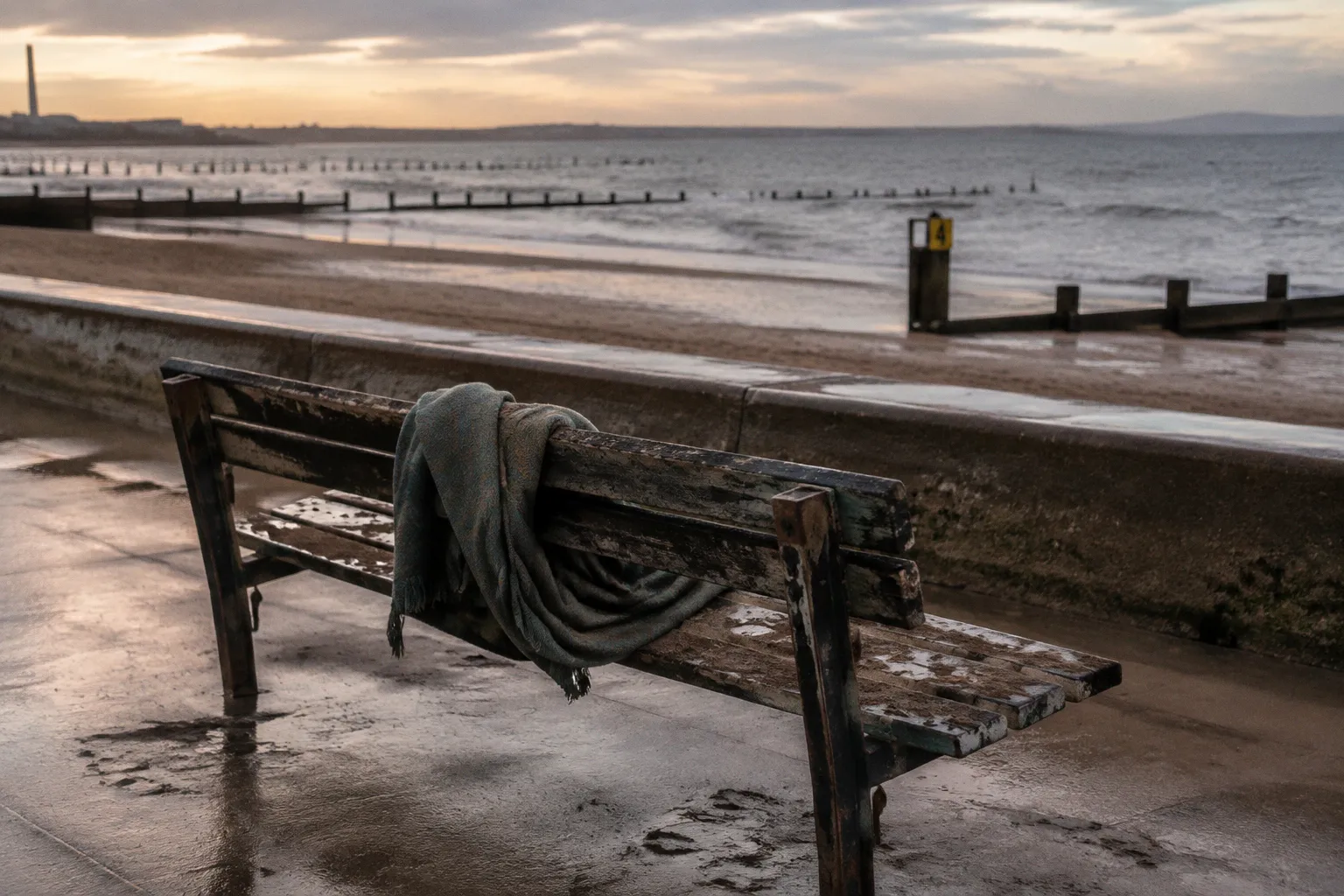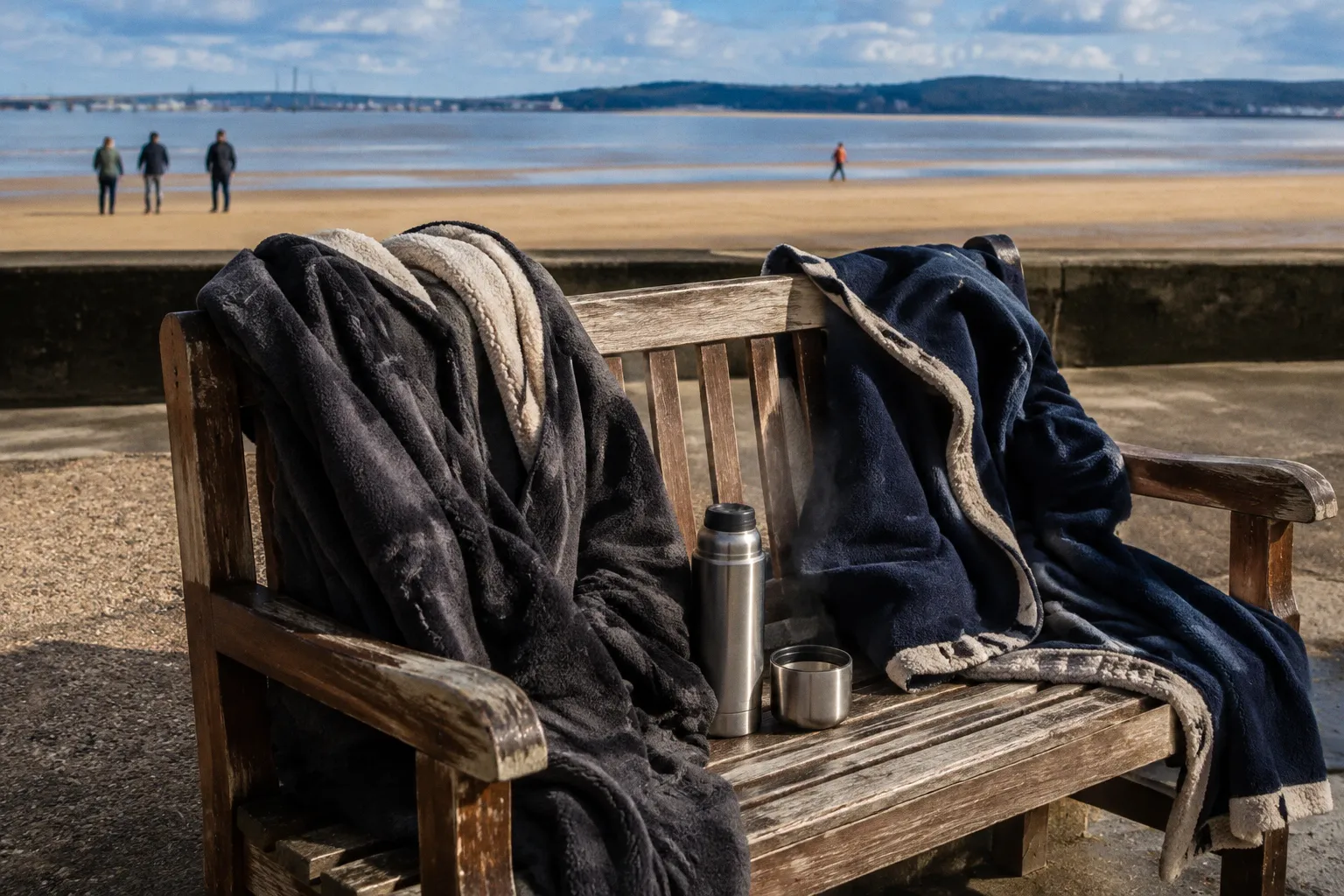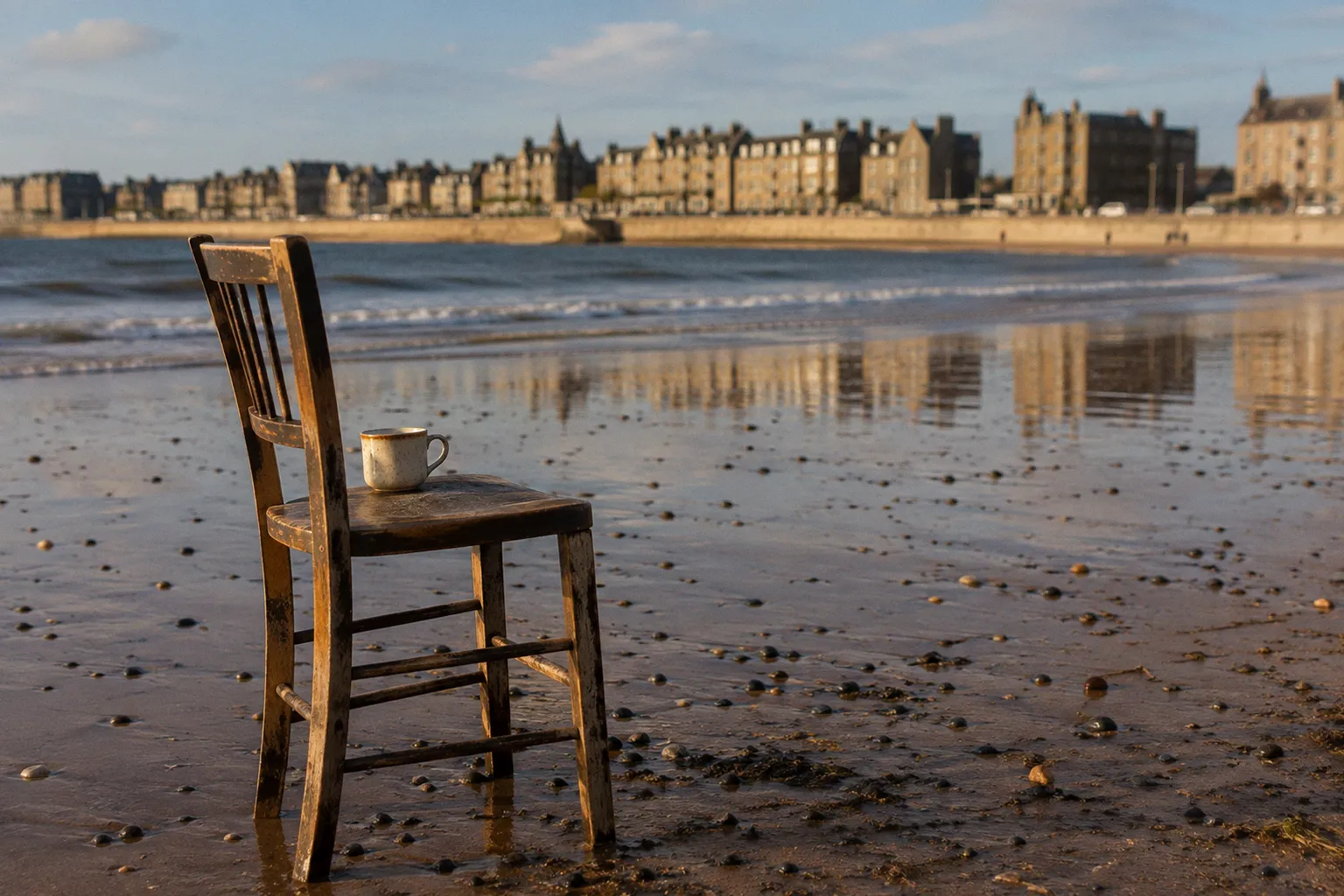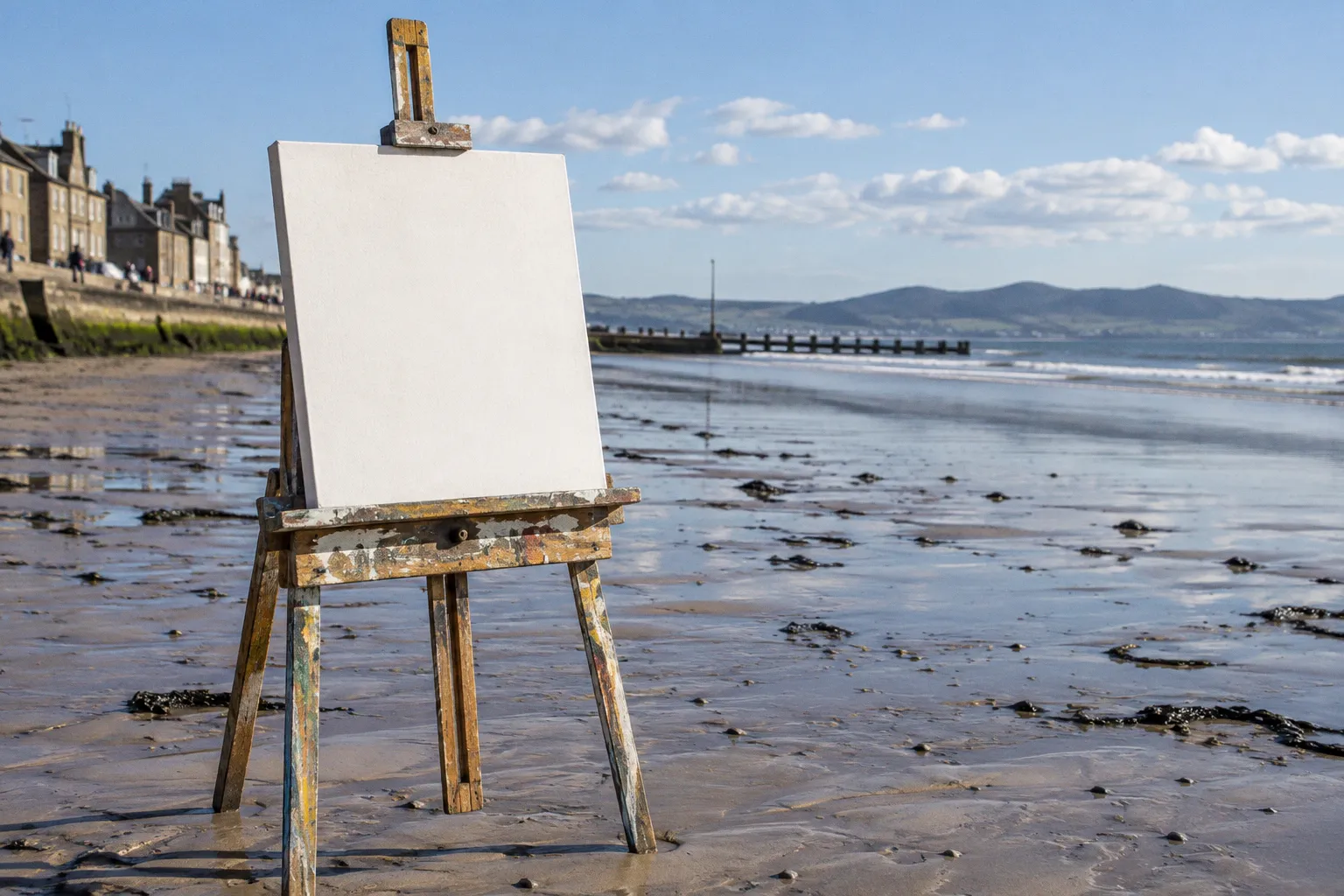
It is roughly 5,000 steps from one end to the other, but the distance is only part of the story. The promenade is also a changing public room: a place where the city meets the tide, where architecture faces the weather, and where art has increasingly moved out of galleries and into the ordinary routes of local life.
The history of portobello promenade art installations is therefore less a story of monumental sculpture than of attention. Artists have worked with the grain of the shoreline, using front rooms, fences, playground edges, the beach and the promenade itself as exhibition spaces. Rosy Naylor’s Art Walk Porty gave that instinct a lasting structure, while later projects have widened the idea into environmental art and coastal cultural programming.
From Victorian piers to modern promenades: the architectural canvas
Portobello’s seafront was shaped before contemporary public art found its language here. The promenade was originally laid out in the 1870s, when the shoreline was being formalised as a place for leisure, bathing and public movement rather than treated simply as a working edge between land and water.
The Victorian resort left behind an architectural vocabulary that still frames every walk along the coast. Portobello Pier opened in May 1871. Designed by Thomas Bouch, it extended 1,250 feet into the Firth of Forth, carrying visitors out over the water and giving the seaside a structure around which promenade life could gather. The pier no longer survives, but its former scale remains part of the cultural memory of the shore: a reminder that Portobello has long been a place where people come to look outward.
The Portobello Swim Centre, built in 1898 by city architect Robert Morham, belongs to the same story. Its surviving presence gives the promenade a civic rather than purely recreational character. Swimming, bathing and public health were brought into the architecture of the waterfront, and the building continues to make the coast feel inhabited even on days when the beach is quiet.
That historical layering matters when considering public art in Portobello. A drawing on the promenade does not appear against a blank urban surface. It sits beside Victorian masonry, later housing, painted shopfronts, sea walls and the wide, mutable line of the beach. The built environment already carries a record of changing ideas about leisure, class, health and access to the water.
This is why a coastal sculpture trail in Edinburgh cannot be understood in the same way as a sequence of works in a formal park. Along Portobello, the setting is active. The haar can flatten the view towards Fife. A neap tide changes the apparent width of the sand. Morning light turns a fence into a screen, while an installation that seemed modest in flat daylight may alter completely when viewed against low sun.
Portobello’s public art works best when it does not compete with the shore, but makes the shore newly legible.
The promenade also has an unusual relationship with domestic space. Houses and flats face the water at close quarters, and the distinction between private frontage and public route is often visually thin. This became central to the development of Art Walk Porty: art could occupy not only a gallery or civic building, but also a local home, a front room, a studio and the spaces people already crossed on their way to the beach.
The rise of Art Walk Porty
Artist and curator Rosy Naylor founded Art Walk Porty around 2015 with a simple but far-reaching proposition: Portobello itself could become an open gallery. The beach, promenade, local homes and front rooms were not merely backdrops for an arts festival. They were the exhibition architecture.
That decision changed the visitor’s relationship with the area. Instead of arriving at a single venue and consuming a fixed programme, people moved through the neighbourhood. The route between works became part of the experience, with the coastline providing a continuous geographical reference. A visitor could encounter an artist’s work, walk towards the sea, pass a café or playground, and then find another piece in a place whose everyday use remained visible.
The distinction is important. Art Walk Porty did not turn Portobello into a sealed cultural quarter. It allowed art to sit within a functioning neighbourhood, where residents were not simply an audience and where the promenade retained its ordinary purposes. People still walked dogs, took children to the playground, went for a swim, bought food and watched the tide. The art entered that existing rhythm rather than replacing it.
For local artists, the model offered a way to work with the specific character of the coast. Portobello’s identity is not reducible to an image of a beach near Edinburgh. It has its own vernacular architecture, its own routes and thresholds, and its own tension between seaside leisure and city life. An exhibition built around those conditions can use the district’s actual materials: weathered timber, harbour light, domestic windows, the long line of the promenade and the sound of traffic behind the sea wall.
For visitors staying in Joppa or looking for a different side of Edinburgh, the art walk also provides a useful way into the shoreline. It connects the beach with the cultural history of the district without forcing the experience into a conventional museum format. The route is walkable, but it rewards patience rather than speed. The point is not to collect every work as quickly as possible; it is to notice how the works alter the meaning of the places around them.
A cultural route rather than a gallery circuit
The strongest local art projects tend to preserve three kinds of contact:
- Contact with the coast: works respond to changing light, tidal movement, exposure and the open horizon.
- Contact with residents: studios, homes and familiar public spaces remain part of the cultural map.
- Contact with the city’s past: the promenade’s Victorian leisure infrastructure is treated as a living context, not a decorative backdrop.
This approach gives Art Walk Porty a significance beyond an annual event. It makes a case for local art as a form of place-making. A promenade is not only a transport line for pedestrians; it is a shared civic surface, and the way it is used can reveal how a community understands its own edge.
Guerrilla art and the intelligence of the ordinary
The history of Portobello promenade art installations does not begin with a formally organised festival. In 2010, an anonymous local resident created a notable piece of guerrilla art by attaching pre-drilled painted wooden planks to a dilapidated fence. When the morning sun came from the right direction, the planks cast shadow lettering across the promenade.
The work was temporary, dependent on position and light. Its meaning changed with the hour, and its visibility relied on the ordinary act of walking past. There was no need for a monumental object or permanent plaque. The fence, the sun and the person moving through the space completed the installation.
This kind of intervention suits Portobello because the promenade is already a place of incidental observation. People notice reflections in wet sand, painted doors, unusual window displays and the long shadows cast across the pavement. The guerrilla work built on that existing attention. It did not ask the shoreline to become something else; it found an artistic possibility in a condition that was already present.
The piece also points to a useful distinction between public art and art placed in public. The former often arrives through an official commission, with a defined location and an intended period of display. The latter can be provisional, unauthorised or quietly folded into the visual life of a neighbourhood. Both have a place on the seafront, but they produce different forms of engagement.
An official installation may be easier to identify and preserve. An anonymous intervention can be more vulnerable, but also more closely bound to the conditions that made it possible. In the case of the painted planks, the work depended on the fence’s neglect and the morning sun. Its impermanence was not a flaw in the experience; it was the experience.
For visitors, this means that looking for public art at Portobello Beach should not involve searching only for objects that announce themselves as art. The coastal route rewards a slower visual habit:
1. Look at surfaces as well as objects. Fences, walls and playground edges may carry the work.
2. Notice the direction of light. Shadows and reflections can be part of an installation’s structure.
3. Read the promenade in relation to the homes behind it. Portobello’s art often crosses the boundary between domestic and public space.
4. Allow for disappearance. Temporary work may belong to a particular season, festival or weather condition.
5. Keep the ordinary life of the shoreline in view. A busy promenade is not an interruption to the art; it is part of its setting.
That last point is particularly important. The beach is not a blank canvas awaiting cultural improvement. It is a lived environment, and responsible shoreline art has to remain aware of the people, habitats and routines already there.
Damian Callan and the human scale of the promenade
During Art Walk events, artist Damian Callan created giant charcoal drawings along Portobello Promenade near Towerbank Playground. The drawings captured people passing along the promenade and beach, placing human movement at the centre of the work.
Charcoal is a fitting medium for this setting. It is direct, granular and vulnerable to weather. It can describe a body with a few forceful lines, but it also carries the suggestion of smudging, erasure and change. On a seafront, where the atmosphere is never entirely stable, the medium keeps the image connected to the physical conditions around it.
The scale of the drawings changed the relationship between figure and route. A passer-by was no longer merely someone moving through the composition; the passer-by became part of the subject. The promenade supplied a stream of gestures and postures: people walking towards the water, pausing near the beach, crossing the playground area or continuing along the long strip towards Joppa.
This is one of the defining qualities of local artist seaside exhibits. They can make the familiar visible without treating local life as picturesque material. The people represented are not anonymous symbols of seaside leisure. They are the actual users of the route, and the work acknowledges that a public place gains its character through repeated, ordinary occupation.
The location near Towerbank Playground matters for the same reason. A playground is not a neutral exhibition wall. It is a place of noise, movement, care and interruption. Children, parents and passers-by bring an unpredictable rhythm to the drawings. That energy prevents the work from becoming too solemn. It keeps the art close to the social life of the promenade.
There is also a subtle reversal at work. Visitors often come to the coast to look at the water, the skyline or the historic buildings. Callan’s drawings redirect attention towards the people sharing the shoreline. The beach becomes not only a scenic edge but a civic one, defined by who uses it and how they move through it.
Why Portobello’s art belongs to the coastline
The phrase Portobello promenade cultural heritage can sound broader than the usual idea of heritage, which tends to favour buildings, dates and surviving structures. Yet the promenade’s cultural identity is carried by use as much as by fabric. The former pier, the 1898 swim centre and the Victorian layout establish the historical frame, but contemporary art demonstrates that the frame is still being interpreted.
Art Walk Porty’s contribution was to make that interpretation collective. Rather than separating heritage from contemporary creativity, it allowed the two to occupy the same route. A Victorian building could stand near a temporary drawing; a local home could become an exhibition site; a fence could become a surface for shadow lettering. The coast remained recognisable, but its meaning was opened up.
This model also has implications for community impact. A coastal arts programme can support local artists and bring visitors to cafés, studios and independent businesses, but it must avoid treating the neighbourhood as a consumable backdrop. The strongest work does not flatten Portobello into a brand. It respects the fact that residents live with the promenade every day, in all weather and seasons, while visitors may encounter it for only an afternoon.
That distinction is increasingly relevant as seaside areas attract more cultural tourism. The appeal of Portobello lies partly in its proximity to Edinburgh and partly in its refusal to behave like a detached resort. It is urban, residential and tidal at once. The promenade is a place for an Edinburgh coastal walking trail, but it is also a route to school, a morning swim, a coffee, a dog walk and a view checked almost without thought.
The best shoreline art works within those overlapping uses. It gives visitors more to see without demanding that residents perform a version of local life for them.
From Art Walk Weekends to FORECAST
Art Walk Projects has announced a transition from the annual festival format towards Art Walk Weekends, held in September, alongside a new coastal environmental arts biennial called FORECAST. The first FORECAST is set for launch in May 2027.
The change suggests that Portobello’s cultural programme is moving in two related directions. Art Walk Weekends will retain the intimacy of local studios, open days and community-based exhibitions. FORECAST will extend the focus towards the environmental conditions of the coast, giving artists a framework for responding to the wider shoreline and the pressures affecting it.
The distinction is useful. A weekend programme can make the neighbourhood legible through encounters with artists and residents. A biennial can create a longer horizon, allowing environmental projects to develop around questions of tidal change, coastal access, materials, habitat and the visual consequences of a changing climate. The two formats need not compete. One is rooted in the immediate life of Portobello; the other can connect that life to the wider Firth of Forth.
For visitors, the upcoming programme creates a reason to return rather than treating the promenade as a one-time attraction. September events will have their own atmosphere, with studios and local spaces opening within the established route. FORECAST, planned for May 21–30, 2027, may bring a different emphasis, particularly if artists work directly with coastal processes and environmental questions.
The practical experience will remain grounded. Art on the seafront is encountered on foot, often between meals, swims, errands and changes in weather. A visitor should expect the programme to be distributed rather than concentrated, and should leave time for the route itself. Portobello Promenade is long enough to reward splitting the walk between Joppa and Craigentinny, with attention given to the architectural landmarks and public spaces along the way.
There is no need to force the promenade into the shape of a formal sculpture trail. Its strength lies in the mixture: historical buildings, temporary drawings, domestic spaces, unplanned details, sea light and the people who continue to use the shore when no festival is taking place.
Reading the promenade at ground level
Portobello’s art legacy is often associated with Rosy Naylor because Art Walk Porty gave a recognisable form to ideas that had been developing along the coast. But the legacy is not a single artist’s monument. It is a way of working with place.
The 2010 shadow lettering showed how an overlooked fence could become an optical event. Damian Callan’s charcoal drawings made the daily users of the promenade part of the subject. Art Walk Porty turned homes, studios and the beach into an open gallery. FORECAST promises to extend that conversation into environmental art. Together, these projects describe a local culture that is collaborative, site-responsive and alert to the particular conditions of the shoreline.
That is what makes Portobello promenade art worth seeking out. The work does not ask the coast to provide a picturesque background for an imported cultural experience. It starts with the place itself: the Victorian promenade, the former pier, the swim centre, the exposed beach, the changing tide and the residents who give the route its continuing life.
Walk slowly enough, and the distinction between heritage and contemporary art begins to loosen. The old architecture becomes part of the current exhibition; the current exhibition becomes another layer in the promenade’s history. That is the real coastal legacy—not a collection of objects fixed permanently in place, but a public shoreline capable of being read, used and reimagined without losing its local ground.