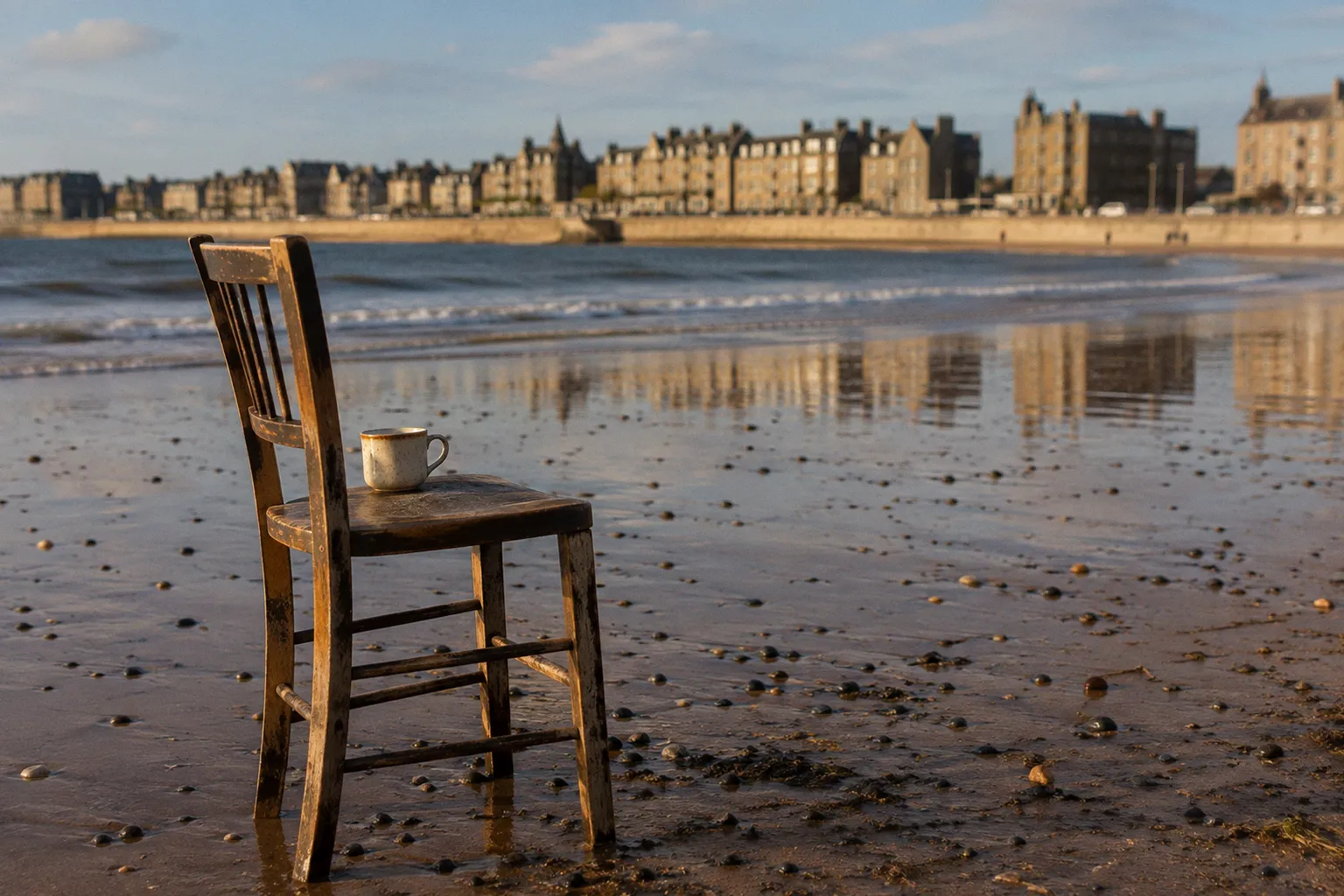
Where many English resorts close their sands to dogs through the long summer stretch — May to September at the strictest — the two-mile stretch between the Victorian bathing pond at the Wisp end and the rocks at Joppa stays open to dogs throughout the calendar. That single fact reshapes almost everything about how the promenade behaves on a Saturday morning in July. The same strip of tarmac has to accommodate off-lead Labradors chasing tennis balls on the hard sand, commuters cycling eastward into the city, parents with pushchairs heading for the King's Road junction, and elderly residents taking their daily walk beneath the rendered tenements of the High Street. Sharing is not optional. It is the defining condition of the place, and the etiquette that holds it together is worth understanding before the lead comes unclipped.
Year-round access and what it actually means
The year-round right to walk dogs on Portobello Beach sits within a broader Scottish framework of responsible access. The Scottish Outdoor Access Code sets the tone for almost all coastal walking on the Firth of Forth, but where dogs are concerned, the practical rules come from two specific pieces of legislation and a long list of council guidance layered on top. The headline is straightforward: the beach does not impose the seasonal bans common further south. A working cocker can chase waves in February and in August without breaking any local byelaw.
For most owners the relevant question is therefore not whether their dog may be there — it almost always may — but how the dog may behave. Portobello runs a permissive off-lead culture rather than a permissive off-lead rule. The beach and promenade are not formally designated as off-lead zones; the council allows dogs to exercise without a lead provided they remain "under proper control," the precise wording of the Control of Dogs (Scotland) Act 2010. What "proper control" looks like shifts depending on who else is using the strip at that hour. A recall-tested spaniel can run freely on the hard sand at low tide on a winter morning when the beach holds perhaps a dozen walkers. The same dog, on the same beach, in midsummer, with toddlers throwing bread to gulls and a cycling club sweeping past in matching jerseys, is expected to be on a short lead — not because the law has changed, but because the environment has.
Joppa, the eastern end of the same coastal walk, follows the same principle but with looser crowds. The dunes and the rocky shoreline around Joppa Point absorb more dogs because the foot traffic thins out before it gets that far. The legislation does not change at the boundary; the social contract does.
The two acts that govern every walk
Two statutes do the heavy lifting on Portobello's sands, and they are worth knowing by name rather than relying on the folklore that drifts around dog parks. The framework is unusually clear compared with many parts of the UK, and that clarity is part of why the promenade still works.
The Dog Fouling (Scotland) Act 2003 places a legal obligation on anyone in charge of a dog to remove faeces from designated public spaces — promenades, beaches, parks, pavements, anywhere the public has access. The act is enforced by the local authority, in this case the City of Edinburgh Council, and applies regardless of whether the dog is on or off lead. Bag it, bin it, or take it home — those are the three options repeated in council communications, and bins are placed along the promenade at regular intervals near the access ramps. The same obligation covers the soft sand, the slipway at the western end, and the dunes east of the King's Road roundabout. There is no distance threshold beyond which the duty lapses.
The Control of Dogs (Scotland) Act 2010 covers the broader question of conduct. Its central requirement is that a dog must be kept under proper control at all times in a public place. "Proper control" is not defined by a lead length or a distance figure; it is judged by whether the owner can reasonably be expected to manage the dog given the circumstances. An owner whose dog runs at a child, chases a cyclist, or bolts into traffic on the Promenade has failed that test, regardless of whether a lead was attached.
Two statutes shape every walk on Portobello: the obligation to clear up after your dog, and the obligation to keep your dog under proper control at all times — terms that read simple on paper but require constant judgement on the ground.
Sharing the tarmac: cyclists, pedestrians, and the working promenade
Portobello Promenade is not a country footpath. It is a working transport corridor as well as a leisure space, and treating it otherwise leads to the small collisions and resentments that erode the atmosphere of the place. Cyclists use the full width of the promenade from the Wisp in the west to Joppa in the east and expect a clear line, particularly at commuting hours. Pedestrians tend to drift in pairs or family groups, especially along the café strip west of the King's Road roundabout. Dog walkers move through both populations, often at slower speeds, often stopping to talk. The polite etiquette, observed by most regulars, comes down to a handful of habits:
- Keep dogs on a short lead when passing the busiest café terraces during peak hours — typically late morning on weekends and on any dry evening in summer.
- Step off the tarmac onto the soft sand or the grass margin when a cyclist approaches from behind and there is no room to pass single file.
- Avoid letting a dog run in long arcs across the promenade at junctions where sight lines for cyclists are short, particularly near the Tower Street and Straiton Place crossings.
- At the western bathing pond and around the children's play area, observe the signed lead requirement even if the beach proper allows off-lead exercise.
- Carry a lead visibly — clipped to a belt loop, for instance — so that if the situation changes, you can take hold of the dog in under a second.
These are not formal byelaws in every case; they are local conventions, observed because the alternative is a promenade that no one enjoys using. The dense housing along Portobello's High Street means that residents step directly onto the beach from their front doors, and they notice quickly when the shared space stops working.
Professional walkers and the council code
Portobello's popularity with owners who work full-time has produced a small but visible professional walking industry. Group walks of six to ten dogs depart from the lower promenade car parks several times a day, and the City of Edinburgh Council has responded with a Code of Conduct for Professional Dog Walkers that sits alongside the general legislation. The code is not law in the strict sense, but adherence is taken into account when the council considers complaints, and the most successful local walkers treat it as binding.
The code's practical requirements address the things that most bother local residents. Dogs must be walked to and from vehicles on lead, which keeps the moment of loading and unloading under control and prevents the chaos of six terriers spilling into a residential street. Insurance must be held by the walker — relevant for liability if a dog causes damage or injury. The code asks walkers to avoid busy areas near children's play spaces and to vary their routes so that the same stretch of sand and promenade is not being churned by the same pack twice a day. The result, when the code is followed, is a professional presence that blends into the promenade rather than dominating it. The result, when it is not, is a stretch of beach where locals stop walking their own dogs because they have been knocked over too often — a quiet but cumulative loss.
| Code requirement | What it looks like on Portobello |
|---|---|
| Lead to and from vehicle | Dogs clip on lead at the van, walk the access ramp together, unclip only once on open sand |
| Insurance held | A copy of the policy can be produced on request; covers third-party damage |
| Avoid play spaces | Routes bypass the western bathing pond, the play park, and the busiest café terraces at peak times |
| Vary routes | Groups rotate between Joppa Point, the central beach, and the Wisp end rather than concentrating in one zone |
Where to pause: dog-friendly stops along the Portobello to Joppa shoreline
A dog walk on Portobello rarely ends at the car. The shoreline is fringed by a working food and drink scene that has, over the past decade, learned to accommodate dogs with the same informality it brings to families with muddy boots. A few stopping points have become regulars' landmarks, and the etiquette around them has settled into a comfortable pattern.
The cafés along the Promenade near the King's Road roundabout keep water bowls out through the summer and tolerate dogs at outside tables without fuss. Some of them keep a small stock of treats behind the counter for regulars. Further east towards Joppa, where the residential streets thin out and the dunes take over, a smaller cluster of establishments offers a quieter pause — useful for longer walks that start or finish at the Joppa end and might not otherwise include a sit-down stop. The path between the two is flat, well-drained, and broad enough for two dogs to walk side by side without forcing other users off the line.
The etiquette inside these places is the same as on the sand:
- Dogs stay on the floor, not on the seating, and certainly not on a chair when another customer wants the table.
- They do not approach other customers' plates, and an owner who sees a food reaction coming steers the dog away before it starts.
- Leads come off only when the dog is settled under the table, and go back on before the dog stands up to leave.
- A wet towel in the bag is now a default for regulars, particularly in autumn when the haar rolls in from the firth and leaves everything damp.
In return, the welcome is genuine, and most establishments will offer a water bowl without being asked.
The coastal café strip from Portobello to Joppa now reads as one continuous walk punctuated by tables rather than a single beach with food attached — a small but real change in how the shoreline is used.
Reading the room: conditions that change the rules
A neap tide pulls the water further out than usual and exposes a wide band of hard sand that invites off-lead running; a spring tide brings the sea close to the wall and compresses everything onto a narrow strip where leads become more or less mandatory simply to avoid stepping on the dog in front of you. The haar can arrive without warning in summer and reduce visibility to a few hundred metres, which changes the dynamic completely: cyclists slow down, dogs stay closer, and the social contract tightens. None of these conditions alter the underlying law, but they all alter what counts as "proper control" under it.
Season matters too, in a Scottish coastal sense, even though the legislation does not change. The beach is at its busiest on a long summer evening between five and eight, when the after-work crowd meets the school-holiday families and the cycling clubs have already gone home. Early mornings in midsummer are the quietest window; late afternoons in winter are when most of the dog-walking regulars choose to come. Learning those windows is part of the local knowledge that turns a first-time visitor into someone the promenade recognises.
Closing: a working compact rather than a rulebook
For the regulars, the etiquette of Portobello's promenade amounts to a working compact rather than a list of rules. Dogs are welcome because the local authority and the legislation permit them, and because owners who use the beach most are the ones most invested in keeping it pleasant. The clean-up bins along the promenade are used because ignoring them would mean fouled sand underfoot on the very walks the offenders want to enjoy. The leads come out at the play park and the bathing pond because the signs are there and because the users of those spaces are often the very residents who would otherwise complain. None of it is enforceable in any strict sense, and all of it depends on the next dog walker continuing to observe it.
The practical lesson for anyone new to the shoreline is to treat the legislation as the floor rather than the ceiling. The two acts tell you what you must do; the local conventions tell you what makes the walk work for everyone else on it. Read the signs at the access ramps, watch how regulars handle the busy stretches, keep a lead to hand rather than buried in a coat pocket, and remember that the beach you are enjoying today is the same beach someone else will want to enjoy tomorrow morning. The promenade has held this compact for decades, and it holds because most people who use it understand what would happen if they stopped.