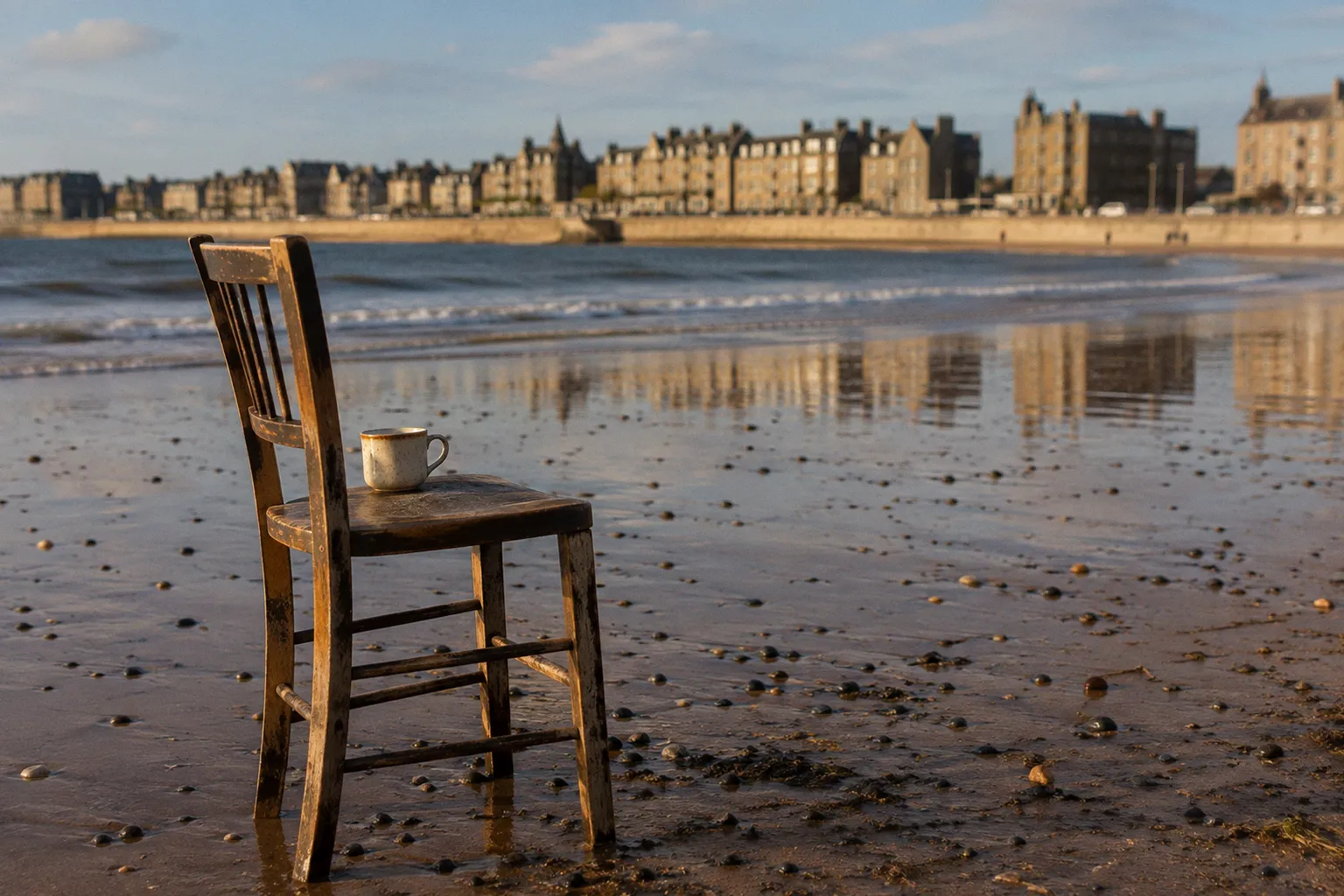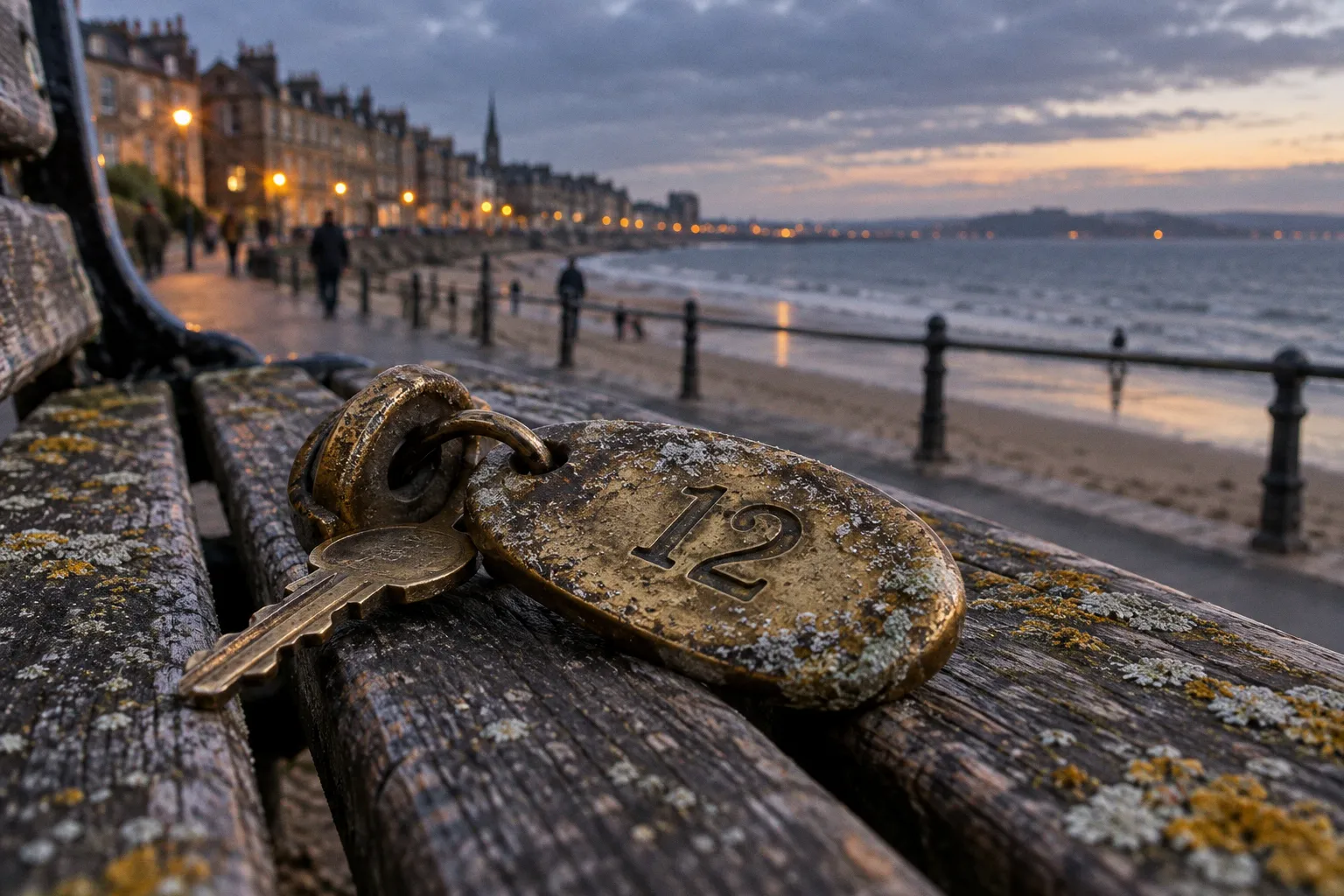
It is close enough to reach by the number 26 bus, yet exposed enough for the water to set its own terms: winter temperatures average between about 5.8°C and 6.6°C, while even in summer the Forth usually remains somewhere between 8°C and 16°C.
That temperature is not a footnote to wild swimming in Portobello. It is the central fact around which the local culture has formed. People arrive early, read the tide and weather, greet swimmers they know, and leave the water before cold becomes a test of will. The beach has its own markers, its own etiquette and its own communities, and a first dip makes more sense when understood as part of that shoreline rhythm rather than as an isolated dare.
The rhythm of the Firth: reading Portobello before entering
Portobello’s beach is easy to understand from land. The promenade runs parallel to the shore, the Victorian and early twentieth-century streets sit behind it, and the groynes divide the sand into recognisable stretches. In the water, the geography is less obedient. The Firth of Forth is tidal, open to weather moving in from the North Sea, and capable of changing its surface and temperature without offering much drama in advance.
The wooden groynes are the most useful fixed reference. They are numbered from 1 at the western end near Kings Road to 6 towards Joppa Rocks. For swimmers, these numbers are more than coastal furniture. They provide a meeting language, a way to describe an entry point and a rough sense of how far along the beach a group has moved.
A message about meeting at Groyne 3 is more useful than a vague instruction to find the middle of Portobello. A swimmer returning to shore can use the same markers to orient themselves, particularly in haar, low light or the flat grey conditions that make the promenade and the sea appear to merge.
The beach’s most active swimming areas are not necessarily the most visually dramatic. A familiar step into the water, a clear exit route and enough room on the sand for changing are more valuable than a supposedly perfect view. At Joppa Rocks, the shoreline becomes more irregular and the relationship between rocks, sand and tide requires closer attention. The setting is part of Portobello’s coastal culture, but it should not be treated as a natural swimming pool.
A sensible first visit begins without entering the water:
1. Walk a section of the beach and identify the groynes, access points and nearest promenade facilities.
2. Watch how quickly the tide is moving across the sand rather than relying only on a tide app.
3. Look at the water surface, wind direction and visibility from shore.
4. Decide where you will exit before you get in.
5. Keep the first immersion short enough that you can leave feeling composed rather than depleted.
The discipline is simple but easily lost in a group. Conversation, photographs and the small theatre of getting changed on a cold morning can make a swimmer forget that the water is still cold water. The Firth does not become less demanding because the beach is urban.
In Portobello, the groynes are not decoration. They are the shoreline’s practical grammar.
Joining the community: Portobello’s swimmers have different reasons for coming
There is no single Portobello swimming community, and it is better that way. Some people swim for the physical clarity of cold water. Others come for company, routine, mental health support or the quiet social structure of meeting outdoors before the day begins.
The Wild Ones is one of the established outdoor swimming communities in Portobello. It began in 2010 and has become part of the beach’s recognisable cold-water culture. Its existence matters not because every visitor needs to join one particular group, but because it shows that local sea swimming has developed as a sustained practice rather than a short-lived fashion.
Edinburgh Blue Balls offers another form of gathering. The men’s mental health and cold-water dipping group meets at John Street on Portobello Beach twice a week, including Sunday mornings at 9:30am. For anyone looking for portobello beach wild swimming groups for beginners, organised communities can provide a gentler entry than arriving alone with a new wetsuit and no clear idea of where to stand.
The useful distinction is between joining a group and outsourcing responsibility to it. A group can help with introductions, local knowledge and confidence. It cannot remove the cold, alter the tide or guarantee conditions. Even experienced swimmers may choose not to enter, and that decision is part of the culture rather than a failure within it.
What a respectful first visit looks like
Portobello beach swimming etiquette is largely practical. It is not a formal code, but regular swimmers tend to understand the same boundaries.
- Ask where people are meeting rather than assuming that a cluster on the sand is open to everyone.
- Keep changing areas clear, particularly around narrow access points and promenade entrances.
- Do not treat swimmers as performers. A person entering cold water may be concentrating on breathing and balance, not inviting conversation or photography.
- Let faster swimmers pass and avoid turning the water into a race.
- If you bring a dog, manage its space around swimmers and changing areas.
- Take every item of packaging, tape and discarded warm-up material home.
- If a swimmer appears distressed, alert the group and help create space for them to exit safely.
The social aspect of these groups is one of their strengths. A shared thermos, a few minutes of conversation and the reassurance of familiar faces can turn a difficult morning into a repeatable habit. But the best communities do not encourage bravado. They make it easier to say no.
The local routine: prepare on the promenade, not in the water
A cold-water routine is mostly decided before the first step through the surf. The essential task is not to look equipped; it is to reduce the number of decisions you will have to make while wet, cold and breathing hard.
For winter swimming at Portobello Beach, the sequence should be deliberately unhurried. Lay out your robe or changing coat, towel, warm clothes, footwear and hat so that each item can be reached without searching. Put your car keys or phone in a reliable waterproof container. If you are meeting a group, agree where you will gather after the swim rather than leaving that conversation until everyone is shivering.
A tow float is useful for visibility and can provide support if a swimmer needs to pause. It is not a substitute for a competent assessment of the conditions, and it should not be confused with a personal flotation device. Neoprene boots, gloves and a changing robe may make the experience more manageable, particularly for people who struggle with exposed hands and feet, but extra equipment can also make a swimmer feel more capable than they are. The water remains the deciding element.
The following comparison is a practical way to think about kit rather than a shopping list:
| Item | What it helps with | What it does not solve |
|---|---|---|
| Tow float | Visibility and a point of support during a pause | It does not make rough water safe or replace supervision |
| Wetsuit | Reducing heat loss and extending comfort for some swimmers | It does not prevent cold shock or guarantee a safe duration |
| Neoprene boots and gloves | Protecting feet and hands during entry and exit | They do not remove the need to move carefully on uneven ground |
| Changing robe | Preserving warmth and privacy before and after the dip | It does not warm the body once prolonged cooling has begun |
| Hat | Reducing heat loss from the head and making the exit more comfortable | It does not indicate that the swimmer can stay in longer |
| Warm drink and dry layers | Supporting rewarming after the swim | They do not compensate for entering in unsuitable conditions |
There is no virtue in staying in the water until a target time has been reached. For a beginner, the better measure is whether breathing remains controlled and whether the exit can be completed calmly. Cold water can produce an immediate gasp response, and the first minute may feel more demanding than the rest of the dip. Enter slowly enough to establish breathing, avoid diving in and keep the shore close.
The Firth’s seasonal range is a useful corrective to the idea that summer swimming is automatically gentle. Water between 8°C and 16°C may feel less severe than winter water, but it is still cold enough to affect breathing, dexterity and judgement. A sunny promenade does not change the temperature beneath the surface.
The safest Portobello swim is not the longest one. It is the one that leaves enough reserve for the walk back up the beach.
Reading the water: SEPA notifications are part of the morning check
Cold is not the only hazard at Portobello. Water quality must be considered separately from temperature and surface conditions.
Portobello Central has been designated as an official bathing water since 1999, and the Scottish Environment Protection Agency monitors it during the official bathing season from 15 May to 15 September. SEPA also provides notifications when bathing water conditions may be affected by pollution risks. These updates matter throughout the year, not only during the formal monitoring window.
Heavy rainfall can overwhelm or affect combined sewer systems, creating a short-term risk of poorer water quality. The guidance is to avoid swimming during heavy rain and for one to two days afterwards, when runoff and sewer overflow risks may remain relevant. This is particularly important for anyone treating Portobello as a regular morning swim: a familiar routine should never become a reason to skip the water-quality check.
The bathing-water catchment for Portobello Central covers approximately 32 square kilometres. That figure helps explain why conditions at the beach are connected to weather across a wider urban area. Rain falling inland can become part of the coastal story later, even when the promenade itself looks calm and dry.
A pre-swim check should therefore cover four separate questions:
- What has the recent rainfall been like, not only at the beach but across Edinburgh?
- What does the current SEPA bathing-water advice say for Portobello Central?
- Are wind, tide and visibility suitable for the swimmer’s experience and equipment?
- Is there a clear plan for getting warm after leaving the water?
The answer does not need to be dramatic. If conditions are doubtful, the correct response may be a walk along the promenade, a coffee at a nearby café or a decision to return another day. That still counts as belonging to the coast. Local shoreline culture is not built from constant entry into the water; it is built from paying attention to it.
Between Groyne 1 and Groyne 6: finding a swim that suits the day
The numbered groynes give Portobello a useful east–west structure, but they should not be read as a list of official swimming zones. They are orientation markers, not guarantees of shelter, depth or water quality.
Near the western end, around Groyne 1 and Kings Road, the beach is closely tied to the town’s promenade life. This can make it a practical meeting area, especially for swimmers arriving by public transport. Further east, the beach leads towards Joppa Rocks, where the shoreline becomes more textured and the connection between sand, rock and tide becomes more apparent.
The right spot is the one that matches the day’s conditions. A swimmer who is new to the Forth may prefer an entry with an uncomplicated route back to the promenade. Someone with local experience may choose a different stretch according to tide, wind or the location of their group. The idea of a single perfect joppa shoreline swimming spot belongs more to social media than to the beach itself.
Portobello also works because swimming is only one part of the visit. The promenade, cafés, seafood restaurants and the wider Edinburgh coastal walking trails offer a slower continuation after the water. This matters to the community impact of sea swimming. Arriving by bus, buying something locally and leaving the beach clean creates a different relationship with the neighbourhood from arriving in a convoy, occupying access space and treating the shoreline as a disposable backdrop.
A swim can be paired with a walk east towards Joppa or west along the promenade, depending on energy and conditions. On a clear day, the firth opens the view towards the opposite shore; in haar, the coast contracts to the nearest groyne, the sound of water and the wet sand underfoot. Neither condition needs to be romanticised. The weather is part of the place, but it is also a reason to remain measured.
A workable first-morning plan
For someone new to the Edinburgh coastal swimming community, the first visit can be kept straightforward:
1. Choose a day without recent heavy rainfall and check the latest SEPA advice before leaving.
2. Travel to Portobello with enough time to walk the beach and identify the meeting point.
3. Join an established group or bring a trusted swimming companion rather than entering alone.
4. Set out all warm clothing and equipment before approaching the water.
5. Use the groynes to confirm your position and agree on an exit point.
6. Enter gradually, keeping the first swim short and close to shore.
7. Leave before numbness, fatigue or poor coordination begin to influence decisions.
8. Rewarm in dry layers, take a warm drink and give yourself time before travelling home.
The routine is intentionally modest. Wild swimming gear for the Firth of Forth can make cold water more manageable, but the most important equipment remains judgement, communication and the willingness to stop. No group identity, personal record or attractive photograph should outrank those things.
What Portobello’s swimmers understand about belonging
Portobello is not a wilderness and should not be sold as one. It is an inhabited coast: a beach beside streets, buses, cafés, houses and working routines. That is precisely why its swimming culture has substance. People return not only for the sensation of cold water but for the repeated meeting of the same geography and the same loose network of neighbours, friends and newcomers.
The beach gives swimmers enough space to find their own relationship with the Firth. Some gather at John Street with the Blue Balls group. Some swim with The Wild Ones. Others arrive in pairs, watch the water and decide that the day belongs on land. The common thread is not endurance. It is attention.
For beginners, the best way into portobello beach wild swimming groups for beginners is to approach the coast as a local practice rather than an achievement to unlock. Learn the groynes. Listen to the people who know the beach. Check SEPA after rain. Carry equipment that supports, rather than inflates, your confidence. Leave the water while the morning still feels clear.
That is the real rhythm of Portobello: the firth in front of you, the promenade behind you, and enough respect between the two to make returning possible.