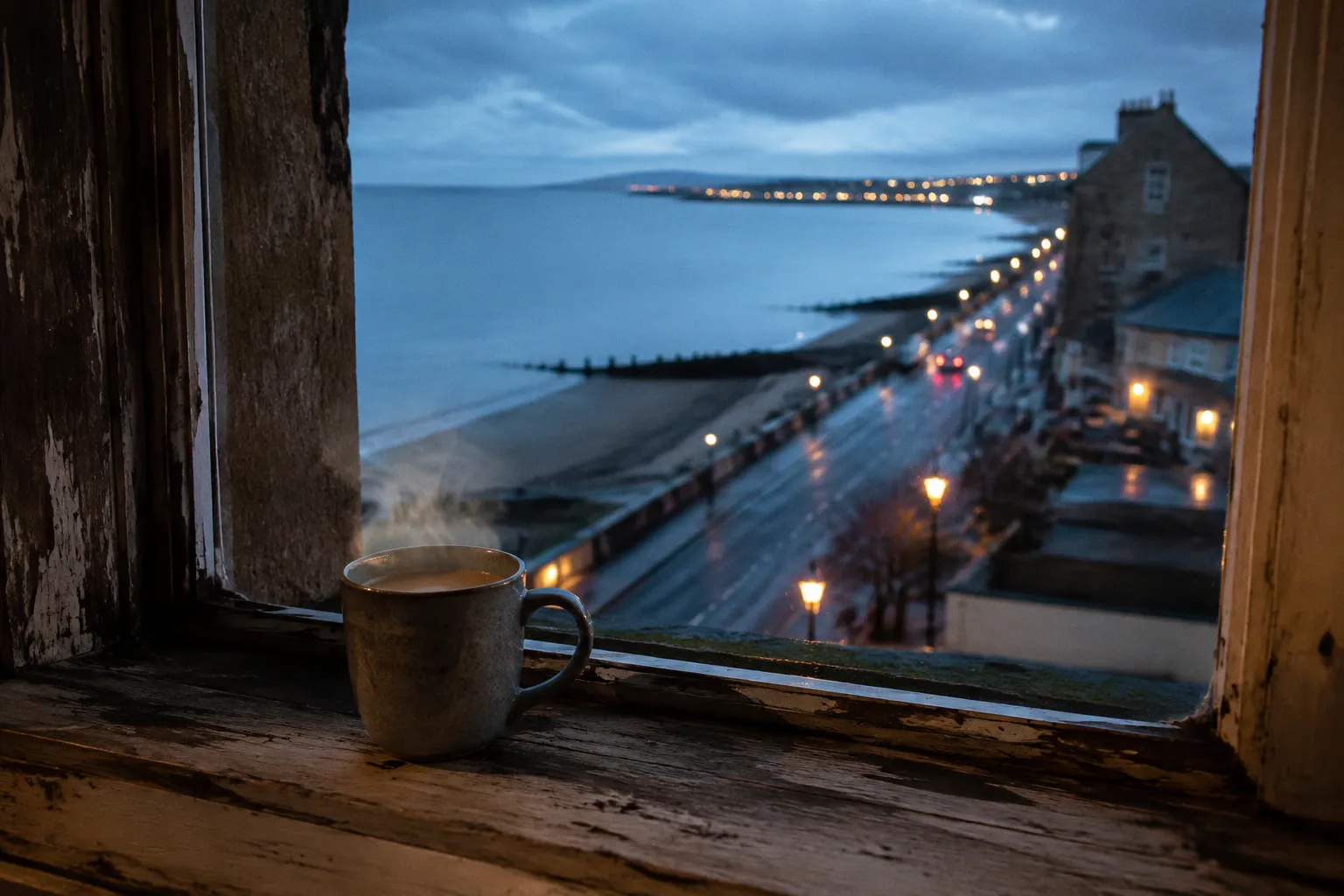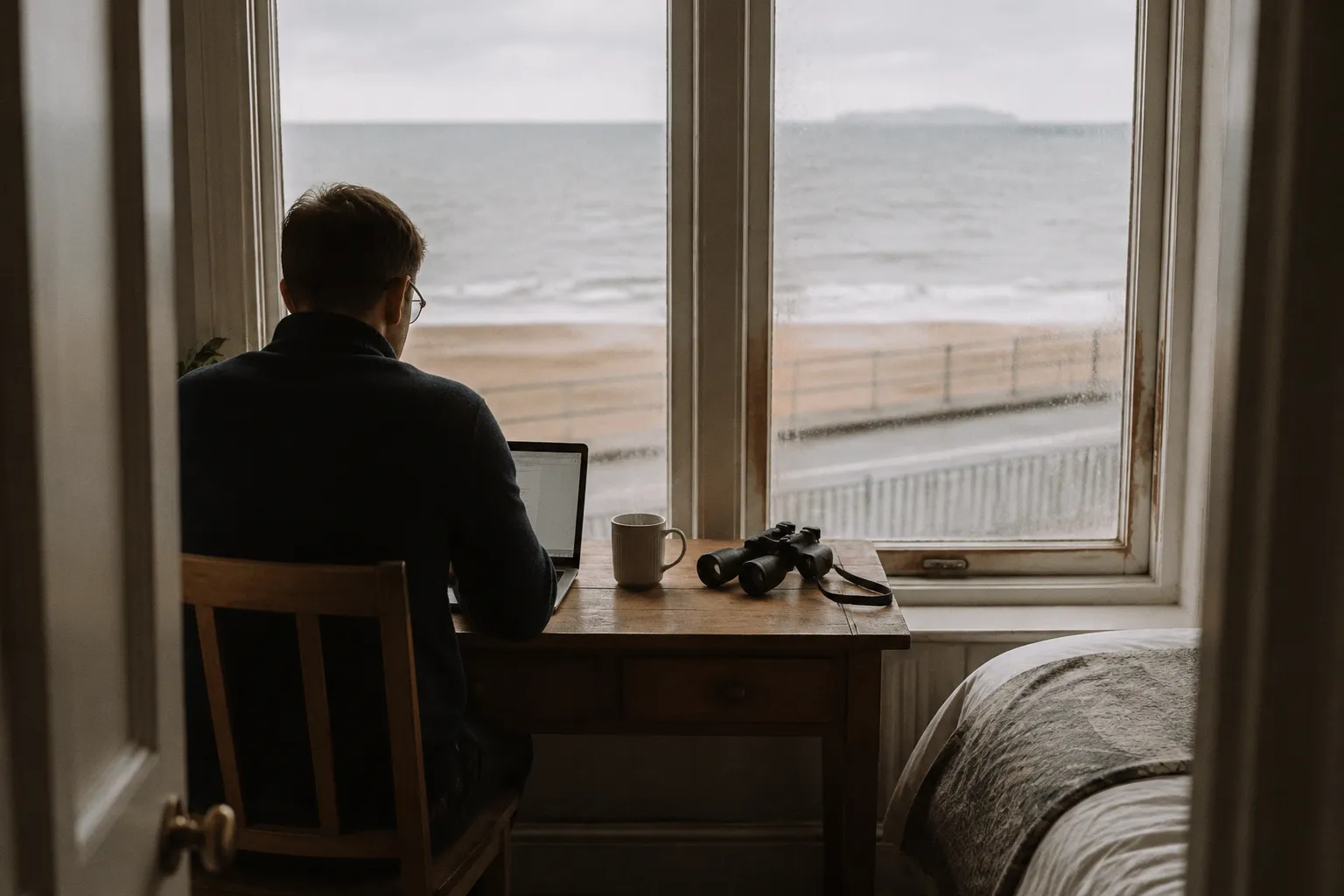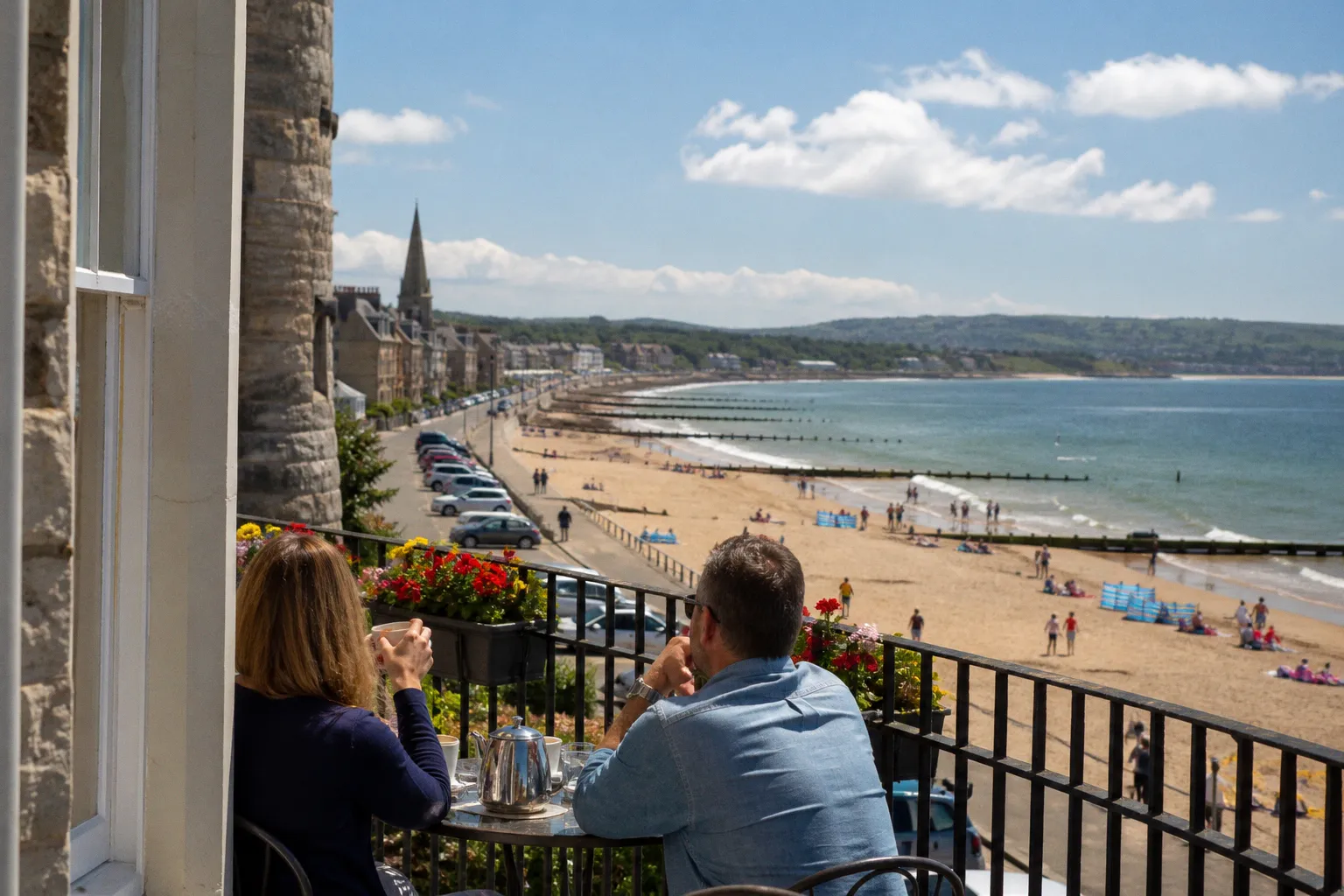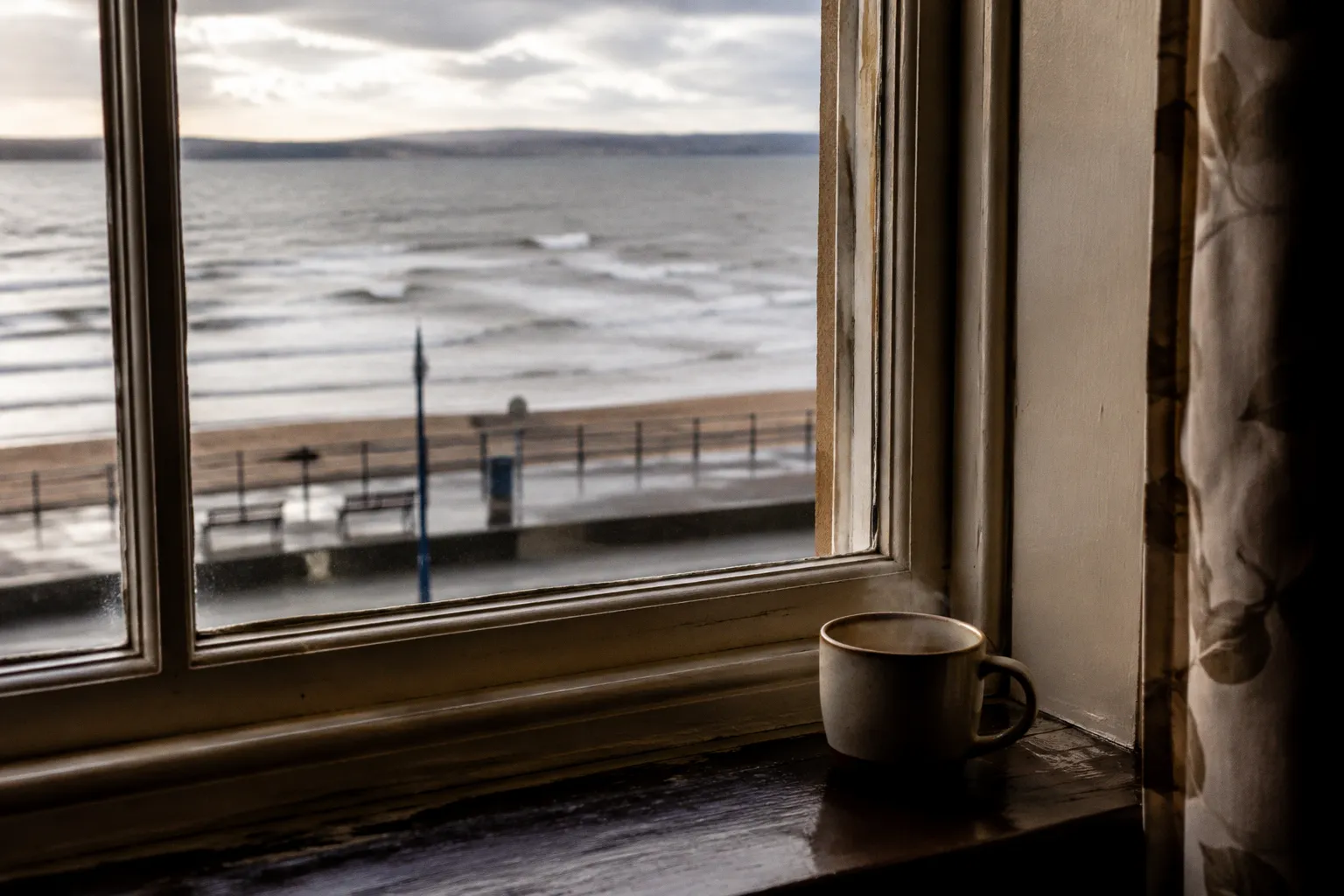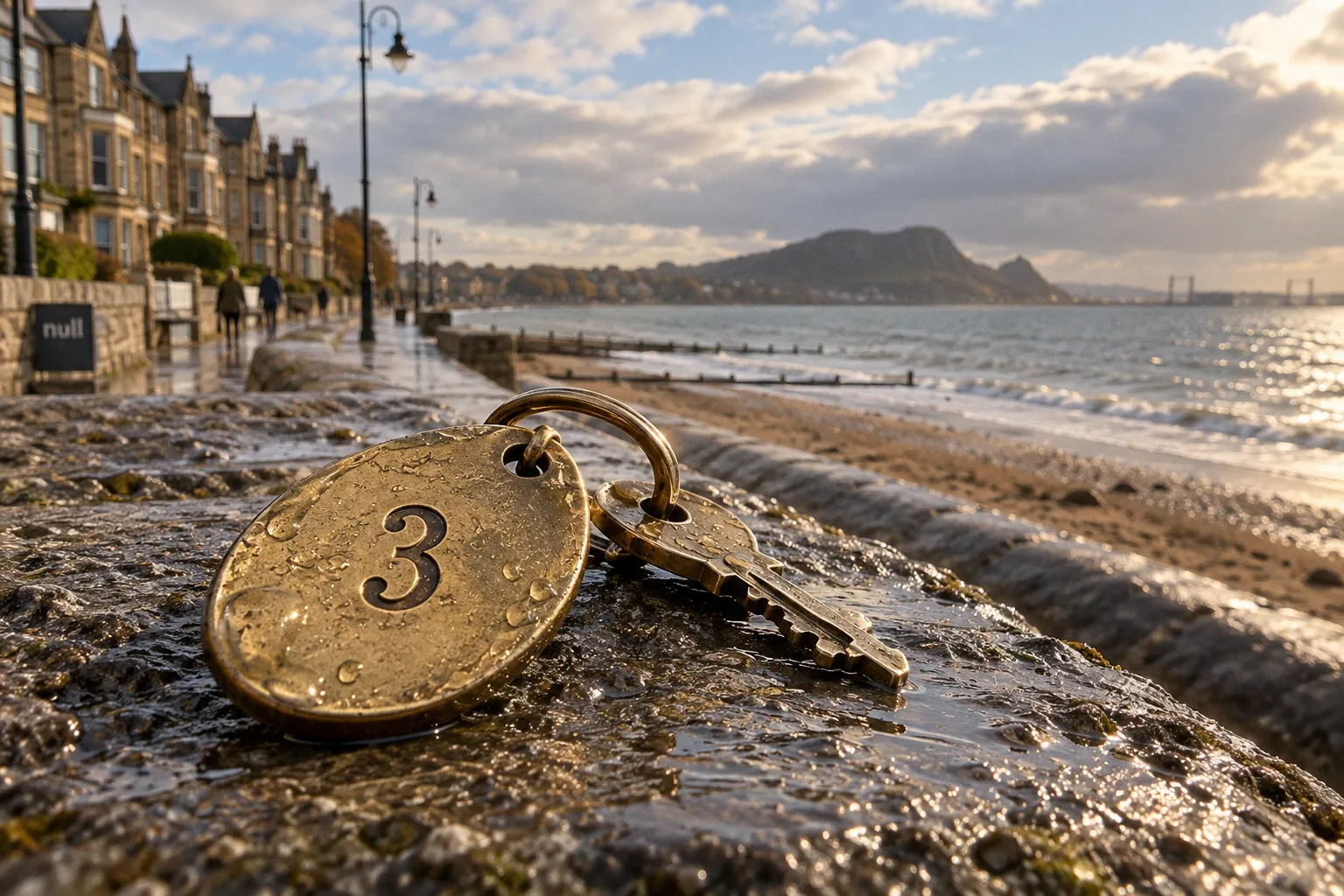
Guests looking for Firth of Forth sea view rooms are choosing between distinctly different experiences: a Victorian guest house close enough to hear the tide, a considered apartment with a roof terrace, or a quieter coastal retreat that trades immediate beach access for more generous space.
That distinction matters. A room facing the water is not automatically a good room. The view may be magnificent but badly framed, the lighting harsh, the textiles thin, or the journey into Edinburgh inconvenient enough to erode the pleasure of staying by the shore. The best coastal accommodation balances three things with unusual precision: the visual drama of the Firth, the physical comfort of the room, and the practical reality of being several kilometres from the city centre.
This is the useful way to approach a Firth of Forth sea view rooms comparison: not as a contest between properties, but as an examination of how different forms of coastal lodging shape the stay.
The geography of Edinburgh’s coast: Joppa, Portobello and beyond
Edinburgh’s shoreline is not one continuous hotel district. It is a sequence of neighbourhoods and waterfront settings, each with a slightly different relationship to the city and the water.
Portobello is the most immediately legible seaside choice. Its beach gives the area a clear sense of place, while the surrounding streets retain the scale of an established residential neighbourhood rather than a purpose-built resort. Joppa, directly alongside Portobello, offers a similarly coastal atmosphere but with a more residential cadence. Properties here can feel tucked into the city’s fabric rather than set apart from it.
Musselburgh extends the coastal choice eastwards, while Leith offers a more urban interpretation of the waterfront. These areas should not be treated as interchangeable. A guest choosing an Edinburgh beach stay room is deciding not only how close they want to be to the sand, but also whether they prefer a historic domestic setting, a self-contained apartment, or a more urban waterfront base.
The distances are manageable, but they are not imaginary. Coastal accommodation in this part of Edinburgh is generally around 4 to 6.7 kilometres from Waverley station and central landmarks such as the Royal Mile. Public bus journeys from Joppa and Portobello to the city centre typically take around 20 to 25 minutes. That is an entirely reasonable compromise for many visitors, particularly those who want mornings by the shore and afternoons among Edinburgh’s galleries, restaurants and Georgian streets. It is less appealing to anyone who expects to walk everywhere without planning.
A sea view also varies considerably according to the building’s position and the room itself. Some rooms face the Firth directly. Others offer a partial or elevated outlook, while landward-facing and garden-facing rooms may exist within the same property. The phrase “sea view” therefore needs a little architectural suspicion. Ask whether the water is visible from the bed, from a sitting area, or only by leaning past the window frame. Those are three very different experiences.
A sea view is not a room category. It is a relationship between window, horizon, light and the time you will actually spend looking outside.
Victorian heritage versus modern lofts
The most compelling choice along Edinburgh’s coast is often not between one address and another, but between two different spatial languages.
Victorian guest houses bring proportion, ornament and a sense of continuity. Straven Guesthouse, a historic Victorian home on Brunstane Road North in Joppa/Portobello, sits approximately 90 metres from Portobello Beach and includes rooms with views towards the Firth of Forth. Its appeal is not merely the distance from the sand. A building of this type offers the possibility of high ceilings, original architectural details and the slightly irregular plan that gives older houses their character.
That character can be tactile. Timber underfoot, painted joinery, deep window reveals and heritage tones create a visual connection to the coast without resorting to literal beach-house styling. The success of the room depends on restraint. A Victorian interior needs carefully edited furnishings, not an accumulation of decorative nostalgia. One well-chosen textile or a properly scaled upholstered chair usually contributes more than a shelf of shells and maritime ornaments.
Aynetree Guest House on Duddingston Crescent presents another form of historic setting. The Victorian architecture is part of the experience, while the outlook varies by room: some rooms provide views towards Arthur’s Seat, and others face the Firth of Forth. This is precisely why room allocation matters in heritage accommodation. The building may be beautiful as a whole, but the individual room determines whether the stay feels coastal, urban, or simply domestic.
Modern coastal lofts and apartments make a different promise. They tend to offer more open space, clearer sightlines and a stronger connection between living, dining and outdoor areas. The accommodation range along the Firth includes single-bedroom coastal cabins, oceanfront B&Bs and multi-bedroom seaside loft apartments with private roof terraces overlooking the water. For longer stays or for guests who dislike the compressed proportions of a traditional guest room, that additional spatial generosity can be worth more than period detail.
The contrast is easiest to see in the following terms:
| Feature | Victorian guest house | Coastal loft or apartment |
|---|---|---|
| Spatial character | Separate rooms, architectural details, domestic scale | Open-plan or adaptable space, broader sightlines |
| Design appeal | Heritage tones, original proportions, curated period references | Clean geometry, contemporary finishes, stronger indoor-outdoor connection |
| Best for | Short stays, couples, guests who value atmosphere and proximity | Longer stays, families, guests needing living space |
| Sea-view experience | Often dependent on room position and window orientation | More likely to benefit from larger glazing or elevated terraces, where provided |
| Practical trade-off | More character, potentially less spatial flexibility | More independence, but sometimes less of the intimacy associated with a guest house |
Neither category is inherently superior. The point is to understand what kind of comfort you recognise. A room can feel premium because it has historic depth, or because every surface has been calibrated for ease: the width of the circulation, the quality of the mattress, the placement of a reading light, the distance between a suitcase and the bed.
How close should a coastal room be to the tide?
Distance from the beach is one of the clearest and least glamorous measures of value. It is also one of the easiest to misread.
A property approximately 90 metres from Portobello Beach offers a fundamentally different rhythm from one that advertises a distant sea outlook but requires transport for an actual walk on the sand. The closer option makes the shoreline available in fragments: an early walk before breakfast, a brief return after dinner, ten minutes watching the weather change. That ease has genuine value, particularly in Edinburgh, where the coastal setting is often chosen precisely because it offers a counterpoint to the city’s stone, traffic and formal architecture.
But immediate access is not the whole story. A room facing the Firth may have extraordinary light and still be uncomfortable at night if the window treatments are inadequate. Coastal exposure brings brightness, wind and seasonal variation. Blackout curtains, layered lighting and textiles with enough weight to soften the room are not decorative luxuries; they determine whether the view enhances sleep or competes with it.
For Portobello seaside B&B amenities, the most consequential details are therefore often quiet ones:
- A window seat or properly positioned chair makes the view usable rather than merely visible.
- Layered lighting allows the room to move from bright morning to restful evening without relying on a single overhead fitting.
- Substantial curtains or blinds help manage early summer light and privacy.
- A generous surface for coats, shoes and damp clothing acknowledges the realities of a coastal stay.
- Good acoustic separation matters, particularly in older buildings where the charm of original construction can come with audible movement between rooms.
- A well-placed mirror, accessible sockets and a comfortable luggage position improve the room more than additional decorative objects.
The visual composition of the window should receive equal attention. A wide horizon is valuable, but so is the foreground. Rooflines, gardens, promenade activity and neighbouring buildings all form part of the outlook. In a well-designed room, the view is framed like an architectural elevation. In a poorly considered one, it becomes background noise.
The room itself: where design either earns its keep or does not
A coastal room should not be judged on aesthetics alone. The most successful interiors make a design decision perform a practical task.
Textiles are a useful example. Linen, wool and brushed cotton can establish a distinctly Scottish material palette, but their value lies in more than texture. Layering gives the guest control over warmth. Upholstery can absorb sound. A rug softens the movement of an older timber floor. Curtains provide privacy, darkness and insulation while contributing to the room’s visual balance.
Lighting is equally revealing. Sea-facing rooms are often naturally bright, especially when the weather is clear. That can make a space feel open during the day, but it also exposes cheap fittings and poorly considered colour temperatures. A discreet reading light beside the bed, low-level illumination near the floor and a warmer source near a chair or desk create a more adaptable environment. This is the difference between a room styled for photographs and a room composed for actual use.
Welcome amenities should be read in the same way. It is easy to be distracted by a polished tray, a branded bottle or a small arrangement of local products. The sharper question is whether the amenity responds to the location. Is there somewhere to make a proper hot drink after a cold walk? Is the bathroom equipped for wet outer layers and salt air? Are there enough hooks, towels and surfaces to prevent a compact room from becoming visually congested?
This is where bespoke detailing can be meaningful. It does not require extravagance. A built-in bench beneath a window, a robust brass hook in the right place, a headboard that integrates reading lights, or a small table sized for morning coffee can have more impact than expensive but generic furniture.
The design language should also avoid overstatement. Coastal accommodation is at its best when it suggests the shoreline through colour, texture and proportion rather than reproducing it literally. Heritage blues, chalky whites, muted greens and natural timber can create a convincing sense of place. Rope, driftwood and overt nautical motifs are rarely necessary.
Sea view, garden view or dual aspect?
The phrase “sea view room” carries a premium, but the best choice depends on how the room will be occupied.
A direct Firth-facing room is the obvious choice for guests who plan to spend time reading, working or having a slow breakfast indoors. The horizon becomes a form of visual architecture, constantly changing with weather and tide. For a short stay, that may be the feature that gives the room its memory.
A room with a view towards Arthur’s Seat, such as some of the rooms at Aynetree Guest House, offers a different Edinburgh composition. The city’s volcanic landscape is not a consolation prize for the absence of water; it is another powerful visual anchor. Depending on the itinerary, a landward outlook may also offer more privacy, softer evening light or less exposure to passing activity.
Dual-aspect rooms can be particularly effective because they provide visual depth and changing light across the day. However, their value depends on the actual arrangement of the windows. Two small windows facing different directions are not necessarily more useful than one generous opening with a clear view.
When comparing Edinburgh beach stay room types, consider the following questions in sequence:
1. Will the outlook be used or merely photographed?
If the room is primarily a base for exploring Edinburgh, paying a premium for a view may not make sense. If mornings and evenings will be spent indoors, it becomes far more consequential.
2. What is visible from the bed?
A view from a standing position is not equivalent to a view enjoyed from bed or a chair.
3. Does the room have somewhere to sit?
A beautiful outlook is diminished if the only comfortable position is on the edge of the mattress.
4. How does the room handle light?
Large windows are a benefit only when the curtains, blinds and bedside lighting are equally considered.
5. What does the price include beyond the view?
A water-facing room in an awkward layout is not automatically better value than a slightly smaller room with stronger spatial harmony.
Navigating the commute without pretending the coast is central Edinburgh
The appeal of Joppa waterfront accommodation features is inseparable from its distance from the central city. The shore offers a change of pace, but it is not a hidden lane beside the Royal Mile.
From Joppa and Portobello, bus connections into central Edinburgh generally take around 20 to 25 minutes. That is a manageable journey for most leisure itineraries, particularly when the accommodation provides a calmer base at the end of the day. It also means that a guest can divide the trip with intention: city-focused mornings, perhaps, followed by a return to the water before dinner.
The practical question is not whether the journey exists, but whether it fits the way you travel. Guests who want to move between museums, restaurants and the accommodation several times a day may find the coastal location less frictionless. Those who prefer one substantial outing followed by a quieter evening will benefit more from the separation.
Transport should also be considered alongside luggage, weather and check-in timing. A 20-minute bus ride is straightforward with a small bag. It feels less elegant after a delayed train, in heavy rain, or when the accommodation is a further walk from the stop. This is not an argument against the coast. It is an argument for evaluating the complete arrival sequence rather than admiring the destination in isolation.
Leith Shore offers a more urban waterfront alternative, while Musselburgh can suit visitors who want access to the coast with a different local atmosphere. East Lothian coastal retreats extend the sense of departure further again. Each step away from central Edinburgh may buy more quiet, more space or more direct engagement with the landscape, but the transport equation becomes increasingly important.
What waterfront lodging can cost
Observed prices for coastal accommodation in and around Edinburgh range from roughly 77 US dollars to more than 280 US dollars per night, depending on the property type, timing, room size and sea-view features. This is a broad range rather than a reliable tariff. Independent guest houses, private apartments and larger coastal lodges do not offer comparable products, and seasonal variation across smaller properties can be significant.
The price-to-value question is therefore more useful than the headline rate. A room at the lower end of the range may be compelling if it provides genuine beach proximity, a well-maintained interior and a practical bus connection. A higher-priced loft may justify itself through a private roof terrace, multiple bedrooms or a level of spatial independence unavailable in a traditional guest house. Conversely, an expensive room with a nominal sea view, weak lighting and no comfortable place to sit can feel oddly unfinished.
A sensible comparison separates the cost into four forms of value:
- Position: how close the property is to the beach and how direct the route is.
- Outlook: whether the water is visible from the room, how it is framed and whether the view is private.
- Space: whether the room provides a chair, working surface, storage and enough circulation for the length of the stay.
- Convenience: the quality of transport connections and the ease of arriving with luggage.
This approach prevents the view from becoming a decorative surcharge. The Firth of Forth is a strong feature, but it cannot compensate for every shortcoming. A premium room should offer a complete experience: visual pleasure, physical ease and a location that works with the rest of the itinerary.
Choosing the right coastal stay
The best coastal guest houses in Edinburgh are not necessarily the most elaborate. They are the ones that understand what the shore adds to a city break and design around it with discipline.
Choose a Victorian guest house when the building’s character is part of the appeal, when proximity to Portobello Beach matters, and when a more intimate room feels preferable to a self-contained apartment. Look towards a loft, lodge or seaside flat when space, privacy and indoor-outdoor living are more valuable than period detail. Select a direct Firth-facing room when the outlook will be part of the daily experience, not simply a feature to mention while booking.
Most of all, distinguish atmosphere from performance. A room can have heritage tones, tactile textiles and an immaculate visual composition yet still fail if the bed is badly placed or the lighting is unusable. Equally, a modest room can feel quietly premium when its proportions are respected, its materials are durable and every convenience is where it should be.
Edinburgh’s coast rewards that level of attention. From a Victorian house roughly 90 metres from the sand to a contemporary apartment with a private roof terrace, the accommodation is varied enough to suit different definitions of escape. The successful choice is the one where the view, the architecture and the practical details agree with one another.
That is the real measure of a seaside stay: not whether the room gestures towards the water, but whether it lets the water change the way the room is lived in.