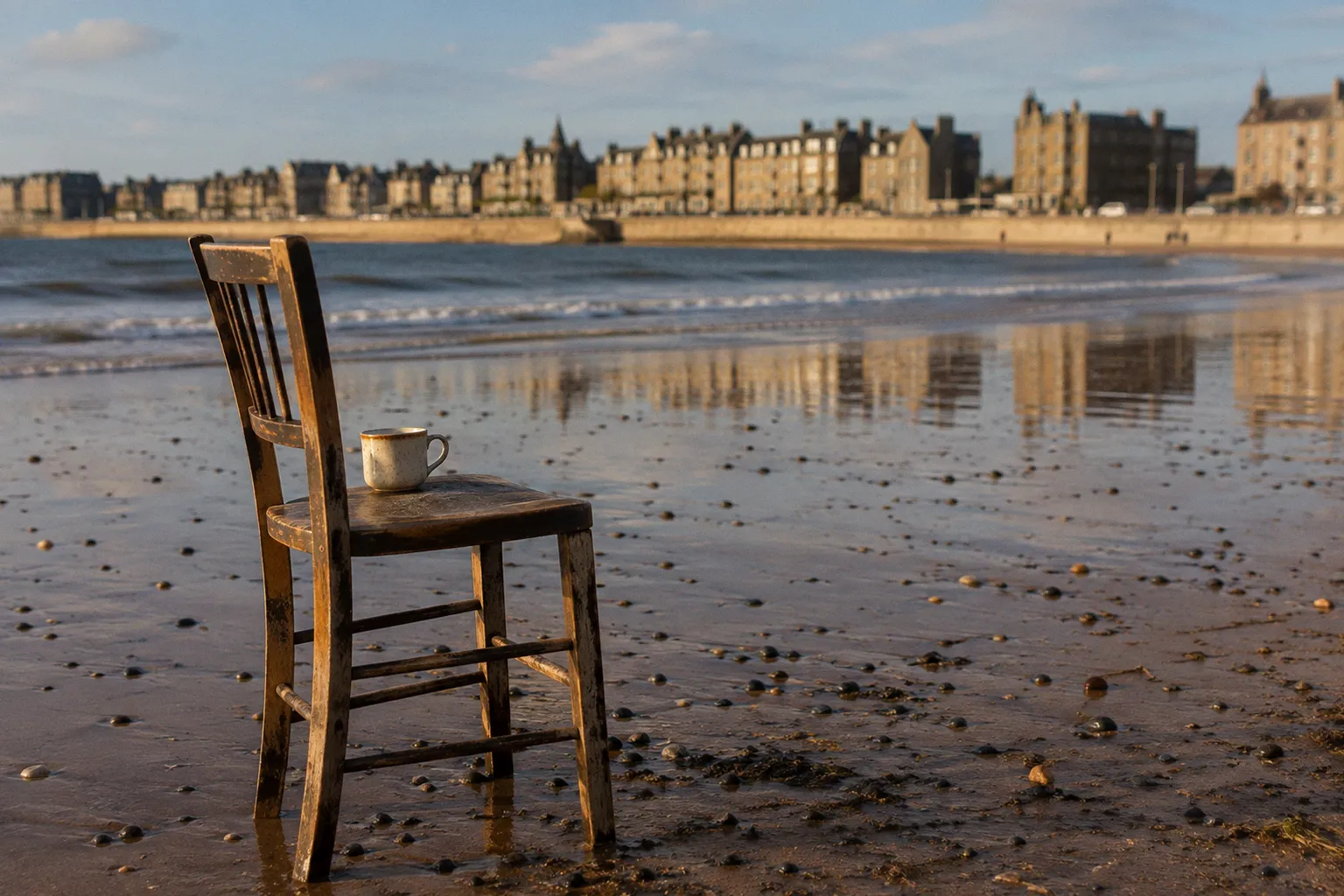
At low water, the beach may open for as much as 250 metres between the promenade and the water’s edge. At high water, that same distance nearly disappears.
The result is a shoreline that changes not only from season to season, but from one tide to the next. The pale surface beneath a walker’s feet is only the uppermost layer of a more complicated coastal sediment system, shaped by wave energy, tidal range, the Figgate Burn, historic manufacturing, and the ordinary debris of a working estuary.
To understand Portobello beach sand composition and tidal debris, it helps to stop thinking of the beach as a clean strip of mineral matter. Portobello is better read as a boundary: between Edinburgh and the Forth, between built ground and intertidal ground, between natural sediment and the materials a city has left behind.
The anatomy of Portobello’s shore
The natural sand at Portobello is notably fine. Offshore sediment surveys have recorded a mean particle size of approximately 0.20 millimetres, a grain small enough to produce the broad, soft surface associated with the beach but substantial enough to settle across the gently inclined foreshore.
That slope is around 1:42. It sounds like a minor technical detail, yet it governs the entire experience of the shore. On a steep beach, a modest change in tide can move the waterline only a short distance across the ground. On Portobello’s shallow foreshore, the same tidal movement travels a long way horizontally. The beach is not merely exposed or covered; it is redrawn.
The distance from the promenade to the water’s edge can vary from almost nothing to roughly 250 metres, depending on the state of the tide. This is why two visits to Portobello on the same day may feel like encounters with different beaches. In the morning, the wet margin may sit close to the promenade, with a hard reflective plane of sand underfoot. A few hours later, the shore may have opened into a broad field of ripples, pools, wrack, shell fragments and darker sediment.
The Firth of Forth has a spring tidal range of approximately 4.5 to 5.7 metres. That movement gives the shoreline its characteristic rhythm, but it also complicates any simple description of what Portobello beach sand is made of. Material is continually redistributed: fine grains settle in sheltered areas, coarser fragments remain where wave action can no longer carry them, and light organic matter gathers along temporary lines that may be erased by the next tide.
Portobello’s beach is not a static surface. It is a daily negotiation between the city, the estuary and the tide.
The visible sand is therefore only part of the story. A dry upper beach can appear uniform and almost architectural, especially under low winter light. Closer to the water, the sediment becomes more legible. Ripples show the last direction of flow. Small hollows hold darker silt. Pebbles collect along wrack lines. The shore’s topography records what the tide has recently done, even when the water itself has withdrawn beyond view.
Why the beach has needed replenishment
Portobello’s fine sediment has not simply accumulated untouched over geological time. Historical studies of the foreshore included offshore sediment surveys carried out in connection with beach renourishment. That matters because the sand encountered by visitors today reflects both natural coastal processes and human intervention.
Beach replenishment is not the same as replacing a beach with an entirely foreign material. It is an attempt to maintain a usable shore where waves, storms and tidal currents remove sediment faster than it is naturally replaced in the same location. At Portobello, the gentle profile and exposed position make the distribution of sand especially sensitive to those movements.
The shore can look smooth after sediment has settled, then become ridged and uneven after a period of stronger wave action. A storm does not necessarily remove the entire beach. It may simply move the finest particles offshore, expose a coarser lag of pebbles and fragments, and leave the upper foreshore with a different texture from the one people remember.
That difference is part of the beach’s ordinary life. The question is not whether Portobello has changed, but which layer of change a visitor happens to see.
Anthropogenic mixed sand: Edinburgh’s industrial legacy
The Firth of Forth contains a quantity of material that does not originate as natural beach sediment. A University of Glasgow study published in Sedimentology found that human-made geomaterials, including brick, concrete, glass, tarmac and slag, account for an average of 22% of coarse, pebble-sized sediments across beaches in the Forth estuary. Across the beaches examined, the proportion ranged from 2% to 48%.
Researchers have proposed the term Anthropogenic Mixed Sand and Gravel, or MSG-A, for beaches where human-made material has become a substantial part of the sediment system. It is an awkward phrase, but an accurate one. It describes a shoreline where the boundary between natural geology and urban material has been permanently blurred.
Portobello’s position within the estuary makes that history especially visible. The shoreline received material from a region shaped by shipbuilding, engineering, glassmaking, pottery, transport infrastructure and dense urban settlement. Some pieces arrive as contemporary litter. Others have been weathered and rounded by decades of movement. Still others are fragments of older structures, industrial surfaces or household objects, reduced slowly by water and abrasion.
The distinction matters when beachcombing. A small, polished green fragment may be sea glass. A pale angular piece may be ceramic. A dark, dense lump may be slag rather than stone. These materials can sit together in the same strandline, but they do not share the same origin.
This does not mean every unusual pebble on Portobello Beach should be treated as an artefact, nor that every fragment has a story that can be confidently reconstructed. The Forth is an active estuary, and objects move. A piece may have been carried from another part of the shoreline, exposed from older sediment or transported by a sequence of tides. The beach gives clues, not guaranteed biographies.
A shoreline made partly by the city
The proportion of anthropogenic material is most apparent among coarse sediments rather than the fine sand itself. The broad sandy surface remains dominated by small mineral grains, while larger fragments become visible where the tide sorts them into lines and pockets.
This sorting is one reason the upper shore can be such a rich place for observation. Water carries smaller particles more readily than heavier or irregular pieces. As the tide retreats, pebbles, glass, brick and shell may be left behind at the high-water margin or gathered around shallow depressions. The beach looks as if it has been arranged, though the arrangement is temporary and governed by water movement rather than design.
For local residents, this is not an abstract geological curiosity. The material is part of the neighbourhood’s physical inheritance. Portobello’s coastal identity is often associated with the promenade, bathing waters, cafés and the long public edge between houses and sea. Yet beneath those familiar uses lies a more complicated sedimentary record, one in which the built history of Edinburgh has become part of the shore.
The Figgate Burn and the movement of sediment
The Figgate Burn, also known as the Braid Burn, reaches the sea between Portobello West and Portobello Central bathing waters. Its outlet introduces another moving element to the beach: freshwater and catchment material arriving from inland, meeting the tidal waters of the Forth.
A burn mouth is never just a line on a map. It is a place where flow changes character. Inland water carries suspended particles and organic matter towards the shore, while the tide pushes seawater and estuarine sediment back across the outlet. The channel may appear modest beside the breadth of Portobello Beach, but its presence adds local variation to the shoreline’s sediment patterns.
Around the burn mouth, the surface can differ from the wider beach. Fine material may settle in calmer pockets; small channels may form across the sand; wetness may persist after the surrounding foreshore has dried. The exact appearance depends on recent rainfall, the state of the tide, wave conditions and the amount of sediment being moved at that moment.
This is one reason broad statements about the beach can be misleading. Portobello is not a single sediment environment. It contains zones: the promenade edge, the dry upper beach, the damp intertidal flats, the burn outlet, the wrack line and the nearshore shallows. Each zone has its own relationship with water and therefore its own mixture of material.
The Figgate Burn also helps explain why visitors should read the beach in relation to weather and tide rather than treating it as an unchanging recreational surface. Following rainfall, the outlet may be more visually pronounced. After a stronger tide, the surrounding sand may carry new runnels and deposits. At neap tide, the range is more restrained; around spring tides, the water reaches further across the foreshore and can rearrange material higher on the beach.
The scale of a tidal shoreline
A tide does not move every object in the same way. Fine sand can be suspended and redeposited across a wide area. A rounded brick fragment may shift only during more energetic conditions. Seaweed can collect at the upper margin, then be drawn back or broken apart. Glass may remain in place for several tides before being transported into a new hollow.
The result is a layered geography that changes at different speeds:
- Fine sand responds readily to wave action and tidal currents, smoothing and reforming across the shallow foreshore.
- Pebbles and brick fragments tend to gather in more stable lines until a stronger tide or storm redistributes them.
- Seaweed and wrack mark recent high-water movement but are not fixed boundaries.
- Ceramic and glass fragments may remain visible through several tidal cycles, becoming easier to find when the finer sediment has been swept away.
- Burn deposits and wet channels can change quickly after rainfall or an alteration in freshwater flow.
This is also why a photograph of Portobello Beach can be geographically accurate and still provide a poor guide to what another visitor will see. The same stretch of shore may be flat and pale on one day, ribbed and debris-lined on the next.
Beachcombing through Portobello’s industrial history
Portobello has long been associated with manufacture as well as leisure. Its eighteenth- and nineteenth-century glassworks and potteries left behind a material record that can still appear in the intertidal zone. Sea glass, Victorian bottle stoppers and ceramic fragments are among the finds that have been reported along the shore.
These objects are not souvenirs in the conventional sense. They are pieces of a civic and industrial landscape that has been softened by the sea. Their edges may be rounded, their colour muted, their original purpose uncertain. The water has transformed them without erasing their material identity.
Sea glass is particularly deceptive. It can look geological at first glance, especially when frosted and covered in wet sand. Colour offers a clue, but not a complete answer. Green, brown and clear fragments are common enough to require caution; an unusual shade may be more distinctive, but rarity alone does not establish age or origin.
Ceramic fragments can be equally difficult to read. A curved edge may suggest the wall of a vessel, while a thicker, glazed piece could come from a domestic or industrial object. Patterns, maker’s marks and glaze colours may provide evidence, but a small fragment rarely tells the entire story. It is better to treat beachcombing as a form of attention than as a hunt for guaranteed antiquities.
The most responsible approach is observational:
1. Look at the setting before the object. A fragment embedded in a stable sediment line has a different immediate context from one washed into fresh wrack.
2. Notice whether the edges are naturally rounded or sharply broken. This can suggest how long the piece has been exposed to abrasion, though it cannot date it with certainty.
3. Compare material with nearby finds. A concentration of ceramic or glass may indicate a local deposit or a temporary tidal accumulation.
4. Leave uncertain or historic-looking material where it lies. The shoreline is a public landscape, not an open archaeological excavation.
5. Avoid disturbing wildlife, burn banks and unstable sediment. The most interesting part of a find is often its relationship to the beach around it.
A visitor who wants to understand beachcombing finds at Portobello promenade will usually learn more by observing the strandline carefully than by filling a pocket. The beach is generous with evidence but poor at providing neat conclusions.
A fragment of glass on Portobello Beach is not merely a thing found by the sea; it is a meeting point between manufacture, tide and memory.
The ethics of looking
There is a temptation, particularly on a shoreline with a visible industrial past, to turn every old-looking fragment into a personal discovery. That approach can strip the object from its setting. A piece of ceramic is more informative when understood among the sand, shell, brick and wrack that surround it.
There is also a practical reason to avoid indiscriminate collecting. The shore’s debris is part of its sedimentary character, and not all material is harmless. Sharp glass, corroded metal and fragments with uncertain origins should not be handled casually. Nor should seaweed be removed in quantity from areas where it forms part of the coastal food web and shelter.
The beach can be read without being mined. That distinction is particularly important at Portobello, where leisure, ecology and local identity occupy the same narrow edge.
Cleaning cycles, wrack lines and what visitors see
Portobello beach cleaning cycles influence the appearance of the shoreline, but cleaning does not create a permanent division between natural and human-made debris. Different materials accumulate together, and the visual line left by the tide may include seaweed, driftwood, shell, plastic, glass and other fragments.
Organic wrack is often treated as untidy because it interrupts the smooth, managed appearance many people expect from an urban beach. Yet it is also a record of recent tidal movement and a habitat in its own right. The absence or presence of wrack changes what the visitor can see. When it is cleared or dispersed, small objects become more visible; when it gathers densely, it conceals the sediment beneath.
This creates a tension familiar to many developed shorelines. A beach must remain accessible and safe, particularly where it functions as a bathing water and a public promenade, but excessive tidying can erase the very processes that make the coast ecologically and culturally legible.
The most useful way to read the cleaned and uncleared shore is comparatively. A broad, uninterrupted sand surface may reveal the beach’s fine grain and shallow profile. A strandline left after a high tide may show the materials being transported. Neither view is the whole beach.
For visitors, the practical implications are straightforward:
- Check the tide before walking towards the water, because the exposed distance can change dramatically across the day.
- Take care near the Figgate Burn outlet, where flowing freshwater and tidal water can produce uneven channels.
- Wear footwear suitable for mixed sediment if walking beyond the promenade, particularly after storms.
- Treat glass, metal and ceramic fragments as potentially sharp even when rounded or attractive.
- Leave wrack and larger natural debris in place unless local guidance indicates otherwise.
- Use the promenade and established access points rather than cutting across fragile or waterlogged areas.
- If swimming, remember that a long exposed foreshore at low tide does not imply a simple or immediate route to deep water.
The final point is easy to miss. Portobello’s wide sands can create the impression of an uncomplicated beach, but the shallow slope means that the waterline may be far away when the tide is out, and the returning tide can cover ground quickly. The beach is open, but it is not inert.
Reading Portobello within the Firth of Forth
Portobello’s shoreline makes most sense as part of the wider Firth of Forth rather than as an isolated urban amenity. The estuary connects beaches, burns, harbour edges, industrial sites and residential promenades through the movement of water and sediment. Material found at Portobello may have travelled from elsewhere; material leaving Portobello may later appear on another shore.
That wider context also puts the 22% average proportion of anthropogenic coarse sediment into perspective. It is not a measurement that can simply be assigned to every part of Portobello Beach. The value describes an average across Forth estuary beaches, while individual locations vary considerably. The documented range, from 2% to 48%, demonstrates how unevenly human-made material is distributed.
Portobello should therefore not be described as either pristine or polluted on the basis of its sediment alone. Neither label captures the physical reality. It is an urban estuarine beach with fine sand, historical artefacts, modern pressures, tidal debris and active natural processes. Its character comes from the mixture.
That mixture is visible in the relationship between the promenade and the shore. The architecture of Portobello faces the water, but the beach carries the marks of inland streets, former works, drainage channels and the wider industrial geography of Edinburgh. The Forth has no interest in keeping those categories separate.
For a visitor staying near the coast, this offers a more rewarding way to spend time at the beach. Walk at different stages of the tide. Compare the dry upper sand with the wet intertidal surface. Look for the Figgate Burn’s outlet and the changes around it. Notice what the water has left behind, but resist the urge to give every fragment a confident story.
Portobello is not best understood through a single scenic view. Its meaning emerges through repetition: the same promenade under different skies, the same sand opened and closed by the tide, the same shoreline presenting new arrangements of old material.
A beach that changes without losing its identity
The composition of Portobello beach sand is neither wholly natural nor simply manufactured. It is fine-grained and gently sloping, altered by replenishment, shaped by the tidal range of the Forth, influenced by the Figgate Burn and marked by the remnants of Edinburgh’s industrial shoreline.
That complexity does not make the beach less authentic. It is the authenticity. Portobello has been a place of habitation, manufacture, bathing, walking and exchange, and its sediment carries those overlapping histories in material form. The coast does not preserve the past neatly. It breaks it down, moves it, buries it and occasionally returns it in the form of a small green shard or a glazed ceramic edge.
Visit with the tide in mind, keep your attention on the ground, and allow the beach to remain partly unresolved. The most accurate description of Portobello is not a fixed composition but a process: fine sand shifting across a shallow foreshore, human-made fragments entering the sediment, freshwater meeting saltwater, and the Firth of Forth continuously redrawing Edinburgh’s eastern edge.