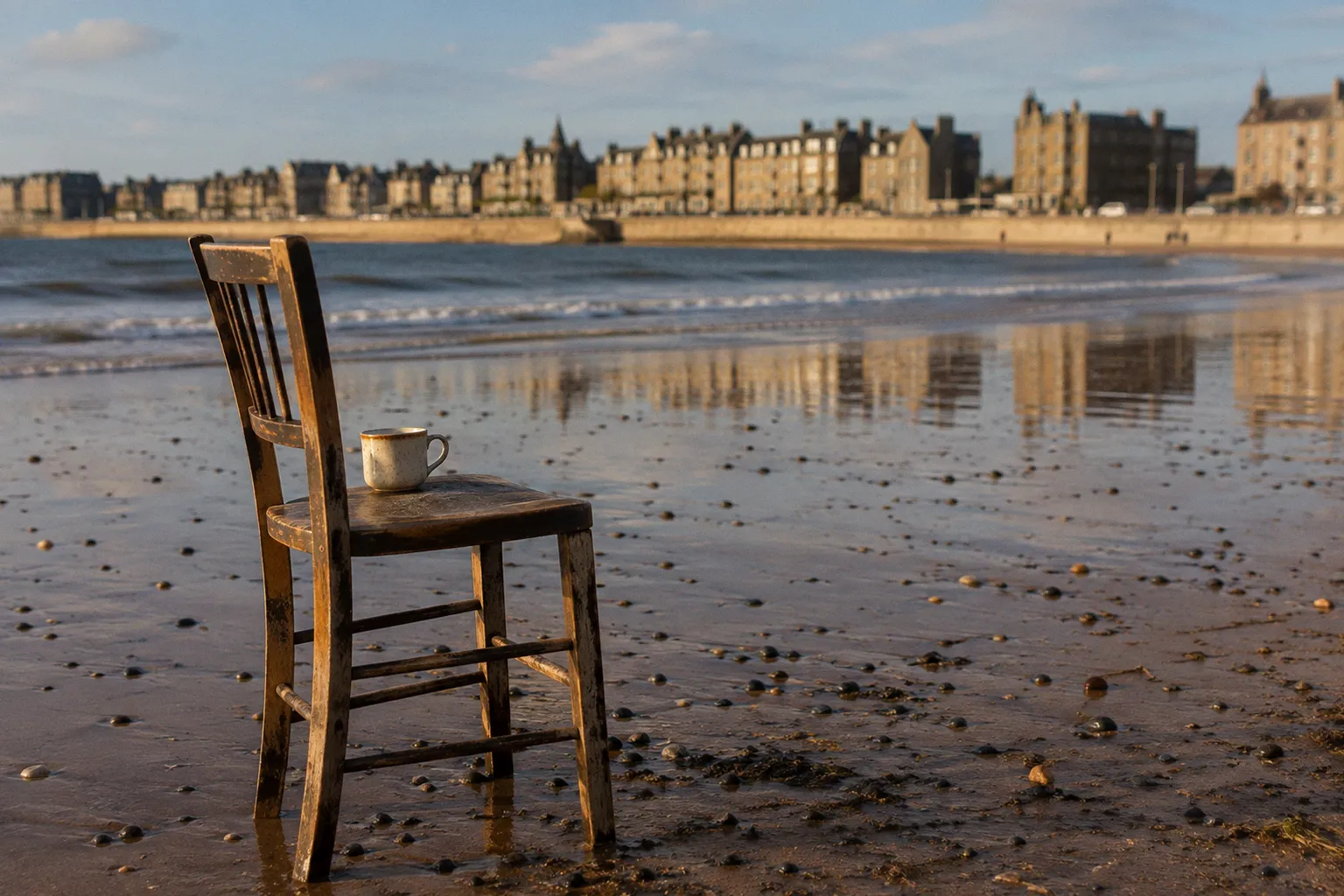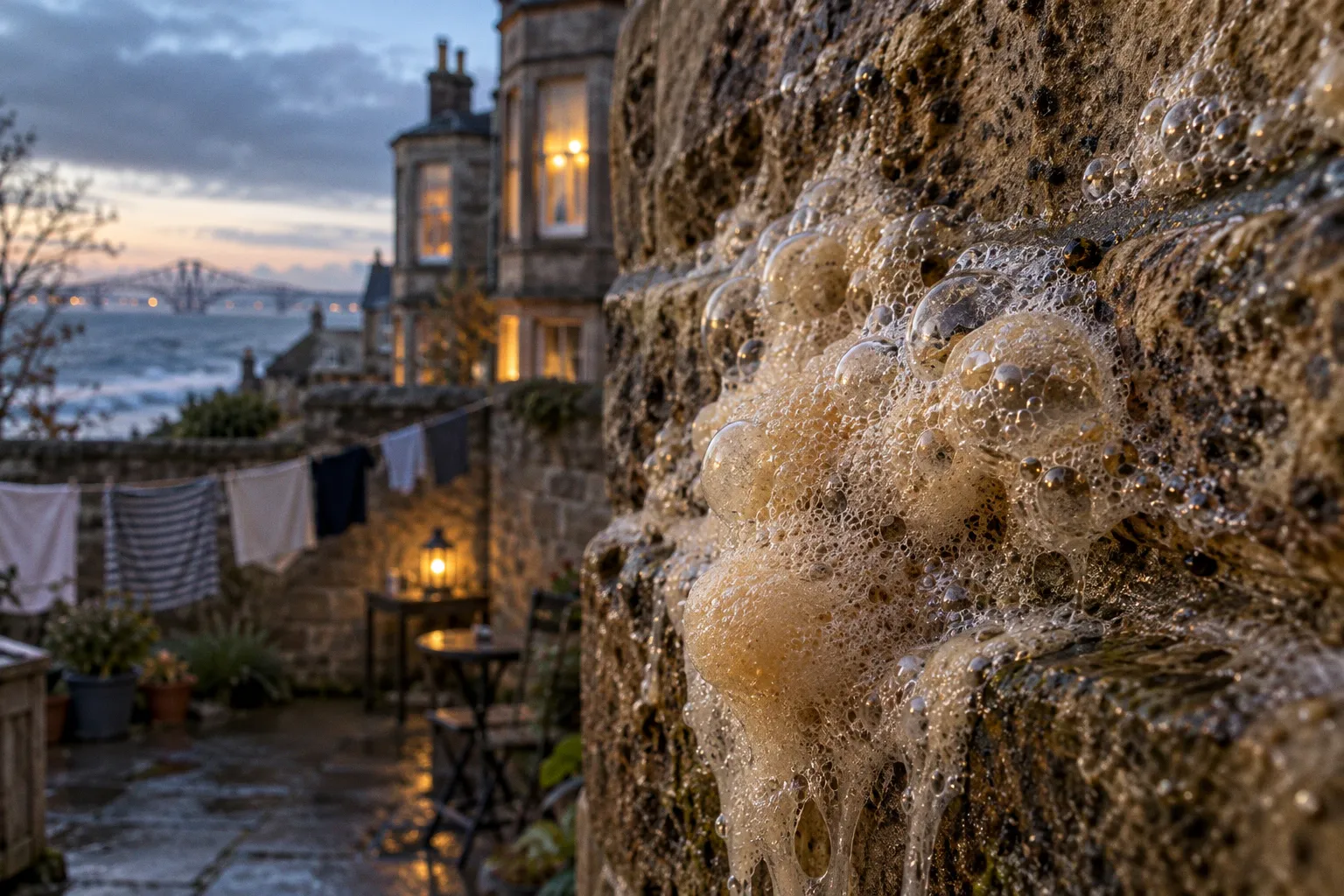
When wind and swell arrive together, that tidal margin may gather into pale ropes of bubbles: cream-coloured, yellowish or brownish foam pushed above the waterline and sometimes carried onto the promenade.
The sight can look industrial, especially beside an urban shoreline. Yet the usual explanation for Portobello promenade sea foam causes is not a ruptured sewer or a single pollution event, but a meeting of moving water, decaying marine material and weather. The Firth is doing what an estuary does: collecting, turning and redistributing what the sea has produced.
That does not mean every patch of foam should be treated as harmless without thought. Natural foam can hold concentrated organic matter, sediment and, under particular conditions, irritants associated with algal blooms. The useful distinction is not between panic and dismissal, but between reading the shoreline carefully and assuming that appearance alone tells the whole story.
The chemistry of the coast: how organic matter creates spume
Sea foam, or spume, begins with a simple physical action. Waves break, wind shears across the surface and air is forced into seawater. Under ordinary conditions, those bubbles disappear quickly. The surface tension of clean seawater does not usually allow them to remain in place for long.
The chemistry changes when the water contains a high concentration of dissolved organic matter. Proteins, lipids, carbohydrates and other compounds released by marine organisms can behave as natural surfactants. They lower the water’s surface tension, allowing bubbles to form more easily and survive longer. The result is the familiar froth that gathers in lines along the strand or sits in wind-polished hollows of the beach.
Some of this material comes from decaying algae. Blooms of organisms such as Phaeocystis can produce organic compounds that make the water more inclined to foam once waves and wind begin mixing it. The foam is not made from one substance, and it is not necessarily evidence of a single bloom directly offshore from Portobello on the day it appears. Marine material can be transported, broken down and concentrated over time before it reaches the beach.
This is why the colour can vary. Fresh foam may look white, while older accumulations take on a cream, ochre or light brown tone as they collect dead microscopic algae, mucopolysaccharides, trapped silt and other suspended material. On a shoreline backed by roads, drains, buildings and a busy city, the visual association with sewage is understandable. It is also an unreliable conclusion on its own.
A greasy sheen, a strong chemical or sewage odour, unusual discolouration in the water, dead fish or a notice about bathing conditions would change the reading. So would foam appearing alongside a known pollution incident. But brownish foam on its own is not proof of raw sewage, and natural foam on the Firth of Forth shoreline can look considerably less pristine than its origin.
Foam is a record of what the water has gathered, not a verdict written in one colour.
The underlying scale of this process is much larger than the strip of beach visible from the promenade. Dissolved organic matter is one of the great mobile reservoirs of carbon in the ocean, estimated at around 662 billion tons of carbon. Portobello’s foam is a local expression of that wider marine cycle, compressed into a few metres of beach and made visible by wind.
Why sea foam appears on Portobello Beach from spring into summer
The seasonal pattern matters. In UK coastal waters, algal blooms and the organic material associated with them commonly increase from April through August. That is not because every beach follows a neat calendar, nor because foam will appear whenever the month changes. Light, nutrient availability, water temperature, currents and wind all influence the sequence.
When a bloom develops offshore, the foam may not arrive immediately. The organic compounds have to be mixed into the upper water, and the material may be transported by currents before it reaches a breaking shore. Foam formation can peak roughly two weeks after an offshore algal bloom becomes visible, although local weather can shorten or extend that interval. A calm period may leave the surface unremarkable; a later run of wind and swell can suddenly turn the same water into froth.
Portobello’s position on the Firth gives this process a particular geography. It is not an exposed Atlantic beach receiving uninterrupted ocean swell. The shore faces a broad estuarine waterway with its own tidal rhythm, channels and wind fetch. A haar may flatten the horizon and soften the distinction between sea and sky, while a stronger onshore wind can reorganise the visible water in a matter of hours.
This is also why foam may appear unevenly along the beach. One stretch beside the promenade can be clear while another collects a thick margin. The difference may come from the angle of the incoming waves, the shape of the intertidal sand, small changes in wind direction or the way the tide has left shallow water in depressions. The sea is not applying a uniform coating; it is sorting floating material according to movement.
A visitor trying to understand why does sea foam appear on Portobello Beach should therefore look at the conditions over the preceding days rather than only at the moment of arrival:
- Has there been a period of warmer, brighter weather associated with increased algal activity?
- Did offshore winds or swell arrive after a calmer spell?
- Is the foam concentrated along the latest high-tide line or gathered in windrows parallel to the shore?
- Does it have a marine, earthy smell, or a distinctly foul and chemical odour?
- Are there public notices, bathing warnings or signs of an unusual water-quality event?
None of these observations replaces official advice or testing. They simply give the shoreline a physical context, which is often more useful than treating every unfamiliar natural phenomenon as evidence of urban failure.
Windrows, neap tides and the physics of accumulation
The foam seen from the promenade is shaped as much by wind as by biology. Strong onshore winds push low-density foam beyond the immediate tidal edge, where it can gather against sea walls, railings, beach entrances and the shallow curves of the strand. A moderate amount of foam at sea can therefore become a conspicuous bank on land.
Offshore, the same wind can form lines known as windrows. These are narrow bands of floating material created by Langmuir circulation, a pattern of rotating surface currents that develops beneath sustained wind. The bands may run roughly parallel to one another, carrying foam, seaweed and other light material into visible lines. Once those lines approach the beach, the shore’s own contours decide where they settle.
The tide then edits the picture. At low water, the intertidal zone is broad and the foam may be spread across wet sand. At high water, it can be lifted and repositioned against the promenade edge. Around a neap tide, when the difference between high and low water is smaller, the material may remain in the shallow coastal zone for longer rather than being swept through the full tidal range. That does not create foam by itself, but it can influence how long an accumulation remains visible.
A Portobello beach walk after wind is therefore a small lesson in coastal mechanics. Foam gathers in the lee of groynes and walls, stretches into ribbons where the swash has retreated, and collapses into dirty-looking bubbles where people or dogs disturb it. The promenade provides a fixed line from which to observe a moving system, but it does not mark the edge of that system. The Firth continues beneath the visual surface, carrying organic material between open water, mudflats and the urban shore.
This is one reason a photograph can mislead. A close image of a thick brown patch may suggest a dense, continuous slick, while the wider beach may show scattered, wind-blown accumulations. Conversely, a thin-looking layer may cover a large area after the tide has deposited it. Scale, smell, movement and context all matter.
The role of breaking waves
Breaking waves are the engine of the visible froth. They trap air in seawater, while organic surfactants help keep the bubbles intact. More wave energy generally means more mixing, but the relationship is not as simple as “bigger waves, more foam”. The water must also contain the right organic material, and the wind must move the resulting foam into a place where people can see it.
A sheltered stretch can hold foam for longer than an exposed one because the bubbles are not immediately dispersed. A shallow pool may become thick with froth even when the water just beyond it appears clear. As the bubbles burst, they leave behind concentrated films and small particles that can be carried in the air or deposited on the sand.
Natural foam, urban run-off and the limits of visual judgement
Portobello is an urban beach. Its shoreline is closely connected to streets, drains, buildings, bathing areas and a heavily used promenade. Run-off from land can carry oils, detergents, fine sediment and other pollutants into coastal waters. It would be careless to say that all foam near a city is natural, just as it would be careless to say that all discoloured foam is sewage.
The question is not whether urban influence exists. It is how to distinguish a broad natural process from a local contamination event when standing at the water’s edge.
Natural marine foam is often spread in irregular windrows or piled along the high-water mark, with a light, airy structure that changes as the wind shifts. It may appear after a period of swell and can cover several parts of the beach in a pattern that follows the tide and prevailing wind.
A discharge or run-off plume may behave differently, particularly if it is associated with a drain, outfall or recent rainfall. It might produce a sharp odour, a persistent sheen, unusual floating debris or a colour that remains concentrated near one point. None of those signs is conclusive in isolation, and natural material can smell unpleasant as it decomposes. They are reasons to step back and seek current local information, not reasons to make a definitive diagnosis from the sand.
The most reliable approach is to combine observation with official coastal-water information. If signs advise against bathing, follow them. If a council or environmental body reports a pollution incident, treat that information as more authoritative than a photograph circulated online. Conditions can change between one tide and the next, particularly after heavy rain or strong wind.
For visitors staying near the shore, this is a practical distinction. A foam bank can be interesting to observe without becoming something to touch, collect or carry back to a guest house. Children and dogs are better kept from swallowing seawater or froth, and hands should be washed after contact with unfamiliar coastal material. That is ordinary shoreline caution, not an assertion that the beach is contaminated.
For those interested in the wider relationship between weather, marine ecology and public bathing, a useful overview of coastal water quality and foam formation offers broader context beyond the Firth of Forth.
Is sea foam on Portobello Beach dangerous?
Most coastal foam is a natural consequence of wave agitation and dissolved organic matter, and its presence does not automatically make a beach unsafe. The difficulty is that foam can also concentrate material from the water, and not every substance present in a foamy patch is visible.
During harmful algal blooms, bursting bubbles may release aerosols that irritate the eyes or respiratory system of sensitive people. That risk is not a reason to regard every spring or summer foam event at Portobello as toxic. It is a reminder that conditions associated with marine blooms can have effects beyond the water itself, especially when wind is strong enough to carry spray inland.
A sensible visitor response is proportionate:
1. Observe before approaching. Look at the extent of the foam, the wind direction and whether it is confined to the high-water line or associated with a wider change in the sea.
2. Do not treat colour as a laboratory result. Cream or brown foam can reflect dead algae, organic compounds and trapped silt; colour alone cannot identify sewage or toxicity.
3. Avoid swallowing foam or seawater. This is particularly important for children, dogs and anyone with a sensitive stomach or respiratory condition.
4. Move away if the air feels irritating. Eye watering, coughing or throat irritation is a reason to leave the immediate area, regardless of the foam’s cause.
5. Check current notices before bathing. A local warning, pollution alert or advice from the relevant authority takes precedence over general explanations of natural foam.
6. Report an unusual event when appropriate. A strong chemical smell, dead fish, an obvious discharge or a sudden persistent plume is worth passing to the relevant local service rather than diagnosing from the promenade.
The distinction between “natural” and “safe” is not absolute. Natural does not mean sterile, and a naturally occurring bloom can still affect sensitive people. Equally, an untidy-looking beach is not automatically polluted. The Firth carries living material, sediment and urban influence together; the shoreline is where those systems become visible in the same frame.
Reading Portobello’s shoreline without losing its character
Sea foam is easy to misunderstand because it makes an invisible process visible. Dissolved organic matter has no dramatic shape while it is dispersed through the water. Breaking waves gather it into bubbles, wind pushes those bubbles into lines and the tide leaves them beside a promenade where they can be examined at walking pace.
That process belongs to the contemporary character of Portobello as much as the cafés, bathing culture and rows of vernacular architecture along the shore. The beach is not a stage set separated from the Firth. It is an active edge, altered by weather, tidal range, season and the daily pressure of the city behind it.
For a guest staying near Joppa or Portobello, the best way to meet the phenomenon is neither to romanticise it nor to dismiss it. Walk far enough to see the pattern rather than only the nearest patch. Notice whether the foam follows the windrow, the tide line or the wall. Give it space. Read the signs. Return another day and the same beach may show only clean wet sand, a grey haar over the water or a line of seaweed marking where the tide turned.
The causes of Portobello promenade sea foam are ultimately both local and oceanic: algal material, dissolved organic compounds, wave energy, wind, tidal movement and the shape of an urban shore. Its appearance can be striking, but the meaning lies in the conditions around it. Once those conditions are understood, the foam becomes less a warning sign to fear or a curiosity to photograph than a brief, visible translation of the Firth’s living water.